


The 30-Hour Shift That Turned a San Jose Robot Lab Into a Global Spectacle

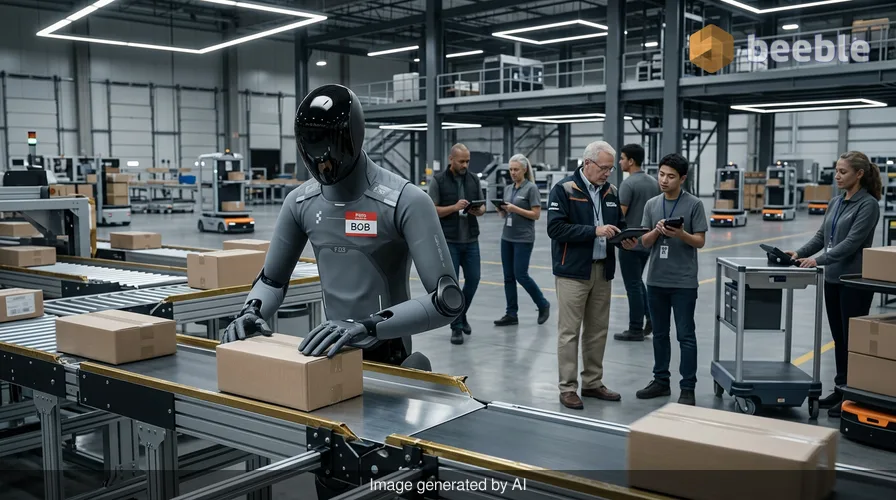
While the world has spent years fearing a dystopian future where robots take over our cities, it turns out the reality of the robotic revolution is far more mundane—and strangely hypnotic. This week, the most compelling content on the internet wasn't a celebrity scandal or a blockbuster trailer; it was a livestream of a metallic, bipedal machine picking up small boxes and putting them on a belt.
Starting on a Wednesday morning in San Jose, Figure AI, a startup now commanding a valuation near $40 billion, decided to pull back the curtain. They didn't release a polished, edited commercial. Instead, they flipped on a camera and let their humanoid robots work a continuous shift that stretched past the 30-hour mark. It was a high-stakes public audition for a machine that many hope—or fear—will soon be the foundational worker in the global supply chain.
The Most Boring Marathon on Earth
For the uninitiated, the footage looked like a screensaver. The robot, nicknamed 'Bob' by the millions of viewers who tuned in on X, stood in front of a looping conveyor belt. Its task was simple: identify a package, pick it up, and place it on the belt with the barcode facing down. When Bob’s battery ran low, he stepped back to a charging station, and his 'colleagues' Frank or Gary stepped in to continue the cycle.
Looking at the big picture, this wasn't just about moving boxes. It was a demonstration of resilience. In the world of robotics, the greatest enemy isn't a lack of strength; it’s the cumulative weight of tiny errors. Usually, after an hour or two, a sensor might glitch, or a software loop might hang. By the time Figure AI introduced a fourth robot, Rose, into the rotation on Thursday evening, the team had proved that their hardware could withstand the grind of a standard industrial workday—and then some.
Under the Hood of the Humanoid Workforce
To understand why this matters, we have to look at what's happening behind the jargon. Most industrial robots are bolted to the floor, performing one specific movement over and over. They are highly efficient but incredibly rigid. If you move a box two inches to the left, a traditional robot will miss it.
Figure AI’s humanoids operate differently. They are designed to function as a tireless intern who uses vision and 'common sense' to navigate their environment. They don't just follow a pre-programmed path; they see the world through cameras and use artificial intelligence to decide how to move their limbs in real-time.
In simple terms, Figure is betting that the most versatile shape for a worker is the one we already have: the human form. If a robot has two legs and two arms, it can fit into the aisles, stairs, and workstations already built for people. This eliminates the need for companies to spend billions redesigning their warehouses to accommodate specialized machinery.
The Gap Between Spectacle and the Stockroom
Despite the addictive nature of the stream—which some viewers dubbed 'robotic ASMR'—industry experts remain cautious. While the robots moved with a grace that was unprecedented just two years ago, they aren't quite ready to replace your local delivery sorter tomorrow.
During the stream, eagle-eyed observers noted several eccentricities. Occasionally, a robot would pause for a long moment or make an odd gesture, like touching its head. Skeptics wondered if a human was 'teleoperating' the machines from a remote location, a common trick in the industry to make robots look more capable than they are. Figure AI CEO Brett Adcock was quick to clarify: the robots are fully autonomous. Those pauses were the AI 'resetting' itself after a minor confusion, a digital moment of thought before proceeding.
Conversely, the messy reality of a real-world logistics center is far more chaotic than a San Jose lab. In a real warehouse, packages are crushed, labels are torn, and floors are cluttered. During the livestream, a package was occasionally knocked off the belt or placed with the barcode facing the wrong way. In a high-speed Amazon facility, these minor flubs can lead to massive bottlenecks.
| Feature | Figure AI (2026 Model) | Tesla Optimus (Gen 2) | Agility Robotics Digit |
|---|---|---|---|
| Primary Goal | General-purpose labor | Factory/Home assistant | Logistics/Warehouse |
| Autonomy Type | Visual End-to-End AI | Neural Network-based | Task-specific mobility |
| Status | Pilot testing (BMW) | Internal factory use | Commercial deployment |
| Key Strength | Reliability/Shift length | Integration with Tesla ecosystem | Proven warehouse track record |
On the Market Side: A $40 Billion Bet
Why is there so much money pouring into these machines? To put it another way, the humanoid robot industry is chasing the 'digital crude oil' of the 21st century: labor. There is a persistent, systemic shortage of workers willing to do repetitive, physically taxing jobs in warehouses and factories.
From a consumer standpoint, the success of Figure AI could eventually lead to more streamlined shipping and lower costs for everyday goods. If a warehouse can operate 24/7 without the overhead of heating, lighting, and safety breaks required for human crews, those savings theoretically trickle down to the price of your next online order. However, the $40 billion valuation of Figure AI reflects more than just a box-moving business. Investors see these humanoids as a scalable platform. Once the software is perfected for a warehouse, it can be updated to work in a construction site, a hospital, or eventually, your kitchen.
What This Means for You
Practically speaking, we are witnessing the transition of robotics from a 'science project' to a tangible utility. You won't see Bob or Gary delivering your groceries next week, but the data gathered from this 30-hour marathon is being used to train the next generation of AI models.
Essentially, the 'dullness' of the task is the point. We are moving away from the era of robots as high-tech novelties and toward an era where they are treated like appliances—reliable, invisible, and efficient. Just as we don't think twice about the dishwasher in our kitchen, the goal for Figure AI is a future where we don't think twice about a humanoid staff in a distribution center.
Ultimately, the livestream wasn't just a marketing stunt; it was a baseline. It showed that the hardware is robust enough to survive the grind. The challenge now shifts from 'can it stand?' to 'can it think fast enough?' To reach human parity, these robots need to shave seconds off their movement time and handle the unpredictable nature of human-occupied spaces.
As you observe your own digital habits and the packages arriving at your doorstep, take a moment to appreciate the invisible industrial backbone of modern life. That backbone is currently made of human muscle and sweat, but if Figure AI’s latest binge-watch is any indication, it’s about to get a very resilient, very patient, metallic upgrade.
Sources
- Figure AI Official Performance Report, May 2026.
- Parkway Venture Capital Market Analysis on Humanoid Robotics.
- Technical Review: Ohio State University College of Engineering.
- Logistics Industry Labor Statistics, Bureau of Labor 2026 Updates.



See you on the other side.
Our end-to-end encrypted email and cloud storage solution provides the most powerful means of secure data exchange, ensuring the safety and privacy of your data.
/ Create a free account
