


The Agentic Org Chart: How AI is Finally Delivering the 'Great Flattening'

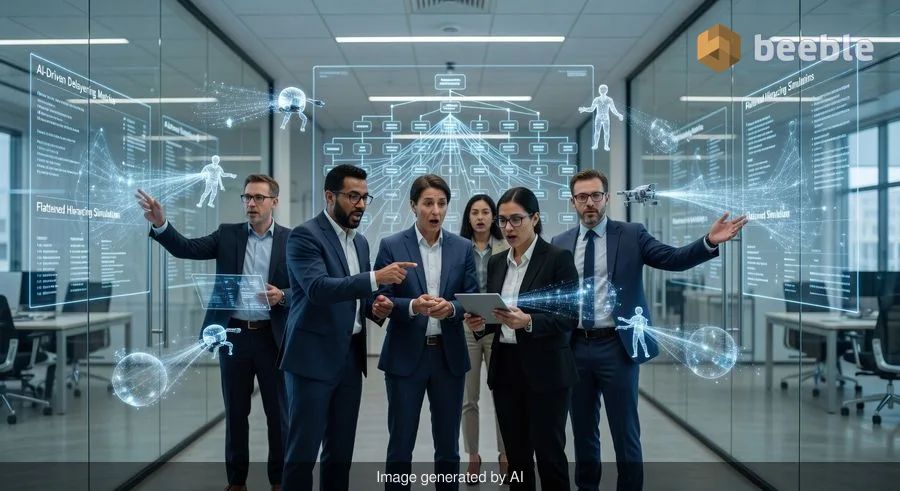
For decades, the corporate world has chased the dream of the "flat organization." Every few years, a fresh wave of management consultants arrives with promises to eliminate bureaucracy, reduce "managerial bloat," and empower the front-line worker. Yet, like a stubborn weed, the middle-management layer almost always grows back. The reason is simple: coordinating human beings is inherently complex and requires a massive amount of communication, oversight, and reporting.
But as we move through 2026, the landscape has fundamentally shifted. The "Great Flattening" is no longer a boardroom slogan; it is a structural reality driven not by human policy, but by the deployment of autonomous AI agents. We are witnessing a transition from organizations governed by "managers managing managers" to lean structures where AI agents handle the coordination, allowing humans to focus on high-stakes decision-making and creative execution.
The End of Information Brokering
Historically, a significant portion of middle management's value was derived from being an information broker. They translated high-level strategy from the C-suite into actionable tasks for the front line and aggregated status reports from the bottom up to inform the top. This "telephone game" created the very layers that CEOs like Mark Zuckerberg sought to eliminate during Meta’s 2023 "Year of Efficiency."
In the modern enterprise, AI agents are replacing this brokerage layer. When a project management agent can autonomously track progress across thousands of GitHub commits, Jira tickets, and Slack conversations, the need for a human manager to spend twenty hours a week "checking in" vanishes. These agents don't just report status; they predict bottlenecks and reallocate resources in real-time. The result is a drastic reduction in the "coordination tax" that previously necessitated deep organizational hierarchies.
From People Management to Agent Orchestration
As digital agents take over the logistical heavy lifting, the role of the remaining managers is undergoing a profound transformation. We are seeing the rise of the "Agent Orchestrator." Instead of managing a team of ten people, a single director might now oversee three senior experts and a fleet of fifty specialized AI agents.
Consider a marketing department. In 2022, launching a global campaign required layers of project managers, localization coordinators, and data analysts. Today, an orchestration agent can receive a creative brief, spin up sub-agents for SEO, regional translation, and media buying, and present a finished plan for human approval. The manager’s job has shifted from supervising the process to auditing the output and ensuring brand alignment. This shift allows for a much wider "span of control," where one leader can effectively oversee a scope of work that previously required an entire division.
The Economic Imperative and the 'Junior Gap'
The drive toward agentic structures is fueled by more than just a desire for speed; it is an economic necessity. Following the lead of companies like UPS and Citi, which cut thousands of management roles between 2023 and 2025, firms are finding that AI agents offer a significantly higher ROI than traditional middle-management layers. Agents don't suffer from burnout, they don't require 401(k) matches, and they maintain perfect institutional memory.
However, this flattening creates a new challenge: the "Junior Gap." Traditionally, entry-level and junior management roles served as the training ground for future executives. If AI agents are now performing the tasks once assigned to junior associates—drafting reports, basic coding, and scheduling—how do companies cultivate the next generation of leaders? Forward-thinking firms are responding by redesigning junior roles to focus on "AI oversight" from day one, teaching new hires how to prompt, audit, and refine agentic workflows rather than performing the manual labor themselves.
The New Organizational Blueprint
What does the 2026 org chart actually look like? It is less of a pyramid and more of a starburst. At the center is a core of strategic decision-makers, surrounded by a thin layer of expert "orchestrators," who in turn manage a massive, flexible perimeter of AI agents and specialized contractors.
| Feature | Traditional Hierarchy | Agentic Organization |
|---|---|---|
| Communication | Top-down / Cascading | Real-time / Decentralized |
| Decision Speed | Days or Weeks | Minutes or Hours |
| Primary Manager Task | Oversight & Reporting | Strategy & Audit |
| Scalability | Linear (Hire more people) | Exponential (Deploy more agents) |
| Span of Control | 1:8 Ratio | 1:50+ (Including Agents) |
Practical Takeaways for the Transition
For executives and managers navigating this shift, the goal is not to replace all humans with software, but to remove the friction that prevents humans from doing their best work. Here is how to prepare:
- Identify Coordination Bottlenecks: Audit your organization for roles that primarily involve "moving information" from one place to another. These are the first candidates for agentic automation.
- Redefine Performance Metrics: Move away from measuring "hours worked" or "team size." Instead, evaluate managers on the efficiency and accuracy of the agentic workflows they oversee.
- Invest in "Human-in-the-Loop" Systems: Ensure that as you flatten the org chart, you have robust auditing mechanisms. AI agents are efficient but can hallucinate or drift from strategic goals without expert human oversight.
- Bridge the Junior Gap: Create mentorship programs that pair junior staff with senior orchestrators, ensuring they learn the nuances of strategy that AI cannot yet replicate.
The Path Forward
The "Great Flattening" is finally here, but it looks different than we imagined. It isn't just about cutting heads; it's about rearchitecting the very nature of corporate collaboration. By offloading the burden of bureaucracy to AI agents, companies can finally become the agile, responsive entities they have always claimed to be. The challenge now lies in ensuring that as the layers disappear, the human element—creativity, empathy, and ethics—remains at the heart of the machine.



See you on the other side.
Our end-to-end encrypted email and cloud storage solution provides the most powerful means of secure data exchange, ensuring the safety and privacy of your data.
/ Create a free account
