


The AI revolution is hungry enough to consume twenty percent of the American power grid

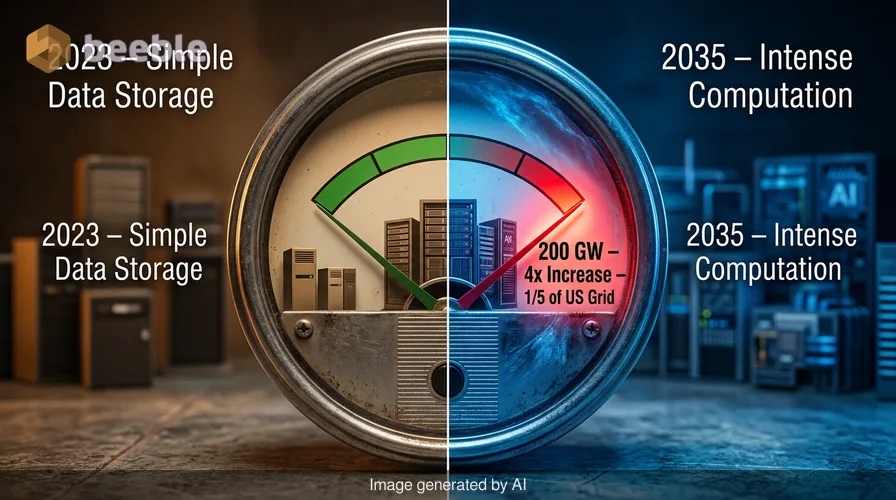
Data centers in the United States will consume 200 gigawatts of power by 2035. This figure is four times the amount of electricity these facilities use today. According to recent data from BloombergNEF, server farms will soon account for one-fifth of all electricity generated in the country. This shift is not a gradual trend. It is a massive surge driven by the global race to build and run artificial intelligence. To put this in perspective, the energy required to sustain our digital habits is growing so fast that previous forecasts are already obsolete.
Looking at the big picture, the demand for electricity is outstripping the ability of power companies to build new wires and plants. In late 2023, analysts expected much lower growth. Now, the estimates for 2035 are 83% higher than they were just six months ago. Other organizations, including the electrical industry nonprofit EPRI and S&P, have similarly hiked their predictions. The reason is simple. We have moved from an era of simple data storage to an era of intense computation.
Why artificial intelligence eats so much power
For the average user, a search query or a request for a generated image feels instant and weightless. Behind the jargon, however, AI is a tireless intern that requires an immense amount of physical energy to function. Traditional data centers mostly stored information like photos, emails, and documents. These tasks are relatively light on electricity. AI is different. It requires two distinct, energy-heavy stages: training and inference.
Training is the process where a model learns from vast amounts of data. This happens on thousands of specialized chips running at full capacity for months at a time. Inference is what happens when you actually use the AI. Every time a chatbot answers a question, it uses more power than a standard Google search. BloombergNEF predicts that nearly half of all data center capacity will soon go toward these two AI processes. By 2033, the U.S. will host 64% of the world’s AI chips. This concentration of hardware creates a localized hunger for power that few regional grids can satisfy.
The invisible backbone is reaching a breaking point
Heavy industry is the invisible backbone of modern life, and data centers are the new steel mills of the digital age. Most of these facilities are not spread evenly across the country. They cluster in specific regions where fiber optic cables and tax incentives are plentiful. The PJM Interconnection is a prime example. This grid spans from Virginia to Illinois and covers the area known as Data Center Alley.
Practically speaking, the concentration of servers in Northern Virginia is so high that the grid is struggling to keep the lights on. PJM expects that 34% of its electricity will eventually go to data centers. The situation is so strained that the grid manager stopped accepting new connection requests for four years. This pause was an attempt to catch up with the backlog of energy projects. When a grid cannot add new power sources fast enough to meet demand, the existing users pay the price. In the PJM region, electricity prices rose 76% over the past year. This is a direct consequence of the supply-demand imbalance created by the rapid expansion of server warehouses.
Texas and the global energy appetite
Texas is another major front in this energy war. The ERCOT grid, which operates independently from the rest of the country, will likely devote 22% of its generating capacity to data centers by the next decade. Texas attracts these projects because of its deregulated market and abundance of wind and solar power. However, the sheer scale of AI demand is testing the limits of even the most flexible systems.
Zooming out, this is a global phenomenon. If AI adoption continues at its current aggressive pace, data centers will create 1,935 terawatt-hours of new electricity demand worldwide by 2033. This is nearly as much electricity as the entire nation of India uses in a single year. While the U.S. is the current leader in this space, other countries are racing to build their own infrastructure to avoid relying on American chips. This creates a cyclical problem where every nation competes for the same energy-generation equipment and raw materials.
What this means for your monthly expenses
For most people, the expansion of data centers feels like a distant corporate issue. The reality is more personal. When a utility company like American Electric Power threatens to leave a regional grid due to congestion, it signals a systemic failure. Utilities must spend billions of dollars on new high-voltage transmission lines and power plants to accommodate these massive new customers.
In many states, the cost of these upgrades is passed down to residential customers. Even if you never use an AI tool, your monthly bill may rise to pay for the infrastructure that supports them. Looking under the hood of your local utility's rate filings often reveals that "grid modernization" is a euphemism for building the heavy-duty wires that data centers require. From a consumer standpoint, the convenience of digital services is no longer a free lunch. We are paying for it through our utility rates rather than through direct subscription fees.
| Region | Expected Data Center Share of Power (2035) | Key Stress Factor |
|---|---|---|
| PJM (Mid-Atlantic) | 34% | 76% price hike in recent auctions |
| ERCOT (Texas) | 22% | Rapid load growth from AI and crypto |
| United States (Total) | 20% | 83% increase in demand forecasts since 2023 |
| Global | 1,935 TWh | Equivalent to India's annual consumption |
The shift toward decentralized solutions
Essentially, the current model of building massive, centralized server farms is hitting a wall. Companies like Microsoft and Google are looking for ways to generate their own power on-site. Some are even exploring small modular nuclear reactors to bypass the public grid entirely. This move is a practical response to the fact that waiting for a standard grid connection now takes years.
Ultimately, the tech industry is becoming its own utility provider. This is a disruptive shift in how we think about the internet. In the past, the web was a software layer that sat on top of existing physical infrastructure. Now, the web is the primary driver of physical infrastructure development. The digital crude oil of chips and electricity is now as volatile and valuable as the physical oil that powered the 20th century.
A new perspective on the digital world
The bottom line is that our digital habits have a tangible footprint on the physical world. Every high-resolution video, every cloud-stored photo, and every AI-generated paragraph requires a pulse of electricity from a power plant. As we move toward 2035, the distinction between the "virtual" world and the "real" world will continue to blur.
You should observe your own digital habits with this energy cost in mind. While individual conservation efforts are small, the collective demand for 24/7 high-speed processing is reshaping our national infrastructure. We are transitioning into a world where the power grid is no longer designed for people, but for the machines that serve them. Appreciating these invisible industrial mechanics is the first step in understanding why the cost of living—and the cost of staying connected—is changing so rapidly.
Sources
BloombergNEF: 2024 Data Center Power Demand Report
Electric Power Research Institute (EPRI): 2024 Energy Consumption Forecasts
PJM Interconnection: 2024 Capacity Auction Results
S&P Global Market Intelligence: Infrastructure and Energy Report Q2 2026



See you on the other side.
Our end-to-end encrypted email and cloud storage solution provides the most powerful means of secure data exchange, ensuring the safety and privacy of your data.
/ Create a free account
