


The AI Revolution Is Quietly Making Your Next Laptop $100 More Expensive

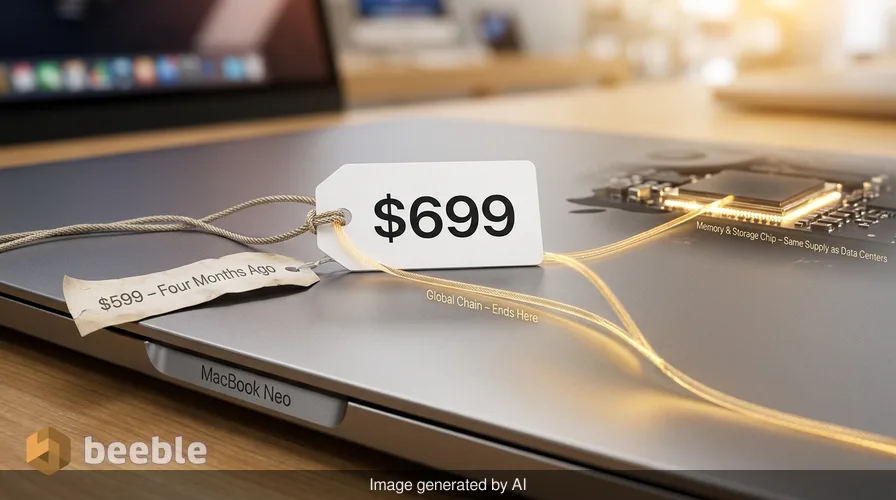
A student walks into a store to buy the Neo, the entry-level laptop Apple released to compete with affordable Windows machines. Four months ago, the price tag was a manageable $599. Today, that same aluminum-clad machine costs $699. This $100 jump is not a random decision by a marketing team. It is the end result of a global chain of events that starts with a finished product and leads back to a small, expensive component inside the chassis.
Behind the screen of every MacBook and iPad is a set of memory and storage chips. These components are the digital equivalent of a workspace. The memory (RAM) is the desk where the computer does its active work, and the storage (SSD) is the filing cabinet where it keeps its data. For years, these parts were cheap and plentiful. That changed when the world decided that every piece of software needed to run on massive artificial intelligence models. To build those models, tech giants need data centers filled with thousands of servers. Those servers need the exact same raw materials as your laptop.
Why the price tag on the shelf is changing
Looking at the big picture, Apple is the first major hardware manufacturer to admit that it can no longer absorb the rising cost of parts. For much of 2025, manufacturers used their existing stockpiles of chips to keep prices stable. Those reserves are now empty. When Apple buys a batch of 8GB memory modules today, it pays significantly more than it did a year ago.
This price hike hits the Neo laptop and the iPad Air the hardest because these devices have thin profit margins. When a component that used to cost $30 suddenly costs $80, the manufacturer has two choices. It can either lose money on every sale or pass the cost to the buyer. Apple chose the latter. The Neo is the flagship for Apple’s attempt to win the budget market, but a $699 starting price moves it out of the "budget" category and back into the premium tier.
Under the hood of the global memory shortage
The silicon chips in your devices are the digital crude oil of our modern economy. They are essential, their price is volatile, and a few massive companies control the supply. Most of the world's memory comes from three companies: Samsung, SK Hynix, and Micron. These manufacturers have shifted their focus away from the chips found in consumer laptops.
Instead, they are pouring their resources into High Bandwidth Memory, known as HBM. This is a specialized, high-performance type of memory that AI chips require to function. Because HBM is much more profitable than the standard memory in a MacBook, the factories are prioritizing it. This shift creates a systemic shortage. As supply for consumer-grade chips drops, the price for the remaining stock goes up. In simple terms, your laptop is getting more expensive because a data center in Virginia needs the same silicon to train a chatbot.
How the cloud is eating your storage budget
From a consumer standpoint, it is easy to assume that storage prices always go down. Historically, this was true. We saw the price of a gigabyte drop steadily for two decades. However, the AI industry has a massive appetite for storage as well as memory. Training an AI requires petabytes of data, and that data must live on high-speed flash storage.
This demand has caused a ripple effect throughout the entire electronics industry. Even the basic NAND flash chips used in an iPad are becoming harder to source at a reasonable price. What this means is that the "base model" of tech products will likely stay at low storage capacities for longer. We might have expected 512GB to become the new standard for the entry-level MacBook this year. Instead, we are seeing 256GB models remain the norm, but at a higher price point.
The logic behind the protected iPhone
Curiously, the iPhone has escaped this price hike for now. This is a strategic choice rather than a reflection of component costs. The iPhone is Apple's most important product and its primary way of keeping users in its ecosystem. If the iPhone gets too expensive, people stop buying apps, subscribing to iCloud, or using Apple Pay.
Apple has more leverage with iPhone components because it buys them in such massive volumes. It likely has long-term contracts that lock in prices for iPhone parts months or years in advance. Laptops and tablets move in smaller volumes compared to phones. As a result, these product lines are more vulnerable to the immediate shifts in the market. The company is essentially using the Mac and iPad as a buffer to protect its most valuable business.
Navigating a market where silicon is the new oil
Practically speaking, this shift changes the math for anyone looking to upgrade their home office. If you were waiting for a sale on a new iPad or MacBook, that window is closing. The era of the $599 "Mac for everyone" was short. We are entering a period where hardware prices are tied to the energy and material demands of the AI boom.
For the average user, the best move is to look at the secondary market. Certified refurbished devices often use parts that were purchased and assembled before the current price spike. Another option is to prioritize memory over storage when buying new. You can always plug in an external drive for your photos, but you cannot easily upgrade the RAM in a modern MacBook once it leaves the factory.
Ultimately, this is a reminder that our personal gadgets are part of a global ecosystem. When a tech company in Silicon Valley or a government in Europe spends billions on AI infrastructure, the cost eventually trickles down to the person buying a laptop for college. The invisible backbone of the tech world is under strain, and the consumer is the one holding the bill.
Observe your digital habits over the next few months. You might notice that the cloud services you use are also raising prices or adding tiers. This is all part of the same trend. As the digital crude oil becomes more expensive to refine, every product that relies on it will cost more. The best strategy is to buy what you need based on current utility rather than waiting for a price drop that may not come for several years.
Sources:
- Apple Investor Relations Q2 2026 Earnings Brief
- Micron Technology Industry Outlook Report June 2026
- TrendForce Memory Market Price Tracker
- International Data Corporation (IDC) Quarterly Hardware Census



See you on the other side.
Our end-to-end encrypted email and cloud storage solution provides the most powerful means of secure data exchange, ensuring the safety and privacy of your data.
/ Create a free account
