


The AI Revolution is Running Out of Steam Just as it Was Getting Started

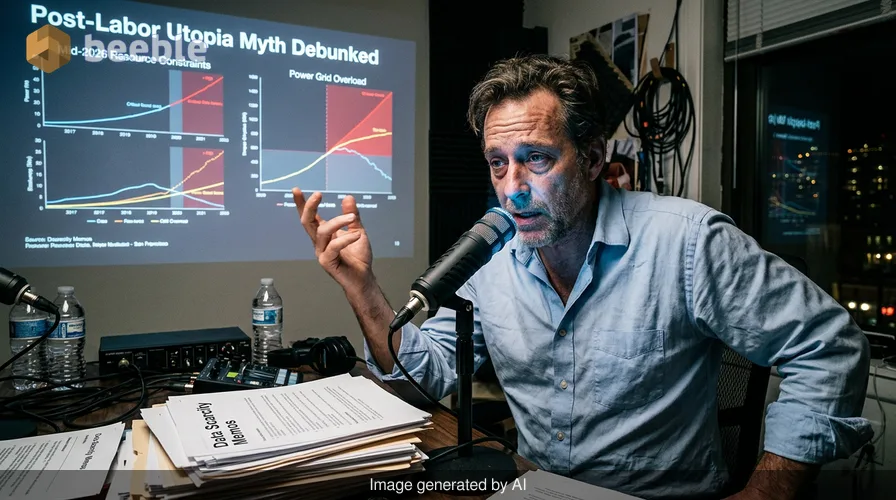
While the last three years were defined by breathless promises of a post-labor utopia where algorithms solve every human inconvenience, the architects actually building this infrastructure are starting to point toward a much messier, more constrained reality. We have spent trillions of dollars chasing the dream of a tireless intern that can think, code, and create in seconds. But in mid-2026, the people holding the blueprints—the CEOs of major labs and the engineers at the heart of the silicon supply chain—are sounding a collective alarm.
Looking at the big picture, the narrative of infinite, exponential growth is hitting a very physical wall. It turns out that building a global intelligence layer isn't just about clever math; it is a brutal game of resource management involving power grids, data scarcity, and the cold, hard logic of profit margins. To put it another way, the digital crude oil we used to fuel the initial boom is running low, and the machinery itself is becoming too expensive to maintain for the average user.
The Energy Wall and the Power Grid Crisis
For years, we treated the cloud as an invisible, ethereal space. In reality, it is a series of massive, humming warehouses that are increasingly thirsty for electricity. Historically, tech companies could scale their services without worrying about the local power utility. That era has ended. As one architect of the AI economy recently noted, we are no longer limited by how fast we can write code, but by how many megawatts we can pull from the grid without causing a regional blackout.
Under the hood, training a next-generation model now requires the energy equivalent of powering a small European city for a year. For the average user, this manifests in a very tangible way: your favorite AI tools are becoming slower or more restricted during "peak hours." We are seeing a shift where tech giants are forced to build their own proprietary nuclear reactors or massive battery farms just to keep the lights on. This isn't just an environmental concern; it is a systemic bottleneck that makes the AI economy incredibly volatile. When power becomes the primary constraint, the cost of every "generate" button press goes up.
The Data Drought and Digital Inbreeding
There is a second, perhaps more existential, problem: we have run out of high-quality human language to feed the machines. The initial success of generative AI was built on scraping decades of human thought from the open internet. However, we have reached the bottom of that well. Essentially, the AI has read everything we’ve ever written, and now it’s being forced to read its own output.
This creates a phenomenon that researchers are calling "model collapse" or, more colloquially, digital inbreeding. When an AI learns from content generated by another AI, the nuances of human logic begin to erode. The results become repetitive, bland, and increasingly prone to errors. From a consumer standpoint, you might have noticed that AI-generated summaries or images are starting to feel a bit "samey." Without fresh, high-quality human data, the rapid improvement we saw in 2023 and 2024 is tapering off into a plateau. We are moving from an era of disruptive leaps to one of incremental, and often expensive, crawls.
The Profitability Paradox
On the market side, the venture capital money that subsidized our cheap AI subscriptions is beginning to dry up. Investors are moving away from "growth at all costs" and demanding to see actual revenue. The problem is that running these models is fundamentally different from running a traditional software business.
In the old world of software, once you wrote a program, it cost almost nothing to sell it to the millionth customer. With AI, every single interaction requires significant computing power. This is the "So What?" filter for the industry: if it costs fifty cents in electricity and hardware wear-and-tear to answer a user's question, but the user is only paying twenty dollars a month for unlimited questions, the math eventually fails.
| Feature of the AI Economy | The 2023 Hype Cycle | The 2026 Reality | Impact on You |
|---|---|---|---|
| Data Sourcing | Infinite "free" internet data | Data exhaustion; paywalls everywhere | Higher costs for quality info |
| Energy Needs | Standard cloud computing | Massive grid strain; custom power plants | Slower response times |
| Subscription Model | Cheap or free "pro" tiers | Tiered, usage-based pricing | Higher monthly bills |
| Innovation Speed | Breakthroughs every month | Incremental, localized tweaks | Fewer "wow" moments |
| Reliability | Hallucinations are "temporary" | Errors are systemic and stubborn | Need for constant human oversight |
Why the "Last Mile" is the Hardest
Behind the jargon of "emergent properties" and "neural scaling laws" lies a frustrating truth: AI is still remarkably bad at the last 5% of any task. It can write a decent draft of a legal brief, but it cannot be trusted to file it. It can suggest a medical diagnosis, but it cannot account for the physical nuances of a patient sitting in a room.
This is known as the "last mile" problem. We have built a tireless intern that is great at brainstorming but mediocre at execution. For the everyday user, this means the dream of a fully autonomous personal assistant is still years, if not decades, away. Practically speaking, we are seeing a retreat from "General Intelligence" toward specialized, narrow tools. Instead of one AI that does everything, you will likely end up with twelve different AI subscriptions—one for your taxes, one for your fridge, and one for your car—none of which talk to each other. This decentralized approach is more robust and scalable, but it is also far more cluttered for the consumer.
The Shifting Landscape of Hardware
Zooming out, the hardware required to run these systems is becoming a geopolitical flashpoint. Microchips are the digital crude oil of our age, and the supply chain is incredibly fragile. While companies like NVIDIA and AMD have performed miracles in engineering, the physical limits of silicon are approaching. We are fighting for every nanometer, and the factories required to build these chips take years and hundreds of billions of dollars to complete.
This interconnected dependency means that a single disruption in a specialized factory halfway across the globe can instantly make your digital life more expensive. We are no longer in a world where tech gets cheaper every year. For the first time in decades, the cost of high-end computing is actually trending upward. This is why you might notice your next smartphone or laptop has a significantly higher price tag without a corresponding leap in "standard" performance; you are paying the "AI tax" for the specialized chips hidden inside.
What This Means for Your Daily Life
So, where do we go from here? The architects of the AI economy aren't saying the technology is a failure; they are saying it is maturing. The wild-west era of "everything, everywhere, all at once" is being replaced by a more transparent, albeit more expensive, industrial phase.
Ultimately, for the average user, this means it is time to shift your perspective. Stop waiting for the AI to take over your entire job and start looking at it as a specialized tool for specific, high-friction tasks. You should expect to see more "usage-based" pricing—think of it like a water or electric bill for your brain. You will pay for what you use, rather than a flat monthly fee.
Curiously, this slowdown might actually be a good thing. It gives our legal systems, our schools, and our social structures time to catch up with the technological tsunami of the early 2020s. The wheels aren't falling off because the car is broken; they're coming off because we've been trying to drive a Formula 1 racer through a suburban neighborhood at 200 miles per hour. It’s time to slow down, stabilize the engine, and figure out how to build a road that can actually support the weight of the future.
Sources:
- TechCrunch: Five Architects of the AI Economy Analysis (May 2026)
- International Energy Agency: Global Data Center Power Demand Report
- Semiconductor Industry Association: 2026 Capacity and Supply Chain Outlook
- Bureau of Labor Statistics: Impact of Automated Systems on Service Sector Pricing



See you on the other side.
Our end-to-end encrypted email and cloud storage solution provides the most powerful means of secure data exchange, ensuring the safety and privacy of your data.
/ Create a free account
