


The Amodei Warning: Navigating the Future of White-Collar Work in the Age of AI Agents

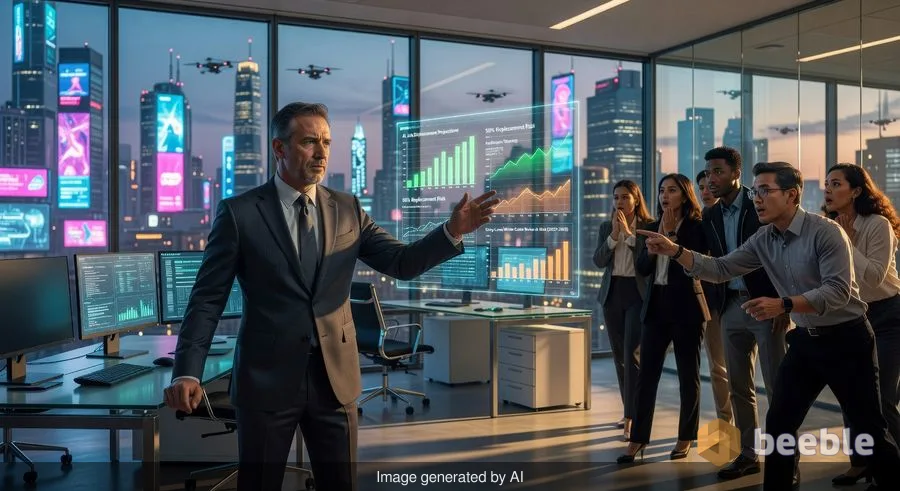
For decades, the automation of labor was a story about factory floors and assembly lines. But as we move through 2026, the narrative has shifted decisively toward the office. The quiet hum of the server room is now echoing in the halls of law firms, marketing agencies, and software houses. At the center of this conversation is Dario Amodei, CEO of Anthropic, who has consistently issued a sobering forecast: up to half of all entry-level white-collar jobs could be replaced by artificial intelligence within a one-to-five-year window.
Amodei’s perspective isn’t just another tech executive’s prediction; it is a fundamental challenge to how we view career development. While other industry leaders offer a more cushioned outlook, the reality of 2026 suggests that the "entry-level" role as we once knew it is undergoing a permanent transformation.
The Logic Behind the Displacement
Amodei’s warning is grounded in the rapid evolution of large language models (LLMs) into autonomous agents. In the past, AI was a tool you used to write an email or summarize a document. Today, AI agents are capable of executing multi-step workflows—conducting market research, drafting a report based on that research, and then formatting it for a specific client—all without human intervention between steps.
This "agentic" capability hits entry-level roles the hardest. Traditionally, junior employees were hired to perform the foundational tasks that senior staff didn't have time for. These tasks—data cleaning, basic drafting, and preliminary analysis—are exactly what modern AI models excel at. When a model can do in thirty seconds what a junior associate does in three hours, the economic incentive for businesses to automate becomes impossible to ignore.
A Divergence of Visions: Amodei vs. Altman
Not everyone in Silicon Valley shares Amodei’s stark assessment. OpenAI CEO Sam Altman has often leaned into a more optimistic "augmentation" narrative. Altman suggests that while tasks will change, the demand for human output will actually increase as the cost of intelligence drops. In this view, AI doesn't replace the worker; it makes the worker ten times more productive, allowing a single person to do the work of a whole department.
However, Amodei has stuck to his guns, pointing out that even if productivity increases, the sheer volume of entry-level positions required by the economy may shrink. If one person can now do the work of five, what happens to the other four? This divergence highlights the central tension of the current labor market: Are we entering an era of unprecedented human empowerment, or a period of structural unemployment for the next generation of professionals?
The Rise of the 'Human Premium'
If the routine and the predictable are being handed over to algorithms, what remains for the human professional? The answer lies in what experts call the "Human Premium." This refers to the specific traits that AI—despite its vast knowledge—still struggles to replicate: high-stakes accountability, complex empathy, and cross-domain intuition.
Consider a legal dispute. An AI can cite every relevant case in history, but it cannot sit across from a distraught client and provide the emotional assurance or the nuanced ethical judgment required to navigate a sensitive settlement. Similarly, in software engineering, AI can write code, but it often lacks the "big picture" understanding of how a specific feature aligns with a company’s five-year strategic goal. The value is shifting from the execution of tasks to the orchestration of outcomes.
Practical Steps: How to Future-Proof Your Career
Being worried is a natural response to rapid change, but the most effective antidote to anxiety is action. To remain indispensable in an AI-driven economy, professionals must pivot their skill sets toward high-value human activities.
1. Master Agent Orchestration
Stop thinking of yourself as a doer of tasks and start thinking of yourself as a manager of AI. Learn how to chain different AI tools together to produce complex results. The person who knows how to direct an AI agent to perform a week’s worth of work in an afternoon is the person who will remain employed.
2. Double Down on Soft Skills
In a world of perfect digital logic, the "soft" skills become the "hard" skills. Negotiation, leadership, conflict resolution, and deep empathy are increasingly rare and valuable. These are the skills that build trust—something an algorithm cannot do.
3. Focus on High-Stakes Accountability
AI can make suggestions, but it cannot take the blame. Positions that require a human to sign off on a decision—whether it’s a medical diagnosis, a structural engineering plan, or a multi-million dollar marketing spend—are the most resilient. Seek roles where human judgment and accountability are the primary requirements.
4. Continuous Re-skilling
The shelf life of technical skills is shrinking. In 2026, the ability to learn a new tool in a weekend is more important than having mastered a specific software five years ago. Cultivate a mindset of "permanent beta."
The Path Forward
We are currently in the middle of the window Amodei described. While the displacement of entry-level work is a real and present challenge, it is not a foregone conclusion that humans will be left behind. History shows that when the cost of a resource (in this case, basic cognitive labor) drops, human ingenuity finds new, more complex ways to use it.
Directing your energy toward mastering these new tools, rather than resisting them, is the only way to navigate the shift. The goal is not to beat the machine, but to be the one who knows how to use it to solve problems that were previously unsolvable.



See you on the other side.
Our end-to-end encrypted email and cloud storage solution provides the most powerful means of secure data exchange, ensuring the safety and privacy of your data.
/ Create a free account
