


The anatomy of a $3.8 billion erasure: How memecoins broke the retail wallet

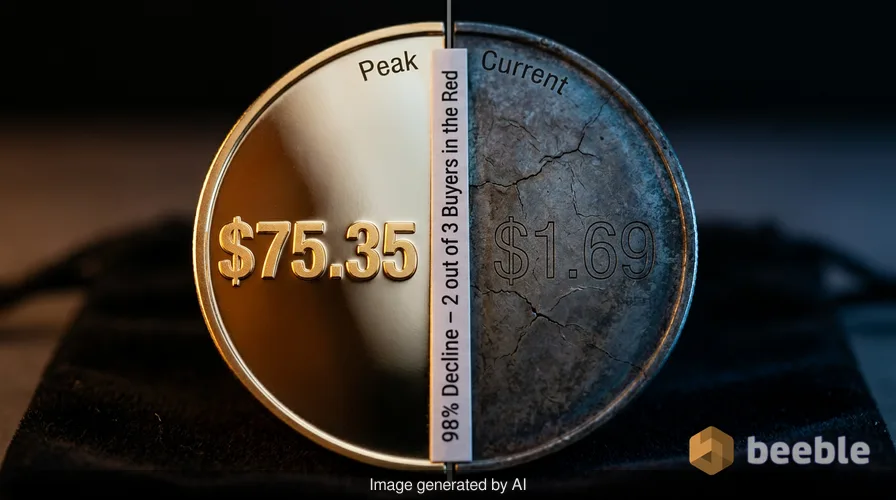
The screen flashes red. The balance drops. Your digital wallet shrinks until the numbers stop making sense. One million people watched this happen in silence. The money is not just down. It is gone.
As of July 6, 2026, the autopsy of the $TRUMP memecoin is complete. The numbers provided by the cryptocurrency analytics firm Nansen are clinical. Nearly one million investors lost a collective $3.8 billion. This is not a rounding error in a large economy. This is a massive extraction of wealth from everyday people who believed they were buying a piece of a political movement or a shortcut to financial freedom.
Financially speaking, the crash was a mechanical certainty. The coin was trading at $75.35 at its peak. Today, it is $1.69. That is a 98% decline. For the 988,905 accounts that lost money, the blockchain serves as a transparent record of a failed bet. Two out of every three buyers are now in the red.
The clinical reality of the blockchain ledger
Nansen’s analysis relies on the public nature of the blockchain. In this glass bank vault, everyone can see the money inside, but only the owner has the key. We can track the flow of every dollar. We see when a retail investor in a suburb of Ohio buys $500 of a coin at the top. We see when a large holder, often called a whale, exits the position.
Zooming out, this event is a symptom of a larger shift in how we value assets. Traditionally, a stock has value because the company makes a product or generates a profit. A memecoin has value only because other people agree it has value. It is a financial mood ring that reacts to the news cycle and social media sentiment. When the sentiment evaporates, the liquidity vanishes.
Liquidity is the ease with which you can turn an asset into spendable cash. For $TRUMP, liquidity was high when the hype was at its peak. As the price started to slip, buyers disappeared. Those who tried to sell found there was no one on the other side of the trade. Consequently, the price collapsed.
A glass bank vault with no exit
The table below shows the stark contrast between the peak of the Trump-themed crypto ecosystem and its current state as of mid-2026.
| Asset | Peak Price | Current Price | Percentage Decline |
|---|---|---|---|
| $TRUMP Memecoin | $75.35 | $1.69 | 98.2% |
| $WLFI (World Liberty) | $1.10 | $0.04 | 96.3% |
| Total Retail Loss | - | $3.8 Billion | - |
In everyday terms, this is like buying a ticket to a sold-out show, only to find the theater is empty and the actors have already left with the box office receipts. The blockchain recorded the transaction, but it could not guarantee the value.
Trump announced the memecoin just days before his 2025 inauguration. He also launched World Liberty Financial with his sons. Both projects promised to bypass traditional banks. Both projects now sit at near-zero valuations for the average buyer. Paradoxically, the decline of these assets happened while the administration promoted the United States as the crypto capital of the world.
The paradox of the crypto capital
On a macro level, the regulatory environment has shifted. The Securities and Exchange Commission (SEC) has backed away from memecoins. Under the current administration, the SEC does not view these tokens as securities. They are treated as digital collectibles or speculative social tools. This lack of regulation was supposed to foster innovation.
In practice, it created a digital wild west. Without the guardrails of traditional finance, retail investors have little protection against extreme volatility. The government dropped lawsuits against major crypto firms. The White House spokesperson stated that the goal was to make America a leader in digital assets.
Through this economic lens, we see a conflict. The state encourages the growth of the industry, but the citizens bear the total risk of the industry's failures. The $3.8 billion loss did not happen to banks or hedge funds. It happened to people using their personal savings.
Personal profit amidst systemic decline
While the majority of investors lost money, the creators and early promoters did not. Financial disclosures reveal that the president made $636 million from the $TRUMP memecoin last year. This income was part of a larger $1.4 billion windfall from the crypto sector.
This is the core of the behavioral economics at play. In a speculative market, wealth is often transferred from the many to the few. The latecomers provide the exit liquidity for the early adopters. The person who bought $TRUMP at $70 was effectively paying the profit for the person who held the coin since it was worth pennies.
Historically, this pattern repeats in every asset bubble. We saw it with the dot-com crash and the subprime mortgage crisis. The technology changes, but the human psychology remains the same. People are driven by the fear of missing out. They see their neighbors making money and they want to participate. They ignore the structural risks because the social proof is too strong.
Why the global mood ring turned red
Speculative assets act as a global mood ring for the economy. When people have extra cash and feel optimistic, they put money into risky projects. When inflation stays high or the job market feels uncertain, that optimism turns into fear.
On an individual level, a $500 loss might feel like a bad weekend at a casino. On a systemic level, $3.8 billion in lost purchasing power has real consequences. That is money that was not spent on local businesses, not put into retirement accounts, and not used to pay down debt.
Ultimately, the memecoin trend is a reflection of financial anxiety. Many people feel that traditional paths to wealth, such as saving a portion of a salary or buying a home, are no longer viable. They turn to high-risk digital assets as a Hail Mary pass. They hope a small investment will turn into a life-changing sum.
Reclaiming control of the financial narrative
The $TRUMP memecoin story is a cautionary tale about the intersection of celebrity, politics, and decentralized finance. It shows that transparency alone is not enough to protect investors. Everyone could see the glass bank vault, but few understood that the vault had a trap door.
Practically speaking, we must look at our own financial habits. We often treat money as a tool for emotional expression rather than a resource for stability. When we buy an asset because of a name or a political affiliation, we are no longer investing. We are donating to a cause that may not have our best interests in mind.
As you navigate the remainder of 2026, consider the source of your financial information. Question the narrative of easy wealth. The most resilient financial plan is not found in a viral coin, but in the mundane work of diversification and risk management. Observe your own reaction to market hype. The next time a digital asset promises to change the world, remember the one million people who are still waiting for their $3.8 billion to return.
Sources:
- Nansen Cryptocurrency Analytics Report (June 2026)
- The New York Times: Analysis of Trump Memecoin Transactions
- White House Press Briefing on Crypto Capital Initiative
- SEC Regulatory Guidelines on Digital Assets (2025-2026)
- Presidential Financial Disclosure Forms (2025)



See you on the other side.
Our end-to-end encrypted email and cloud storage solution provides the most powerful means of secure data exchange, ensuring the safety and privacy of your data.
/ Create a free account
