


The Anatomy of a Corporate Manifesto: How Algorithmic Supremacy and Cultural Hierarchies Shape the Future of Power

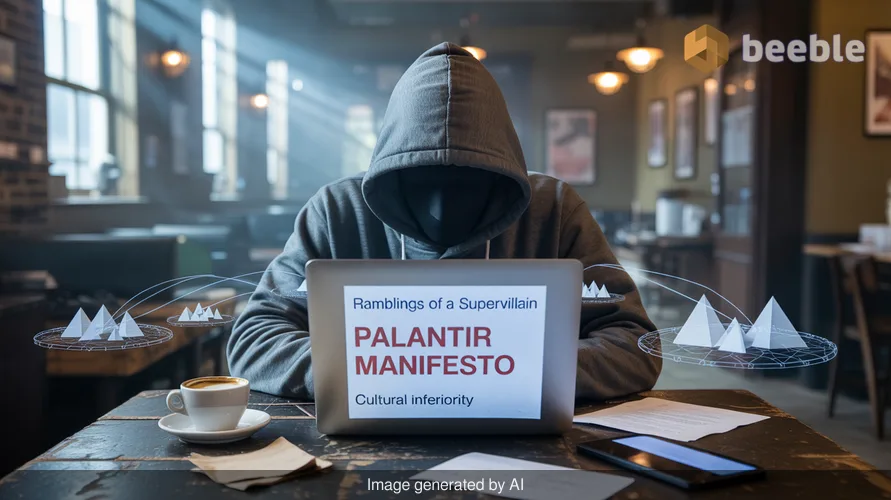
I was sitting in a small, windowless cafe in East London yesterday, the kind of place where the espresso is served with a side of quiet desperation and the hum of high-end laptops. Across from me, an anonymized figure in a charcoal hoodie was scrolling through a leaked PDF, their face illuminated by the cold blue light of a screen that seemed to vibrate with the weight of the document it held. It was the Palantir 'manifesto,' a text that the headlines have already dubbed the 'ramblings of a supervillain.' As I watched the stranger’s brow furrow, I couldn't help but notice how the very architecture of our digital age has turned the act of reading a corporate strategy document into a visceral experience of modern anxiety. We are no longer just consumers of software; we are the subjects of a new kind of sovereign logic that operates behind the opaque curtains of Silicon Valley.
On a macro level, the document released by Palantir—a company long synonymous with the 'black box' of surveillance and defense analytics—does more than just outline a business strategy for AI weaponry. It attempts to rewrite the social contract through the lens of technological Darwinism. By claiming that certain cultures are 'inferior' because they lack the requisite 'will to power' or technological infrastructure, the manifesto isn't just selling a product; it is performing a cultural autopsy on the West while simultaneously declaring itself the only viable surgeon.
The Digital Illusion and the Promise of Sovereignty
We are frequently told that the rapid advancement of artificial intelligence represents the ultimate democratization of knowledge, promising a future where hyper-connected societies can finally solve the systemic ills of poverty, disease, and administrative inefficiency through the sheer force of computational elegance. Yet, this expansive vision of a global digital utopia remains algorithmically contingent upon a total submission to specific proprietary frameworks, unless we are prepared to find ourselves marginalized in a world that no longer speaks our human dialect. The Palantir document exposes the restrictive nature of this progress, suggesting that true sovereignty now requires a marriage to the machine—one that inevitably creates a hierarchy between the 'digitally enlightened' and the 'culturally stagnant.'
Through this lens, the manifesto’s rhetoric about AI weapons and cultural superiority is less about the hardware and more about the discourse of power. Linguistically speaking, the use of the word 'manifesto' is a deliberate choice. It moves the conversation out of the realm of quarterly earnings and into the territory of political philosophy. It suggests that the company is no longer merely a service provider but a geopolitical actor. Paradoxically, while the document claims to defend Western values, it does so by adopting a tone that feels profoundly alien to the democratic tradition of open debate and pluralism.
The Archipelago of Modern Power
To understand why this feels so jarring, we have to look at the concept of 'liquid modernity.' In the past, power was visible—it was the factory owner, the government building, the physical border. Today, power is ephemeral and ubiquitous, flowing through fiber-optic cables and hidden in the training data of Large Language Models. In everyday terms, this creates a society that looks like an archipelago: we are all living densely packed together in urban centers, yet we are completely atomized by the different algorithms that curate our realities.
Zooming out, the Palantir manifesto seeks to build bridges between these islands, but only for those who can afford the toll. When the text speaks of 'cultural inferiority,' it is employing a form of symbolic violence. It suggests that the habitus—the deeply ingrained habits and dispositions of a people—is only valuable if it can be optimized for the next generation of algorithmic warfare. If your culture values silence, reflection, or non-linear progress, it is categorized as a liability. This is the 'fast-food diet' of digital communication: it offers the quick satisfaction of 'efficiency' while starving us of the deep emotional and cultural nutrition that comes from diversity of thought.
The Supervillain Trope as a Cultural Anesthetic
It is tempting to dismiss the document as the 'ramblings of a supervillain' because that label acts as a cultural anesthetic. If we categorize the authors as comic-book antagonists, we don't have to reckon with the fact that their technology is already deeply rooted in our systemic reality. From the way our borders are policed to the way insurance companies calculate risk, the 'supervillain' logic is already at work. Curiously, the more we mock the ego behind these manifestos, the more we ignore the structural shifts they are signaling.
On an individual level, this creates a profound sense of helplessness. As I sat in that cafe, I wondered if the person across from me felt the same. We are all performing our shifting social identities on the theater stage of the modern city, yet the script is increasingly being written by entities that view human culture as a set of variables to be solved. Historically, manifestos were written by the marginalized to challenge the status quo; today, they are written by the powerful to cement it.
Reclaiming the Human Narrative
Ultimately, the Palantir manifesto is a symptom of a broader trend: the migration of authority from human institutions to algorithmic ones. Behind the scenes of this trend, we are seeing the slow erosion of the 'third place'—those physical spaces where people could gather and debate without the presence of a monitoring screen. When our communication becomes entirely digital, it becomes data, and once it is data, it can be judged as 'superior' or 'inferior' by the very systems described in the leak.
To put it another way, we are being invited to join a race where the finish line is a world of perfect predictability. But in practice, a predictable world is a dead one. The beauty of human culture lies in its inefficiency, its unpredictability, and its refusal to be mapped by a surveillance engine.
Food for Thought: Navigating the Algorithmic Age
- Question the Inevitability: When a tech giant claims that a certain future is 'inevitable,' ask who benefits from that inevitability. Is it a law of nature, or a business plan?
- Observe Your Digital Vocabulary: Notice how often you use terms like 'optimization,' 'efficiency,' or 'data-driven' to describe your own life. Are these your words, or have they been installed in your vocabulary by the platforms you use?
- Reclaim the Analog Silence: Find moments where you are not 'training' an algorithm. Whether it's a walk without a smartphone or a conversation that isn't mediated by an app, these small acts of resistance help preserve the nuanced, non-binary parts of being human.
- Analyze the Discourse: Next time you see a corporate 'manifesto,' look past the jargon. Is it describing a way to help people, or a way to categorize and control them?
As I left the cafe, the stranger in the charcoal hoodie was still there, bathed in blue light. The Palantir document isn't just a glimpse into the mind of a tech giant; it's a mirror reflecting the world we are allowing to be built. Whether we remain atomized inhabitants of an algorithmic archipelago or find a way to stitch together a more human patchwork quilt of experiences remains the defining question of our time. We must remember that the most resilient part of any culture isn't its technology, but its ability to remain, stubbornly and beautifully, unquantifiable.
Sources:
- Bauman, Z. (2000). Liquid Modernity.
- Bourdieu, P. (1977). Outline of a Theory of Practice.
- Euronews Next (2026). 'Ramblings of a supervillain': Palantir manifesto claims AI weapons and cultural inferiority.
- Palantir Technologies (2026). Internal Strategy Document / Shareholder Perspective (Leaked).



See you on the other side.
Our end-to-end encrypted email and cloud storage solution provides the most powerful means of secure data exchange, ensuring the safety and privacy of your data.
/ Create a free account
