


The anatomy of a market crash: why the ghost of Black Monday haunts your digital wallet

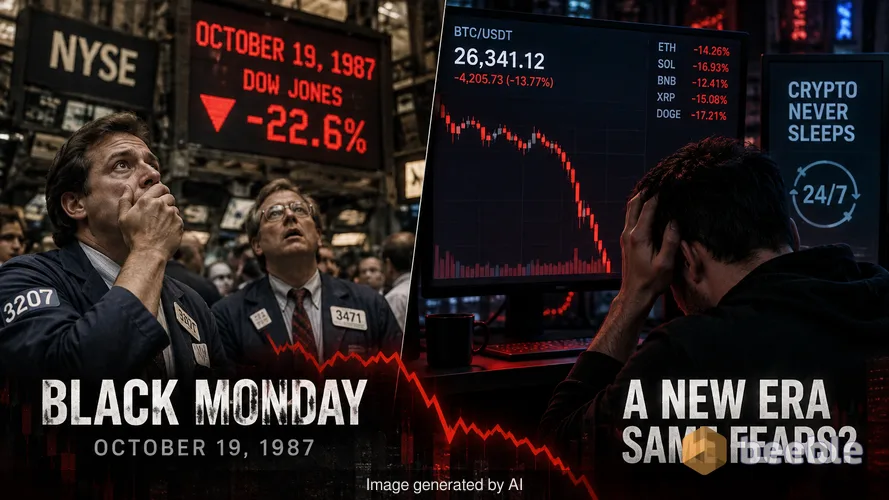
Screens flash red. Portfolios evaporate. Panic sets in. The date is October 19, and for anyone with money in the market, this day carries a heavy historical weight. Thirty-nine years ago, the Dow Jones Industrial Average collapsed by 22.6% in a single session. It remains the largest one-day percentage drop in history. Traders stood on the floor of the New York Stock Exchange in stunned silence as the financial world as they knew it ended. Today, we look at a crypto market that is bruised and bleeding, and the question is whether we are watching a replay of that infamous disaster.
Black Monday was a systemic failure of automation. The late 1980s saw the rise of portfolio insurance, a new strategy that used computer programs to automatically sell stocks as prices fell. This created a feedback loop. The more the market dropped, the more the machines sold. The more the machines sold, the further the market dropped. There were no circuit breakers to stop the bleeding. Today, traditional stock exchanges have these safety valves. When prices fall too fast, the machines turn off. The market takes a breath. Crypto has no such luxury. It trades through the night, through the weekend, and through every anniversary. It is a market where the machines never sleep and the exit doors are often narrow.
The uneven culling of the crypto herd
Bitcoin sits at $82,161 today. This figure is deceptive. It is down just 1.4% over the last week. In a vacuum, this looks like stability. However, when we look at the rest of the market, the picture is grim. Outside of Bitcoin, the average decline among major coins is 7.5%. Ethereum is at $2,415, a drop of 5.3%. BNB, Solana, and XRP all show significant losses. This is a fragmented market where the leader stays afloat while the followers are pulled underwater.
Further out in the risk spectrum, the situation is worse. Starknet lost 45% of its value this week. LayerZero fell 24%. Ethena and Fetch both dropped 20%. These are not minor corrections. These are liquidations. When we see the top twelve weekly losers averaging a 20% loss, we are witnessing a forest fire. This fire clears out the speculative dead wood that accumulated during the recent rally. It is painful for the individual investor, but it is a natural part of the market cycle.
The bleeding of the institutional glass vault
We often describe the blockchain as a glass bank vault. Everyone can see the money inside, but only the owner has the key. This transparency allows us to see exactly how much institutional money is leaving the room. Last week, spot Bitcoin ETFs saw $228.4 million in net outflows. Ethereum ETFs were hit even harder with $320.1 million in losses. For the month of October, the total drain reached $1.86 billion. This is a massive shift in sentiment from the players who were supposed to bring stability to the asset class.
Ethereum is in a particularly fragile position. The product line has $14.5 billion in net assets, but the cumulative inflows are $12.9 billion. This leaves a cushion of only $1.6 billion. If the price of Ethereum continues to slide, the entire ETF complex will be underwater on a mark-to-market basis. When institutional products go into the red, the pressure to sell increases. Professional fund managers are often more sensitive to losses than retail HODLers because they have quarterly reports to justify to their clients. This institutional exit is a slow bleed rather than a sudden burst, but the impact on your wallet is the same.
The paradox of the expected disaster
There is a deep-rooted fear that today will be another Black Monday. Paradoxically, this fear is exactly why a total collapse is unlikely to happen. Market crashes are typically the result of a surprise. They happen when everyone is positioned for growth and no one has a plan for a downturn. When the entire market is watching the calendar and waiting for a crash, they tend to move to the sidelines. They hold cash. They set stop-loss orders. They prepare.
Consequently, the setup today is the opposite of the 1987 cascade. Instead of a sudden cliff, we are seeing an orderly exit. Bitcoin is holding its ground while the tail end of the market is cut off. Over the weekend, a modest bid even returned to the majors. The bears want a repeat of history, but they are unlikely to get a spectacular firework show. The market is symptomatic of exhaustion, not an immediate heart attack. It is a period of revaluation where the speculative froth is removed so that new growth can eventually happen.
Growth behind the scenes of the price action
While the prices on your screen look volatile, the infrastructure of digital money is expanding. Circle is currently planning to move into 40 emerging market countries. This is a tangible expansion of how people use stablecoins for everyday trade. In these regions, fiat currency is often a source of anxiety due to high inflation. For a merchant in a developing economy, a dollar-pegged stablecoin is a resilient tool for survival. It is a way to escape the invisible leak in their local currency wallet.
Furthermore, on-chain protocols are still generating significant revenue. Papertrade led the way this week with $30 million in revenue. This shows that people are still using the technology even if they are not buying the tokens. The utility of the blockchain is becoming decoupled from the speculative price of the assets. In everyday terms, this is like seeing a high-speed rail line being built while the stock price of the construction company fluctuates. The physical tracks are still there, and the trains are still running.
The cold wind in the trenches
The Trenches index hit "cold" for the first time since April. This index tracks the activity and sentiment of the most active on-chain traders. When it turns cold, it means the excitement has left the room. Retail investors are tired. The psychological impact of market volatility is profound, and many people are choosing to step away from their screens. This is a transient phase, but it feels permanent when you are in the middle of it.
Ultimately, your personal finance is not a global mood ring. It is a system you control. The broad concern for a crash today serves as a reminder to check your own risk levels. If a 20% drop in an altcoin ruins your week, you are likely over-leveraged. The history of Black Monday teaches us that markets can move faster than our ability to react. The only real protection is a portfolio that is built to survive the fire, not just the sunshine.
As we move past this anniversary, reflect on your own financial habits. Are you chasing the next 100x coin because you fear missing out, or are you building a resilient floor for your future? The machines might never sleep, but you should be able to. The ghost of 1987 is a teacher, not a prophecy.
Key takeaways for the mindful investor
- Bitcoin acts as a stabilizer while smaller assets face a systemic culling.
- Institutional outflows from ETFs create a psychological floor that is thinner than many realize.
- The lack of circuit breakers in crypto means that liquidations happen in hours, not days.
- Infrastructure expansion in emerging markets shows utility that is independent of token prices.
- Expected crashes rarely happen because the crowd is already defensive.
Sources: Dow Jones Historical Data, CoinMarketCap, Farside Investors ETF Tracker, Circle Expansion Report 2026, Papertrade Protocol Revenue Audit.



See you on the other side.
Our end-to-end encrypted email and cloud storage solution provides the most powerful means of secure data exchange, ensuring the safety and privacy of your data.
/ Create a free account
