


The anatomy of a private crash: When zero-knowledge math fails the market

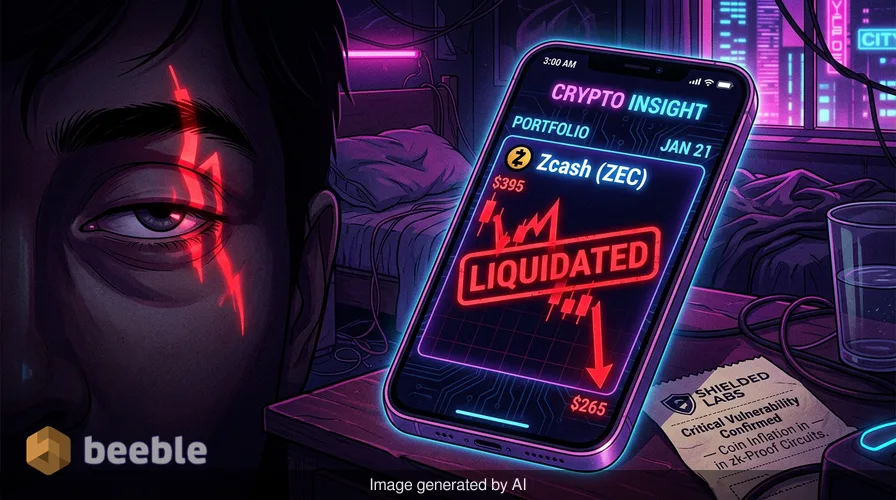
Red candles. Empty orders. Panic selling. Zcash collapsed to $265 in a single night. The market reacted to a four-year-old secret. Your digital wallet lost a third of its value while you slept. This was a liquidation event driven by code. Shielded Labs confirmed a critical vulnerability in the privacy protocol. This flaw allowed for undetected coin inflation. The breach occurred within the zero-knowledge proof circuits.
On a macro level, the fallout from the Zcash bug is a reminder that privacy is a double-edged sword. Most blockchain networks function like a glass bank vault. Every passerby can see exactly how much money is in the vault. They can see every deposit and every withdrawal. This transparency is the reason Bitcoin is considered auditable. If a billion new Bitcoins appeared tomorrow, the network would know instantly. Zcash is different. It is a glass bank vault with a thick velvet curtain pulled across the front. You can see the vault exists, but you cannot see the stacks of cash inside. This curtain is the privacy feature users pay for, but it also hides the rot when the vault develops a leak.
The ghost in the private machine
The vulnerability sat in the Zcash code for four years. During this time, the technical possibility of counterfeit coins was real. Shielded Labs admitted that there is no definitive way to determine if anyone exploited the bug. This is the paradox of a privacy coin. You cannot have absolute privacy and absolute auditability at the same time. If the system is truly private, the developers themselves cannot see the total supply of coins with certainty. They can only see the math that says the supply should be correct.
Nic Carter of Castle Island Ventures views this as part of the deal. He reminds us that Zcash faced a similar issue in 2018. Monero had a bug in 2017 that allowed for infinite coin creation. Historically, these systems are experimental. When you step into the world of privacy coins, you accept a specific type of risk. You trade the transparency of a public ledger for the anonymity of a shielded one. This trade is fine until the market realizes the shielded ledger might be full of counterfeit money. Consequently, the price dropped to $350 as investors fled for the exits.
The democratized hacker and the rise of ai
Curiously, the bug was not found by a human researcher alone. Shielded Labs used Claude Opus 4.8 to identify the flaw. This is a shift in the balance of power between developers and bad actors. Carlos Guzman of GSR notes that complex cryptography was a barrier to entry for most hackers. Only a few people in the world truly understand the math behind zero-knowledge proofs. AI is changing this. These models can scan millions of lines of code and find the tiny mathematical errors that humans miss.
In everyday terms, this is like a world where everyone suddenly has a master key to every lock in town. If AI can find these bugs, the time between a code update and an exploit will shrink. This creates a permanent state of high alert for crypto developers. The barrier to entry for finding critical flaws is falling. This trend is not limited to crypto. It is a systemic shift in how we secure all digital financial systems. If a machine can find a four-year-old bug in a specialized privacy protocol, it can find bugs in your banking app or your credit card processor.
The auditability trade and the grocery store test
Through this economic lens, we see why Bitcoin advocates are vocal about this failure. Rob Hamilton of AnchorWatch argues that this will happen again. He claims that if you cannot audit the supply, you cannot trust the asset. Imagine going to a grocery store where the price of milk is hidden until you swipe your card. You trust the store to charge you the fair price, but you have no way to verify it. If the store makes a mistake and overcharges everyone by ten cents for four years, you would never know.
Financially speaking, auditability is a form of insurance. In traditional finance, we rely on central banks and auditors to tell us how much money exists. We know this system is flawed. Central banks print money and cause inflation, which is an invisible leak in your wallet. Crypto was supposed to fix this by making the ledger public. Zcash tried to add privacy back into the mix. This bug shows that when you add privacy, you might accidentally bring back the same lack of transparency that crypto tried to solve.
The psychology of a private panic
On an individual level, the Zcash crash was a lesson in behavioral economics. When the news broke, people did not wait for a technical explanation. They sold because of fear. In a transparent system, you can check the data to see if you should be afraid. In a private system, fear has no ceiling. If you cannot prove that no one minted a million fake coins, the market will assume someone did.
This is why Monero community members like Seth Simmons are not celebrating the Zcash failure. They know that a lack of trust in one privacy coin is a lack of trust in all of them. The entire sector relies on the belief that the math is perfect. When the math is not perfect, the belief system shatters. The digital asset recently changed hands around $350, which is a significant drop from its previous highs. This price action is a direct reflection of that shattered belief.
Financial mindfulness in a shielded world
Ultimately, the Zcash crisis asks us to reconsider our relationship with digital money. We want privacy from prying eyes. We want our neighbors and the government to stay out of our transactions. Yet, we also want the security of knowing our money is real. We want the curtain, but we also want to know the vault is full. This situation proves we might not be able to have both.
Practically speaking, every financial tool is a compromise. Your bank account offers security but no privacy. Cash offers privacy but no digital convenience. Zcash offers digital privacy but a hidden risk of inflation. Recognizing these trade-offs is the first step toward financial mindfulness. Instead of looking for a perfect coin, look for a system where the risks are acceptable to you. The Zcash bug was fixed, but the question of auditability remains.
Zooming out, the pattern is clear. As we move more of our lives onto blockchains, the complexity of our financial systems will increase. This complexity creates hiding places for bugs and bad actors. Whether we use AI to find these bugs or wait for the market to crash, we are responsible for the assets we hold. The next time you see a "perfect" financial product, ask where the curtain is. Ask what is being hidden to give you the features you want. In the world of money, someone is always counting the coins. If it isn't you, and it isn't the public, you have to hope the math is as strong as the marketing suggests.
Sources:
- Shielded Labs Technical Disclosure (Halo 2 vulnerability report).
- CoinGecko Market Data (Zcash price performance, June 2026).
- GSR Research (AI impact on cryptographic protocols).
- Castle Island Ventures (Historical analysis of privacy coin exploits).
- AnchorWatch Bitcoin Insurance (Auditability vs. Privacy commentary).



See you on the other side.
Our end-to-end encrypted email and cloud storage solution provides the most powerful means of secure data exchange, ensuring the safety and privacy of your data.
/ Create a free account
