

The anatomy of a production pivot: when code writing becomes prompt engineering

The specific feeling of unease when a digital character speaks with a voice that is almost, but not quite, human has a name. It is the uncanny valley. It is the hollow resonance of a world that lacks a heartbeat, where a character like Darth Vader suddenly utters nonsensical profanities because an algorithm failed to understand the context of his villainy. This is the frustration of the modern player who senses that the soul of a game has been replaced by a mathematical approximation. It is a quiet, nagging suspicion that the expansive world before them is less an act of creation and more a result of a calculation.
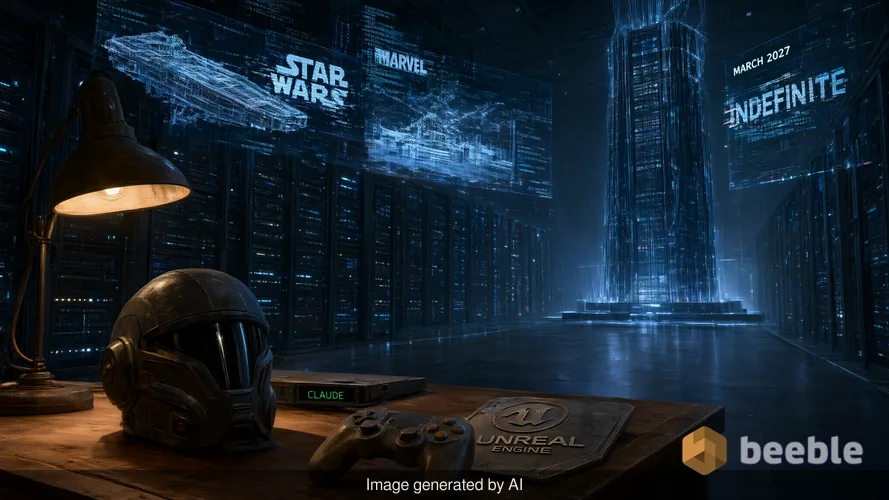
Epic Games is now testing the limits of this audience tolerance. The company has shifted to an AI first development strategy for its massive collaboration with the Walt Disney Company. According to a Bloomberg report, human developers at the Unreal Engine maker will no longer write code by hand. Instead, they will manage and guide code and art assets generated by large language models like Anthropic’s Claude. This change has already impacted the timeline for a highly anticipated Marvel and Star Wars shooter. Originally scheduled for a March 2027 release, the project now faces an indefinite delay.
The end of the handwritten line
Historically, game development functioned as a high-stakes form of digital architecture. Every interaction, from the way a player jumps to the lighting in a dark corridor, required a specific string of logic written by a human. This process is slow. It is prone to error. It is expensive. By removing hand-written code from the workflow, Epic Games is attempting to bypass the traditional bottlenecks of the AAA industry. They are turning software engineers into editors. The shift suggests that the primary skill for a developer in 2026 is no longer the ability to solve a complex logical problem, but the ability to prompt a machine to solve it for them.
This transition has profound implications for the structure of the work. When a developer writes code, they understand the intent behind every line. They know why a specific variable exists. In a prompt-driven environment, the developer manages a black box. They see the output, but the underlying logic is a product of statistical probability. This creates a fundamental disconnect between the creator and the creation. The machine produces the assets, and the human simply approves them. This is the industrialization of creativity.
The math behind the billion dollar mouse trap
Zooming out to the industry level, the $1.5 billion partnership between Epic and Disney is a massive bet on the future of the content walled garden. Disney wants a persistent digital universe where Marvel heroes and Star Wars icons live alongside Fortnite avatars. Epic wants to prove that Unreal Engine is the essential infrastructure for this reality. However, the scale of such a project is immense. It requires thousands of unique assets, millions of lines of code, and a level of interconnectedness that traditional development cycles struggle to maintain.
Epic CEO Tim Sweeney has been vocal about this necessity. He views generative AI as a tool to enable small teams to build interactive worlds with infinite dialogue. In his view, the technology is a way to break the limitations of human labor. Paradoxically, the pursuit of this efficiency has led to significant internal friction. The delay of the Disney shooter indicates that AI is not yet the magic wand that leadership describes. The transition to AI workflows requires a retooling of the entire development pipeline. This process has slowed production even as it aims to accelerate it.
Efficiency as a mask for exhaustion
Through this audience lens, the pivot to AI first development feels like a reaction to the bloat of the modern blockbuster. The cost of making a game that meets the visual expectations of players has become unsustainable. In March, Epic laid off over 1,000 employees. The company cited a downturn in engagement as a primary reason for the cuts. When a studio follows layoffs with a mandate for AI acceleration, the message to the remaining workforce is clear. The goal is to maximize output while minimizing the number of people required to produce it.
From a creator's standpoint, this is a precarious position. The promise that AI will allow developers to build more and better stuff sounds like a benefit. However, the reality often involves a loss of agency. If a machine generates the art and the code, the developer is no longer a craftsman. They are a quality assurance lead for an automated system. This shift changes the nature of the job from one of invention to one of curation. It prioritizes the volume of content over the intentionality of design.
The feedback loop of derivative art
Narratively speaking, the use of AI in franchise-heavy games like those from Marvel and Star Wars creates a unique problem. These intellectual properties rely on a specific tone and history. When an AI model like Claude generates art or dialogue for these worlds, it does so by analyzing existing data. It looks at what has been done before and creates a version of it. This makes the output inherently derivative. It is a copy of a copy.
This is why the AI-voiced Darth Vader in Fortnite was such a resonant failure. The machine understood that Vader is a villain, but it did not understand the gravity of his character. It lacked the human nuance to know what words he would never say. If an entire game is built on this foundation, the result is a fragmented experience. The world may look correct at a glance, but the deeper details feel wrong. The logic of the game mechanics becomes clunky because the code was not written to solve a specific problem, but to mimic a solution from a dataset.
A future of synthetic worlds
In everyday terms, this trend reflects the way we consume media on platforms like Netflix or YouTube. We are surrounded by an endless digital buffet of content, much of it shaped by algorithms to keep us engaged for as long as possible. Epic Games is extending this logic to the very foundation of how games are made. They are moving toward a future where the game world is not a static place built by artists, but a dynamic, synthetic environment generated on the fly.
Consequently, the role of the player is also changing. We are no longer just participants in a story told by another person. We are users of a system that responds to us. While this offers the possibility of infinite play, it also risks the loss of a shared cultural experience. If every player encounters a slightly different, AI-generated version of a Marvel world, the common language of gaming begins to dissolve. We lose the ability to talk about that one specific, perfectly designed level because that level only existed for one person.
The human scale of the unreal
At its core, the pivot to AI first development is an attempt to solve an economic problem with a technical solution. The industry has reached a point where it cannot sustain the human cost of its own ambitions. Studios want larger worlds, better graphics, and faster release cycles. They are turning to AI to bridge the gap between what they want to build and what they can afford to pay humans to create.
As audiences, we must decide if this is the trade-off we want. A game that is perfectly efficient and infinitely large may still feel empty if it lacks the intentionality of a human hand. We should observe our own reactions to these synthetic experiences. When a game world feels seamless, we should ask if it is because of great design or a great algorithm. The infrastructure of our entertainment is becoming invisible. It is our responsibility to look closer at the code, even when the developers are no longer the ones writing it.
Sources:
Bloomberg, internal Epic Games communications and reporter notes.
IGN, interview with Tim Sweeney on AI in game development.
Epic Games, official corporate statements regarding March 2026 layoffs.
Game Developers Conference (GDC), State of the Game Industry Survey 2026.



See you on the other side.
Our end-to-end encrypted email and cloud storage solution provides the most powerful means of secure data exchange, ensuring the safety and privacy of your data.
/ Create a free account