


The Anatomy of a Risk-Off Cascade: Why a Geopolitical Shift in Oil Froze the Bitcoin Market

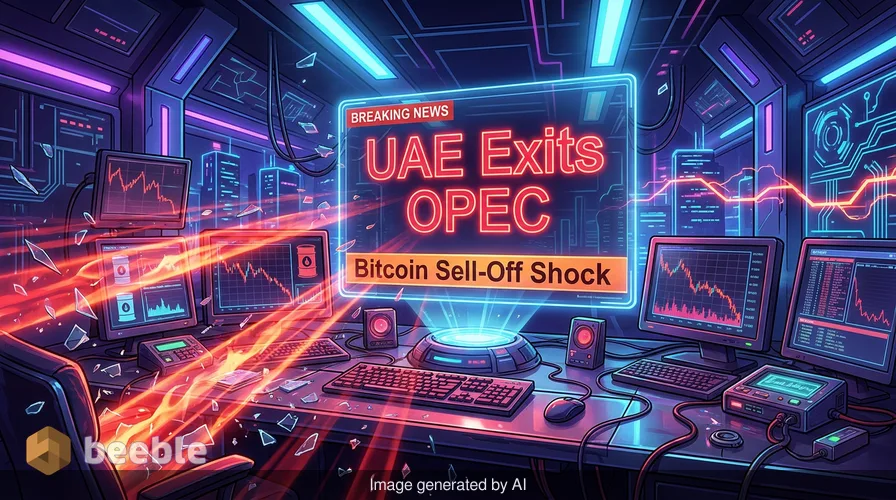
The screen flickered. Numbers turned red. Portfolios bled. The sell-off began with a whisper in the oil markets. By noon, it was a roar in the digital ones. Bitcoin, which had been flirting with the sun, suddenly found its wings clipped. This localized volatility was merely a symptom of a systemic rebalancing of global liquidity. When the United Arab Emirates (UAE) announced its departure from OPEC, the shockwaves didn't just rattle oil barrels; they shattered the glass ceiling of a market that thought it was ready for six figures.
Behind the scenes of this trend, we are witnessing the breakdown of a decades-old correlation. For years, we were told Bitcoin was 'digital gold,' a hedge against the very chaos we are seeing today. Yet, when the gears of global power shifted this morning, investors didn't run toward the blockchain. They ran toward the exit. This sudden retreat reveals a profound truth about where we stand in 2026: despite our dreams of decentralization, our digital wallets are still deeply tethered to the physical world of energy, oil, and old-school geopolitics.
The $82,000 Glass Ceiling
To understand why your screen is flashing red, we first have to look at the 'sell wall' parked at $82,000. In the world of trading, a sell wall is effectively a massive psychological and financial barricade. Imagine a concert where thousands of people are trying to get into a stadium, but a line of security guards at the gate has been told not to let anyone through unless they pay a price no one is willing to meet.
At $82,000, institutional and retail whales have placed thousands of 'limit orders'—pre-set instructions to sell their Bitcoin the moment it hits that price. This creates a massive glut of supply. For the price to move higher, there must be enough buyers to chew through all that available Bitcoin. Paradoxically, the moment the news from the UAE hit the wires, those buyers vanished.
Historically, these walls act as a global mood ring for the market. They tell us exactly where the collective 'greed' turns into 'caution.' At $82,000, the market decided it had seen enough growth for one season. The sell wall became a self-fulfilling prophecy: because everyone saw the wall, no one wanted to be the last one holding the bag when the price inevitably bounced off it.
The UAE’s Great Uncoupling
The catalyst for this particular forest fire was not a blockchain hack or a regulatory crackdown. It was a press release from Abu Dhabi. The UAE’s decision to exit OPEC (the Organization of the Petroleum Exporting Countries) is a seismic shift in the structural foundation of the global economy. For decades, OPEC has been the thermostat of the world, clicking on and off to regulate oil prices and, by extension, global inflation.
By leaving, the UAE is signaling a move toward a fragmented energy market. On a macro level, this introduces a level of uncertainty that institutional investors loathe. When the future of the world’s most essential commodity—energy—becomes unpredictable, big money managers do something called 'de-risking.' They sell anything that fluctuates wildly in value to move into safer, more boring assets like short-term government bonds or cash.
Financially speaking, Bitcoin is still the 'wild child' of the investment world. Even in 2026, with widespread institutional adoption, it remains the first thing to be sold when a geopolitical storm clouds the horizon. This is the 'risk-off' trade in its purest form: when the world feels dangerous, people want the comfort of the familiar, even if that familiar currency is being eroded by inflation.
The Invisible Leak in the Wallet
It is easy to look at these billion-dollar oil deals and think they have nothing to do with your daily life. But the intersection of global indices and your grocery bill is more direct than you might think. When the UAE exits OPEC, it potentially leads to more volatile oil prices. Because almost everything you buy—from the bread on your table to the phone in your pocket—requires energy to produce and transport, oil volatility is essentially an invisible leak in your wallet.
If energy prices spike because the old oil cartels are crumbling, your purchasing power drops. For a retail investor, this creates a tangible sense of financial anxiety. You might look at your Bitcoin holdings and think, 'I need to make sure I have enough cash for rent and gas next month.' You sell a little. Your neighbor sells a little. Multiply that by ten million people, and you have a market correction.
Through this economic lens, we can see that Bitcoin isn't failing because its technology is broken. It is sagging because the humans who own it are reacting to the cost of living in a shifting world. The 'glass bank vault' of the blockchain is transparent and secure, but the people holding the keys are still prone to the same fears that have driven market cycles for centuries.
The Illusion of Decentralization
We often talk about Bitcoin as being decentralized—free from the whims of any single government. While that is true of its code, it is not true of its price. The price of Bitcoin is a collective belief system, and that system is currently being tested by the realities of a multipolar world.
Curiously, the very things that were supposed to make Bitcoin mainstream—like the spot ETFs and pension fund integrations of the mid-2020s—have also made it more sensitive to traditional market shocks. Because 'Big Finance' now owns a significant portion of the supply, Bitcoin now moves in lockstep with the S&P 500 and the oil markets.
Ultimately, we are seeing the maturation of an asset class. It is no longer a niche hobby for cypherpunks; it is a systemic component of the global financial web. But with that maturity comes the burden of reality. You cannot be a major player in the global economy and remain immune to its fractures. The sell-off today is a reminder that in an interconnected world, a decision made in a boardroom in the Middle East can trigger a liquidation event in a digital wallet in the Midwest.
Key Takeaways for the Mindful Investor
As we navigate this volatile period, it is worth pausing to reflect on how we perceive value and risk. Here is some food for thought for your own financial journey:
- Observe Your Reflexes: When you saw the news today, was your first instinct to check the price or to understand the cause? Learning to distinguish between a 'broken story' and a 'broken price' is the first step toward financial emotional intelligence.
- The Energy Tether: Acknowledge that as long as our world runs on physical energy, 'digital' assets will never be fully decoupled from the geopolitics of oil and gas.
- Sell Walls as Mirrors: A sell wall isn't just a technical indicator; it’s a scoreboard of human conviction. When you see a wall at $82,000, ask yourself what it would take for the world to feel 'safe' enough to climb over it.
- Reclaiming Control: Market corrections are a forest fire that clears out the dead wood of speculative hype. Use these moments not to panic, but to reassess whether your portfolio reflects your long-term goals or just your short-term fears.
In the end, the UAE’s move and the subsequent dip in Bitcoin are part of a larger, ongoing story about the evolution of money. We are moving away from a world of centralized control and toward something more nuanced and fragmented. It will be messy, it will be volatile, and it will occasionally be frightening. But by understanding the mechanics behind the madness, we can move from being victims of the market to being informed participants in it.
Sources:
- OPEC Secretariat: April 2026 Monthly Oil Market Report.
- UAE Ministry of Energy and Infrastructure: Press Release on Strategic Economic Realignment.
- CoinMarketCap: Bitcoin Liquidity and Order Book Depth Analysis (April 29, 2026).
- Bureau of Labor Statistics: Impact of Energy Volatility on Consumer Price Index (Q1 2026).



See you on the other side.
Our end-to-end encrypted email and cloud storage solution provides the most powerful means of secure data exchange, ensuring the safety and privacy of your data.
/ Create a free account
