


The anatomy of a staking traffic jam: How a $1,000 error stalled $5 billion in Ethereum

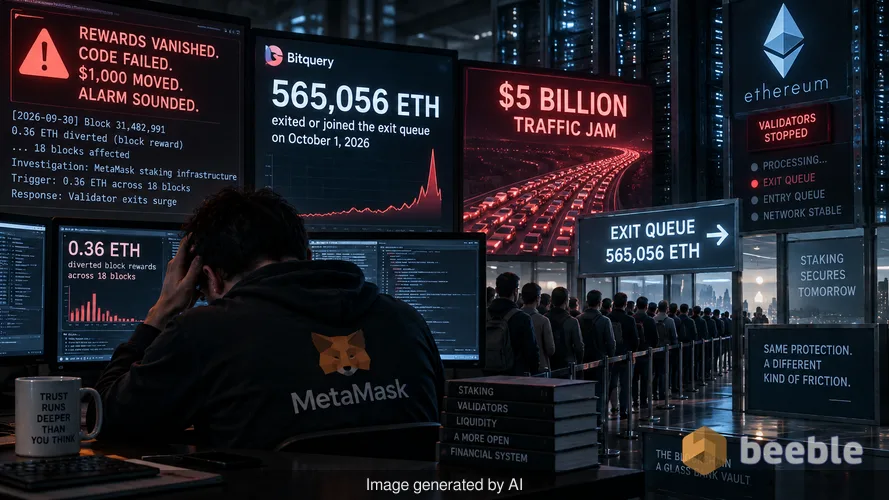
The rewards vanished. The code failed. A thousand dollars moved. The alarm sounded. Servers hummed. Validators stopped. A $5 billion traffic jam formed. Bitquery identified 565,056 ETH that had either exited or joined the exit queue on October 1, 2026. This mass departure followed a technical investigation into MetaMask’s staking infrastructure. The incident originated from 0.36 ETH in diverted block rewards across 18 blocks on September 30. While the dollar value of the diverted funds was small, the operational response triggered a systemic bottleneck in the Ethereum network.
Historically, financial systems operate on a knife-edge of trust. When we swipe a credit card at a coffee shop, we assume the plumbing works. We rarely think about the clearinghouses or the liquidity buffers behind the transaction. The blockchain is a glass bank vault—every movement is visible but not every movement is fast. In the world of Ethereum staking, where users lock up their assets to secure the network and earn rewards, the "plumbing" is a complex series of entry and exit queues. These queues exist to prevent a sudden mass exodus from destabilizing the security of the blockchain. Paradoxically, the same mechanism designed to protect the system has now become a point of significant friction.
The small pebble that started a landslide
On an individual level, $923 is a mundane amount of money. It is the price of a monthly grocery bill for a small family or a mid-range laptop. However, in a decentralized system, a tiny anomaly can trigger a massive automated response. Bitquery measured 0.36 ETH in diverted block tips on September 30. These tips are essentially the "service charge" paid to the people who maintain the network. When these funds did not go where they were expected, MetaMask operators took a precautionary stance.
MetaMask identified 16,965 validators that needed to exit the system to ensure customer funds remained safe. Each of these validators holds 32 ETH. When you multiply that by the number of affected nodes, the scale becomes profound. Consensys, the company behind MetaMask, stated that its investigation found no indication that wallets or customer funds were compromised. The exits were a safety measure. In a traditional bank, this might look like a branch closing its doors for an afternoon to audit a drawer. In the crypto world, this looks like a $1.4 billion exit request hitting a network that only allows a few thousand people through the door at a time.
The mechanics of the Ethereum entry gate
Ethereum is a resilient network, but it is not built for speed during times of crisis. To maintain stability, the protocol limits how much ETH can join or leave the staking layer each day. This throughput is a structural safeguard. Zooming out, we can see how this creates a bottleneck. If one large player decides to move their funds, everyone else behind them has to wait.
Bitquery's data shows that restaking the 565,056 ETH involved in this incident would require 9.8 days of the network's total entry capacity. This calculation uses the throughput recorded on October 7. This is not just a MetaMask issue. Because these validators were part of larger staking pools like Lido, the ripple effect touched thousands of smaller investors who may not even know what a "validator" is. The entry backlog was worth approximately $3.59 billion in the October 7 snapshot. When you add the value of the ETH still waiting to exit, the total economic exposure reaches toward the $5 billion mark.
Why the cycle takes forty-five days
For a retail investor, "liquidity" usually means how fast you can turn an asset into spendable cash. We are used to the instant gratification of a debit card swipe. Crypto often promises similar efficiency, but the reality of institutional staking is different. The process of exiting a validator, waiting for the withdrawal period, and then re-entering the staking queue is a multifaceted journey.
Lido expects its final affected validators to finish their exit by the end of October 7. However, that is only the first step. Full withdrawals and the subsequent re-entry take much longer. The protocol estimates that the complete cycle could take up to 45 days. During this time, the ETH is in a state of transit. It is not earning rewards, and it is not easily spendable.
| Phase of Staking Cycle | Estimated Duration | Current System Impact |
|---|---|---|
| Exit Queue | 1 to 7 Days | High congestion |
| Withdrawal Period | 1 to 5 Days | Standard protocol delay |
| Re-entry Queue | 9.8 to 15 Days | Significant bottleneck |
| Total Cycle Time | Up to 45 Days | Extended capital inactivity |
The psychological cost of precaution
Financially speaking, this event reveals a deep-rooted tension between security and efficiency. Behavioral economics tells us that humans are naturally risk-averse. When an institution like MetaMask sees even a tiny $923 discrepancy, their incentive is to shut everything down to avoid a potential catastrophic loss. This is a rational decision for the company, but it creates a systemic burden for the network.
This herd behavior is common in traditional markets. When one major bank stops lending, others often follow, leading to a credit crunch. In this case, the "crunch" is not in credit, but in the queue. The transparency of the blockchain means that every other market participant can see the 565,056 ETH waiting to move. This visibility can lead to speculative anxiety. Traders watch the queue as a mood ring for the market. If they see a massive exit, they might fear a price drop, even if the exit is purely for technical maintenance.
The shift in decentralized governance
On a macro level, this incident has forced the hand of decentralized organizations. An October 5 contributor proposal in the Lido forum suggested stopping new deposit allocations to MetaMask operators in two specific modules. This is a significant move. It shows that even in a decentralized world, there are consequences for technical friction. Return to the protocol does not guarantee a return to the same operator.
This is a tangible example of how blockchain governance works in practice. It is not just about code; it is about people making decisions on how to allocate billions of dollars in assets. The forum proposal describes calls intended for an on-chain vote. This process is the digital equivalent of a corporate board meeting, played out in public view. It highlights how interconnected these systems are. A small error in a wallet provider's reward system can lead to a governance shift in the largest staking protocol in the world.
Navigating the friction of digital money
Ultimately, the $5 billion traffic jam is a reminder that the evolution of money is still in its early stages. We have moved from physical gold to paper fiat, and now to digital assets secured by math. Each step has reduced certain types of risk while creating new forms of friction. The invisible leak in your wallet today might not be inflation, but the "yield gap" created by a 45-day wait in a staking queue.
From a consumer standpoint, this event is a call for patience and due diligence. When we choose a financial tool, whether it is a traditional savings account or a crypto wallet, we are also choosing the plumbing that comes with it. The MetaMask incident was not a forest fire that destroyed the forest; it was a controlled burn that cleared out a technical glitch. However, the smoke from that fire is still visible across the entire Ethereum market.
As we move forward, we should reflect on our own financial habits. We often value speed above all else, but in the new economy, security often requires a slow-motion approach. Understanding that a $1,000 error can stall $5 billion is not a reason to panic. It is a reason to respect the scale and the complexity of the systems we now inhabit. Mindfulness in finance means recognizing that behind every digital balance is a vast, interconnected network of queues, gates, and human decisions.
Sources:
- Bitquery: Staking Exit and Entry Queue Data Analysis (October 2026)
- Consensys/MetaMask: Technical Update on Validator Reward Diversion (October 1, 2026)
- Lido Finance: Community Governance Forum Proposal (October 5, 2026)
- Ethereum Network Protocol Statistics: Staking Throughput Snapshots (October 7, 2026)



See you on the other side.
Our end-to-end encrypted email and cloud storage solution provides the most powerful means of secure data exchange, ensuring the safety and privacy of your data.
/ Create a free account
