


The Anatomy of a Stalled IPO: Why the Tech Market is Swapping Crypto Dreams for AI Realities

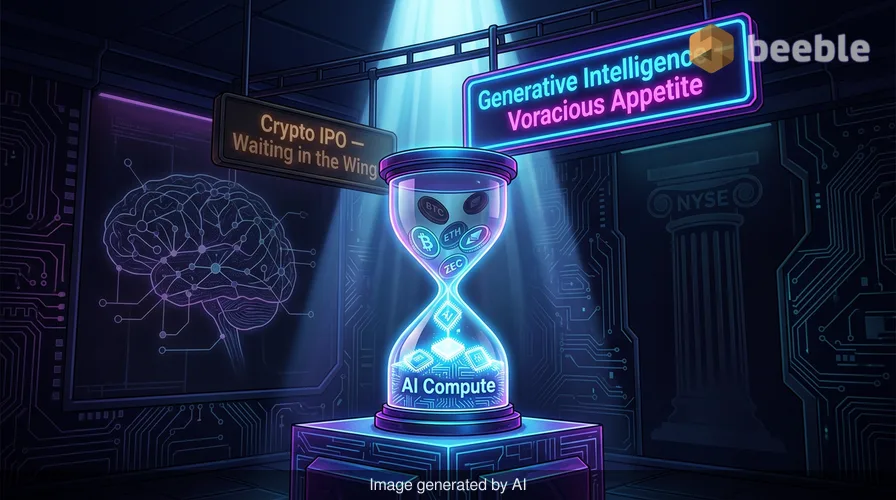
A decade ago, the average retail investor’s greatest risk was a stagnant savings account—today, the primary threat is the invisible erosion of purchasing power in a high-speed digital economy. In the era of 2021, the market narrative was dominated by the revolutionary promise of decentralization; however, by mid-2026, the spotlight has shifted toward the pervasive efficiency of generative intelligence. This transition represents more than a mere trend; it is a fundamental reconfiguration of how we value the future. While crypto firms once anticipated a celebratory march toward the New York Stock Exchange, they now find themselves waiting in the wings—sidetracked by a global market that has suddenly developed a voracious appetite for silicon brains over digital tokens.
The Great Divergence in the Listing Lobbies
On a macro level, the contrast between the current tech landscape and the previous cycle is stark. In 2021, venture capital flowed into any project that featured the word "blockchain"—regardless of its actual utility; conversely, in 2026, the public markets demand clear, tangible revenue streams that only AI companies seem to be consistently producing. We are witnessing a systemic pivot in investor behavior. While major crypto exchanges and stablecoin issuers like Circle and Kraken have long teased their public debuts, the "IPO window" appears to have a very specific filter installed. It is wide open for companies that automate labor—it is firmly shut for those that merely facilitate the exchange of speculative assets.
Historically, the path to an IPO was paved with user growth and a clear narrative of disruption. In practice, however, the hurdles have grown taller. Central bank policies have kept interest rates at a level that punishes "growth-at-all-costs" models—consequently, the speculative premium that once floated crypto valuations has largely evaporated. Zooming out, we see that the market is no longer willing to subsidize the "Digital Wild West" when it can instead invest in the "Digital Infrastructure" of AI. This isn't just a change in ticker symbols; it is a profound shift in the collective belief system of the investing public.
The Productivity Premium vs. The Speculative Hope
To understand why a Fundstrat executive would flag this stall, we must look at what happens behind the scenes of this trend. When you buy a monthly subscription to an AI productivity tool, you are making a mundane financial decision based on a tangible return: you save time. This is a clear, deflationary force in your personal economy. In contrast, when you buy a crypto asset, you are often participating in a more nuanced, speculative gamble on future adoption. The stock market, acting as a global mood ring, is currently reflecting a preference for that time-saving tool over the speculative asset.
Financially speaking, the "hurdle rate" for a new public company has changed. Investors are looking for structural resilience rather than transient hype. AI companies are presenting balance sheets that show immediate integration into the global economy—from automating legal briefs to optimizing power grids. Meanwhile, crypto firms are struggling with the paradoxical reality that while asset prices (like Bitcoin) remain high due to institutional ETFs, actual trading volumes on retail exchanges remain anemic. The "glass bank vault" of the blockchain is transparent as ever, but fewer people are walking through the front door to trade.
| Feature | AI IPO Candidates (e.g., Anthropic, OpenAI) | Crypto IPO Candidates (e.g., Circle, Kraken) |
|---|---|---|
| Primary Value Prop | Efficiency and Labor Automation | Financial Sovereignty and Infrastructure |
| Market Sentiment | High Pervasive Growth | Nuanced Skepticism / Regulatory Fatigue |
| Revenue Model | SaaS Subscriptions / Enterprise Licensing | Transaction Fees / Interest on Reserves |
| Macro Sensitivity | Resilient (Productivity is an All-Weather Need) | Highly Sensitive to Liquidity Cycles |
| Regulatory Path | Emerging Frameworks (Safety focus) | Mature but Opaque (Compliance focus) |
The Liquidity Mirage and the Retail Wallet
Through this economic lens, we can see why your personal financial apps feel different lately. You might notice fewer notifications about "the next big coin" and more features centered around AI-driven budgeting or automated savings. This is because the liquidity that once fueled the crypto frenzy has been redirected. At its core, the IPO market is a reflection of where the "big money" thinks the "little money" will go next. Right now, the bet is that you will spend your next $20 on a ChatGPT-5 subscription rather than on a decentralized finance (DeFi) liquidity pool.
Paradoxically, the success of Bitcoin ETFs has actually hurt the IPO prospects of crypto companies. Zooming out, we see that if an investor wants exposure to digital assets, they no longer need to buy shares in a crypto exchange—they can simply buy the ETF. This has effectively cannibalized the "uniqueness" of a crypto IPO. Consequently, firms like Blockchain.com or eToro find themselves in a fragmented position, where their private valuations from 2021 no longer align with the transparent, often brutal reality of the 2026 public markets.
The Psychology of the "New Shiny"
From a consumer standpoint, there is a limit to how much "disruption" we can handle at once. Behavioral economics tells us that herd behavior is a powerful force. In 2021, the FOMO (Fear Of Missing Out) was rooted in the idea of a decentralized future. Today, that psychological pendulum has swung toward the fear of being left behind by the machine. Inflationary pressures have also made us more protective of our capital; we are less likely to throw money at a digital wallet that feels like a speculative experiment when we are worried about the cost of a grocery run.
Ultimately, the stall in crypto IPOs is symptomatic of a market that is "clearing out the dead wood." Much like a forest fire allows for new, stronger growth, this cooling period is forcing crypto companies to prove they are more than just a digital casino. They are being forced to show systemic value. In everyday terms, the market is asking: "Besides trading, what can you actually do for me?" If the answer is opaque or overly complex, the capital stays in AI.
The Shift from Speculation to Utility
On an individual level, this trend invites us to look at our own digital wallets with more scrutiny. Are we holding assets that have a tangible use, or are we holding onto a collective belief system that hasn't quite delivered on its promise of daily utility? The transition from Web2 to Web3 was supposed to be a straight line, but it has turned into a multifaceted maze. AI, by contrast, has offered a more direct path to our daily habits.
Behind the scenes of this trend, the message from the markets is clear: the "Wild West" era of crypto is being replaced by a demand for structural maturity. If a company wants to go public in 2026, it must offer more than just a decentralized dream; it must offer a resilient, transparent business model that can withstand the scrutiny of a world that is increasingly skeptical of hype. The stall in IPOs isn't a death knell for crypto, but it is a sobering reminder that in the global economy, attention is the scarcest currency of all.
Toward Financial Mindfulness
As we navigate these shifting tides, it is worth pausing to reflect on our own financial habits. We often move our money in response to the loudest voice in the room—whether that was the crypto influencer of yesterday or the AI evangelist of today. But a truly resilient personal economy isn't built on chasing the next IPO; it is built on understanding the mechanics of value.
Instead of looking for the next "100x" listing, we might find more success in observing how these technologies actually change our productivity and our spending. Is that new AI tool actually saving you money, or is it just another recurring fee? Is your digital asset holding serving a purpose in your long-term plan, or is it a relic of a past hype cycle? By asking these questions, we reclaim a sense of control. The markets will always have a new favorite child, but your wallet functions best when it is governed by your own internal logic, not the shifting moods of a global ring.
Sources:
- Fundstrat Global Advisors: "2026 Tech Market Outlook: The AI Absorption."
- Securities and Exchange Commission (SEC): "Quarterly S-1 Filing Reviews and Market Statistics."
- Nasdaq Indices: "Comparison of AI-linked vs. Blockchain-linked Equity Performance 2024-2026."
- Bureau of Labor Statistics: "Consumer Price Index and the Impact of Automation on Service Sector Costs."
- Circle Internet Financial: "Annual Transparency and Reserve Reports."



See you on the other side.
Our end-to-end encrypted email and cloud storage solution provides the most powerful means of secure data exchange, ensuring the safety and privacy of your data.
/ Create a free account
