


The anatomy of an automated essay: how Denmark is fighting the erosion of human thought

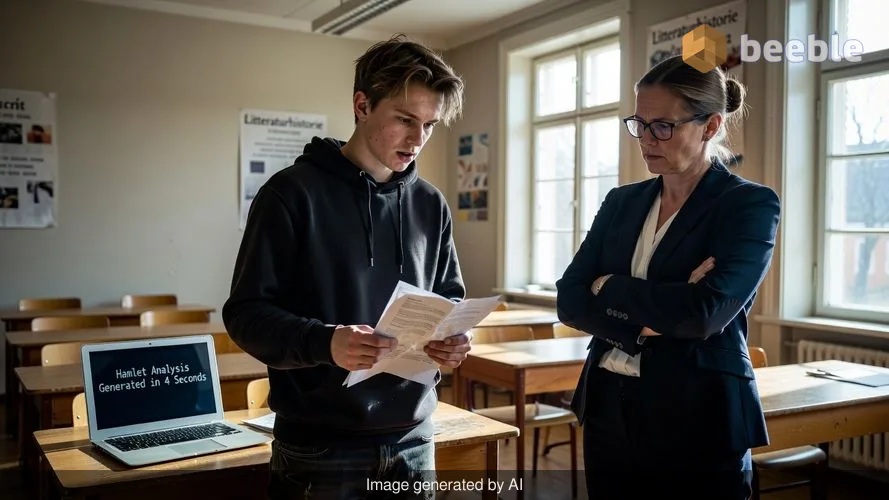
The laptop lid opens. The student pastes a prompt. A complex analysis of Hamlet generates in four seconds. The task is complete. The learning is absent. This sequence is now a daily ritual in secondary schools across the globe. It represents a systemic collapse of the traditional homework model. In Denmark, the government decided to intervene before the process of education became entirely mechanical.
Next week, thousands of Danish upper secondary students will return to their classrooms under a new set of constraints. Education Minister Magnus Heunicke announced these measures to address what he describes as an urgent threat to academic integrity. The state is no longer content with passive software filters. It is reintroducing the human voice as the ultimate arbiter of knowledge. The most significant shift involves mandatory oral defenses for written take-home assignments. If a student submits a paper, they must now stand before a teacher and explain their logic. This move targets the opaque nature of generative AI. It forces a reconciliation between the digital output and the student’s actual cognitive grasp of the material.
The return to the oral tradition
Curiously, this high-tech problem has led to a low-tech solution. The oral defense is an ancient academic tool. It dates back to the Socratic method and the early European universities. By applying it to the SSO—a major written exam taken by roughly 9,000 students annually—Denmark is placing a higher value on the process of thought than the final product. Zooming out, this shift reflects a growing anxiety about the disappearance of the individual voice in a world of predictive text.
Linguistically speaking, AI does not speak; it calculates the next most probable word. When a student relies on this, their own linguistic habitus begins to atrophy. Language is an archaeological site where every sentence reveals the depth of a person’s culture and experience. AI flattens this site into a polished, average surface. The oral exam forces the student to dig again. It requires them to inhabit their own words. If they cannot explain why they chose a specific metaphor or how they arrived at a conclusion, the generative illusion breaks. The ministry also requires schools to use screen-monitoring tools during in-school tests. This creates a digital panopticon, but one intended to preserve the sanctity of the individual effort.
Liquid modernity and the frictionless grade
On a macro level, the rise of AI cheating is a symptom of what Zygmunt Bauman called liquid modernity. In this state, everything is transient and efficiency is the primary virtue. Education, which once required the heavy friction of reading and drafting, has become a series of frictionless transactions. A student trades a prompt for a grade. The result is a fast-food diet of information—quick and accessible, but lacking deep emotional or intellectual nutrition.
Magnus Heunicke’s recent press release acknowledged that AI-assisted cheating is a pervasive problem. The prompt action includes a requirement for schools to use firewalls that filter online content during school hours. The government also encourages schools to bring assignments back into the physical classroom. By working under controlled conditions, students receive immediate feedback. This environment makes the learning process transparent. It replaces the atomized experience of solitary, AI-supplemented homework with a collective academic environment.
A continent in transition
Denmark is not an isolated case. From a societal standpoint, the entire European educational sector is grappling with this paradox. Norway recently imposed a near-ban on generative AI for elementary students and restricted it for older pupils. These nations are moving away from the early technocratic optimism that suggested AI would simply be a neutral tool like a calculator. Instead, they see it as a structural shift that alters how children learn to think.
Data from a Eurobarometer study shows that 54% of Europeans recognize that AI brings both benefits and challenges to the classroom. Only 22% believe AI has no place in education at all. This suggests that the public is not experiencing a moral panic. Instead, they are performing a nuanced assessment of a shifting reality. The Danish approach reflects this balance. Last year, the country experimented with allowing AI during English oral tests. That experiment was not a failure, but it highlighted the need for boundaries. The current measures are an attempt to define where the machine ends and the human begins.
The attention economy and systemic pressure
In everyday terms, we must ask why students reach for the AI prompt in the first place. The modern student lives in a fragmented attention economy. They are constantly bombarded by notifications and systemic pressures to achieve high grades for university admission. Paradoxically, the tools designed to save them time often increase their anxiety. When a student uses AI to skip the struggle of writing, they are not just cheating the school; they are adopting a coping mechanism for an over-stressed academic environment.
Education serves as an anchor in a world of systemic chaos. When that anchor is replaced by a digital shortcut, the student is left adrift. The Danish requirement for in-school assignments under supervision aims to restore this grounding. It moves the focus back to the mundane, visceral work of drafting a paragraph or solving an equation. This is where the actual transformation of the student occurs. The firewall and the monitor are not just tools of punishment. They are attempts to carve out a space where deep work is still possible.
Food for thought
As we observe the implementation of these rules, we should consider how our own daily routines have become automated. The Danish model suggests that the solution to technological encroachment is a return to human presence.
- How much of your own daily communication is a product of your own thought versus a suggested response from a device?
- Does the removal of friction in your work actually make you more productive, or does it simply make your efforts more ephemeral?
- If you had to orally defend your last three emails or reports, could you explain the logic behind every word?
- Is it possible to maintain an individual habitus in a world that rewards algorithmic speed?
Ultimately, the goal of education is not the production of a perfect document. It is the development of a mind that can navigate complexity. Denmark’s decision to monitor screens and mandate oral defenses is a profound statement on the value of human presence. It suggests that even in a digital age, the most important technology we possess is the ability to think for ourselves.
Sources
- Danish Ministry of Children and Education, Press Release on AI measures, August 2024.
- Eurobarometer, Public opinion on the use of Artificial Intelligence in education, 2024.
- Norwegian Directorate for Education and Training, Guidelines on Generative AI in schools, 2024.
- Zygmunt Bauman, Liquid Modernity, 2000.
- Pierre Bourdieu, The Logic of Practice (Habitus theory), 1980.



See you on the other side.
Our end-to-end encrypted email and cloud storage solution provides the most powerful means of secure data exchange, ensuring the safety and privacy of your data.
/ Create a free account
