


The App That Became a Feature: Why Cameo’s TikTok Integration is a Survival Strategy for the Creator Economy

The Frictionless Birthday Wish
You are scrolling through TikTok, caught in the rhythmic, algorithmic flow of short-form storytelling. You stop at a video from your favorite niche creator—perhaps a comedian who specializes in hyper-specific office humor or a chef who only cooks with 18th-century tools. Beneath their username, a new button appears: "Request a Personalized Video."
In three taps, you’ve commissioned a birthday greeting for your brother. You never left the app. You didn’t have to remember a separate password, navigate a clunky third-party interface, or deal with the cognitive load of switching contexts. Behind the screen, a complex handshake occurred between two massive software architectures, but to you, it felt like a single, seamless thought. This is the new reality of Cameo’s integration with TikTok, a move that represents far more than a simple business partnership; it is a profound shift in how we consume digital celebrity.
From Unicorn to Integration: The Valuation Gravity
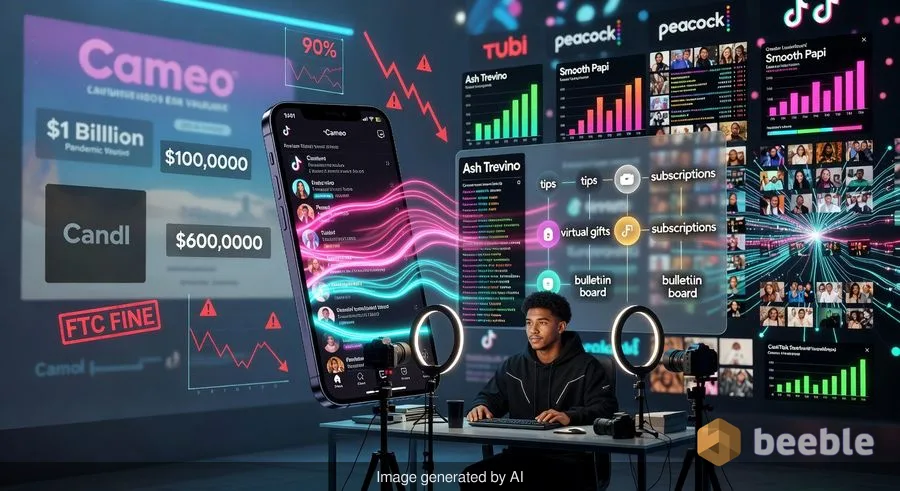
Zooming out to the industry level, this integration is a pragmatic response to a brutal correction. Historically, Cameo was the darling of the pandemic era, achieving a ubiquitous status and a $1 billion valuation when we were all trapped indoors, starving for connection. However, as the world reopened, the "destination app" model—where users are expected to download and maintain a separate application for a single, infrequent task—began to feel like a legacy approach.
By 2024, Cameo’s valuation had plummeted by over 90%. The company faced a fragmented market and a $600,000 fine from the Federal Trade Commission. When an app loses its status as a destination, it must become a feature within someone else’s ecosystem to survive. This is the paradox of the modern software industry: to remain relevant, a platform must often sacrifice its independence to live where the users already are.
The API as a Life Raft
Technically speaking, this partnership is powered by robust APIs (Application Programming Interfaces). To put it another way, if TikTok is a sprawling digital city, Cameo’s API acts like a specialized courier service that allows TikTok’s infrastructure to request specific data—celebrity rosters, pricing, and video delivery—without the user ever seeing the "gears" of the Cameo engine.
In everyday terms, APIs are like restaurant waiters. You, the customer (TikTok user), give your order to the waiter (the API), who takes it to the kitchen (Cameo’s servers) and brings back your meal (the personalized video). This reduces what developers call digital friction. Every extra click or app-switch is a moment where a user might change their mind. By embedding itself directly into the TikTok feed, Cameo is effectively erasing the distance between the impulse to buy and the transaction itself.
The Influencer as the New Infrastructure
Curiously, this move highlights a broader trend where tech giants are treating influencers not just as content creators, but as the infrastructure of the platform itself. We see this in how streaming services like Tubi and Peacock are partnering with creators for original content. In practice, the creator is the "hook" that keeps the user within the ecosystem lock-in.
TikTok already boasts a multifaceted suite of monetization tools: virtual gifts, tips, and subscriptions. By adding Cameo to this list, TikTok is essentially building a proprietary mall where the creators are the storefronts. For stars like Ash Trevino or Smooth Papi, who currently top the Cameo leaderboards, this integration isn't just a convenience; it’s an evolution of their digital storefront, making their brand more resilient against the shifting whims of the algorithm.
The Ghost of Technical Debt
Under the hood, Cameo’s journey has been marked by attempts to pivot away from its core identity. Last year’s launch of Candl, a birthday planning app, felt like an attempt to solve a problem that users didn't necessarily have. In the world of software development, this is often a sign of trying to outrun technical debt or a stagnating user base by adding "bloat"—new features that complicate the user experience without adding core value.
In contrast, the TikTok integration feels like a return to a more streamlined philosophy. Instead of trying to force users into a new, proprietary environment, Cameo is acknowledging that the modern web is interconnected. It is a realization that a specialized service is often more valuable as a transparent layer within a larger platform than as a standalone monolith.
Reclaiming the Human Connection
Ultimately, on an individual level, we have to ask what this means for our relationship with technology. We are moving toward a world where every digital interaction is monetized and "shoppable." While the convenience of ordering a Cameo on TikTok is undeniable, it further blurs the line between social interaction and commercial transaction.
As users, we should observe our own software habits. Are we choosing these services because they truly add value to our lives, or simply because the friction has been reduced to zero? The next time you see that "Request" button, take a moment to look behind the screen. Recognize the massive engineering and business machinery working to make that interaction feel invisible. In a world of seamless integrations, the most important skill we can develop is the ability to pause and see the architecture for what it is.
Food for Thought
- The Friction Test: Notice which apps you use as "destinations" and which you only interact with through other platforms. Why does that distinction exist for you?
- The Cost of Convenience: Does making a purchase "too easy" change the emotional value of the gift? Is a Cameo more special if you had to go looking for it?
- Ecosystem Awareness: Consider how many of your daily digital tasks happen within a single "super-app" like TikTok or Instagram. What happens if that platform changes its rules?
Sources
- Federal Trade Commission: Report on Consumer Protection and App Transparency (2024).
- Cameo Corporate Newsroom: "TikTok Integration Announcement" (March 2026).
- Creator Economy Analysis: "The Shift from Destination Apps to Embedded Services."
- Software Architecture Quarterly: "API-First Strategies in the Post-Unicorn Era."
- TikTok Developer Documentation: "Creator Marketplace and Third-Party Integrations."



See you on the other side.
Our end-to-end encrypted email and cloud storage solution provides the most powerful means of secure data exchange, ensuring the safety and privacy of your data.
/ Create a free account
