


The Battle for AI Sovereignty: Why Tech Giants and Military Leaders are Rallying Behind Anthropic

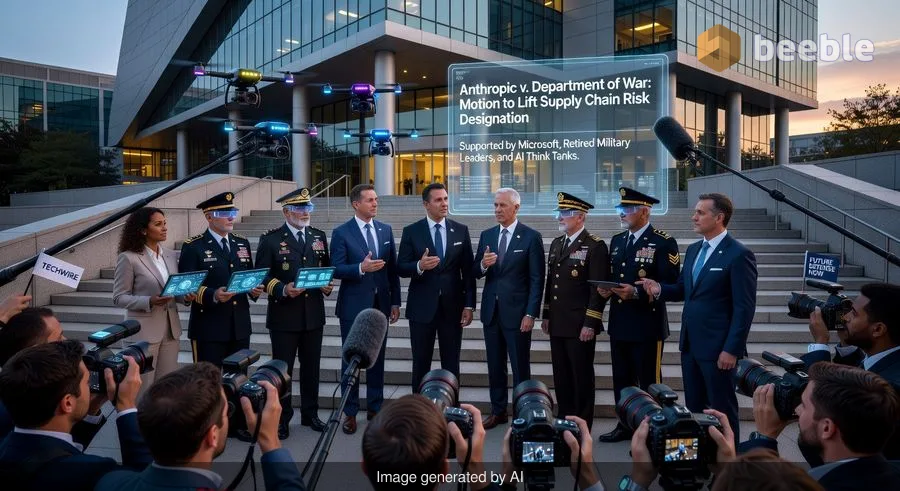
In a move that has sent shockwaves through the corridors of both Silicon Valley and Washington D.C., a formidable coalition of tech titans and former military commanders has stepped forward to support Anthropic in its high-stakes legal battle against the United States government. The dispute centers on a controversial designation by the Department of War (DOW) that labels the AI safety research company a "supply chain risk," a move that critics argue could stifle innovation and compromise national security.
The legal challenge, mounted by Anthropic last week, seeks to overturn a directive issued under the current administration. This designation effectively blacklists the company from federal contracts and prevents other private entities from integrating Anthropic’s technology if they wish to maintain their own standing with the government. For a company built on the foundation of "Constitutional AI," the irony of being labeled a threat to the state is not lost on industry observers.
The "Supply Chain Risk" Death Sentence
In the world of federal procurement, being labeled a supply chain risk is often described as a corporate death sentence. It is a tool traditionally reserved for foreign entities suspected of espionage or hardware manufacturers with compromised components. By applying this label to a domestic AI developer like Anthropic, the Department of War has entered uncharted legal territory.
The designation allows the DOW to exclude Anthropic from bidding on any defense-related projects. More significantly, it creates a "chilling effect" across the entire private sector. If a major cloud provider or a logistics firm uses Anthropic’s Claude models to power their internal systems, they risk losing their own government certifications. This effectively forces the industry to choose between cutting-edge AI tools and their most lucrative government contracts.
Microsoft’s Surprising Intervention
Perhaps the most significant development in the case is the vocal support from Microsoft. Despite being a primary competitor in the AI space through its partnership with OpenAI, Microsoft filed a legal brief urging the court to lift the designation. The tech giant’s interest is not merely altruistic; it is a matter of protecting the broader technological ecosystem.
Microsoft’s legal filing argues that the DOW’s actions force contractors to comply with "vague and ill-defined directions" that have never before been publicly used against a domestic firm. The company warned that the designation could bring "severe economic effects that are not in the public interest." By siding with Anthropic, Microsoft is signaling that the precedent of arbitrary government intervention is a greater threat to the industry than any single competitor.
A Divided Front: The Military Perspective
It isn't just tech executives who are worried. A group of retired military leaders and AI think tanks have also joined the fray. Their argument is rooted in the concept of "innovation as a national security imperative." These leaders argue that by alienating domestic AI pioneers, the government is inadvertently handing an advantage to global adversaries.
"National security in the 21st century is not just about hardware; it is about the agility of our software ecosystems," one retired general noted in a supporting statement. "If we create a climate where our most innovative companies are treated as adversaries without due process, we will find ourselves relying on inferior technology while the rest of the world moves forward."
These experts argue that the DOW has failed to provide a clear roadmap for how a company can "cure" its status as a risk, leaving Anthropic in a legal limbo that prevents long-term planning and investment.
The Legal Core: Vague Directions and Due Process
At the heart of the lawsuit is the claim that the Department of War has overstepped its authority. Anthropic’s legal team argues that the criteria used to determine "supply chain risk" are opaque and inconsistently applied. Unlike traditional security clearances, which have a defined process for appeal and remediation, the current designation appears to be a unilateral decision with no clear path to resolution.
Microsoft’s brief echoes this sentiment, highlighting that the government has not provided specific evidence of a security breach or a compromise in Anthropic’s code. Instead, the designation seems to stem from a broader, more nebulous concern regarding the "unpredictability" of large language models—a concern that could theoretically be applied to any AI company.
What This Means for the AI Industry
This case is about more than just one company's ability to sell software to the government. It is a litmus test for how the U.S. will balance national security concerns with the need to foster a thriving domestic tech sector. If the court upholds the DOW’s designation, it could set a precedent where any company’s market access is subject to the changing political winds of the executive branch.
For other AI startups, the message is clear: technical excellence is no longer enough. Navigating the complex web of federal compliance and geopolitical positioning has become a core requirement for survival in the age of generative AI.
Practical Takeaways for Tech Leaders
As this legal battle unfolds, companies operating in the AI and defense sectors should consider the following steps to mitigate their own risks:
- Audit Third-Party Dependencies: Regularly review your software supply chain to ensure that your partners are not under federal scrutiny.
- Engage in Policy Advocacy: Join industry groups and think tanks that advocate for clear, transparent regulatory frameworks for AI.
- Diversify Revenue Streams: Avoid over-reliance on government contracts if your core technology is subject to rapid regulatory shifts.
- Prioritize Transparency: Maintain rigorous documentation of safety protocols and data sourcing to provide a "paper trail" of compliance if challenged.
Sources
- [Anthropic Official Legal Filings - March 2026]
- [Microsoft Press Room: Statement on AI Supply Chain Integrity]
- [Department of War: Procurement and Risk Mitigation Guidelines]
- [AI Policy Institute: The Impact of Federal Designations on Domestic Innovation]



See you on the other side.
Our end-to-end encrypted email and cloud storage solution provides the most powerful means of secure data exchange, ensuring the safety and privacy of your data.
/ Create a free account
