


The BCI Era Begins: China Greenlights World’s First Commercial Brain Implant

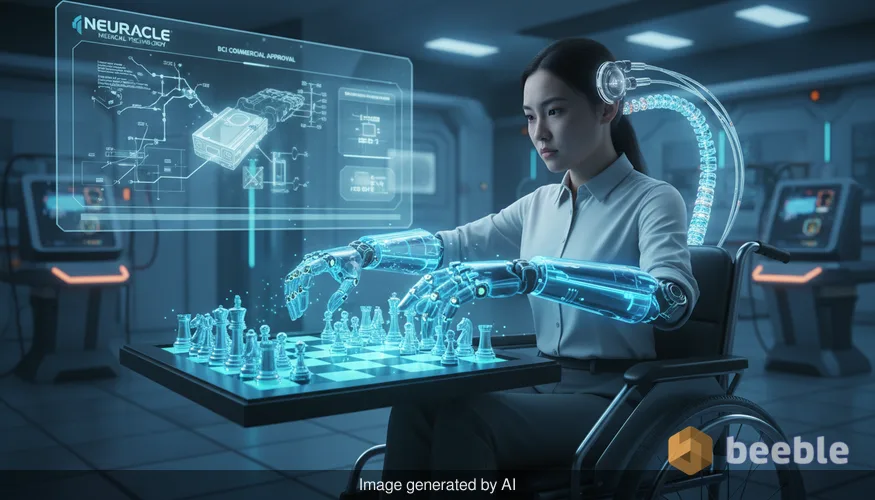
The boundary between human thought and digital action has officially blurred. In a landmark move for medical technology, China has granted the world’s first commercial authorization for a brain-computer interface (BCI) implant designed to restore hand movement in paralyzed patients. Developed by Beijing-based Neuracle Medical Technology, the device marks a transition from experimental laboratory trials to a regulated medical product available for clinical use.
While the tech world has long focused on the high-profile demonstrations of Elon Musk’s Neuralink, this regulatory milestone in China shifts the narrative. It signals that the infrastructure for neuroprosthetics is maturing, moving beyond proof-of-concept into a phase where accessibility and scalability become the primary goals.
Breaking the Silence of Paralysis
The newly approved system is specifically engineered for individuals suffering from cervical spinal cord injuries. These injuries often act as a biological 'roadblock,' preventing the brain's electrical commands from reaching the limbs. Even though the brain remains capable of generating the intent to move, the physical pathway is severed.
Neuracle’s BCI functions by bypassing this roadblock. The implant consists of a high-precision sensor array that sits on the surface of the motor cortex. When a user thinks about moving their hand, the device captures those neural firing patterns and translates them into digital signals. These signals are then transmitted to an external stimulator or a robotic glove that physically executes the movement. For a patient who has spent years unable to perform basic tasks, the ability to grasp a cup or type on a keyboard via thought alone is nothing short of life-changing.
A Tale of Two Approaches: Neuracle vs. Neuralink
The timing of this approval coincides with a surge in activity from Neuralink. As of early 2026, Elon Musk has signaled that his company is moving toward high-volume production of its own BCI devices. However, the two companies represent slightly different philosophies in the neurotech space.
Neuralink has focused heavily on high-bandwidth, fully invasive procedures using robotic 'sewing machines' to insert flexible electrode threads deep into the brain. This approach aims for massive data throughput, potentially allowing for more complex interactions. In contrast, Neuracle’s commercialized version utilizes a more established electrocorticography (ECoG) approach, which offers a balance between signal clarity and surgical safety. By securing commercial approval first, Neuracle has effectively set the standard for how these devices will be regulated and integrated into hospital environments.
| Feature | Neuracle Medical (Commercial) | Neuralink (Trial/Production) |
|---|---|---|
| Primary Goal | Restoring motor function (Hand) | General human-AI interface/Paralysis |
| Invasiveness | Semi-invasive (Surface of cortex) | Highly invasive (Deep tissue threads) |
| Regulatory Status | Approved for commercial use (China) | Clinical trials / High-volume prep |
| Target User | Spinal cord injury patients | Broad neurological applications |
The Technical Hurdle: Signal Translation
One of the greatest challenges in BCI technology is 'noise.' The brain is a chaotic environment of electrical activity. To make a prosthetic hand move naturally, the system must distinguish the specific 'intent to grasp' from the background noise of other thoughts and biological functions.
Neuracle utilizes advanced machine learning algorithms to calibrate the device to each specific user. During the initial setup, the patient visualizes specific movements while the system maps their unique neural signatures. Over time, the software becomes more adept at predicting the user’s intent, reducing the cognitive load required to operate the device. It is less like learning to use a tool and more like physical therapy for the mind.
Safety, Ethics, and the Road Ahead
Commercialization brings a new set of responsibilities. Unlike a smartphone, a brain implant cannot be easily 'uninstalled' or updated with a simple software patch if the hardware fails. The National Medical Products Administration (NMPA) in China required extensive longitudinal data to ensure the implant’s biocompatibility—meaning the body’s immune system won't reject the device over time.
There are also significant ethical considerations regarding data privacy. Because BCIs interpret neural activity, the data they collect is the most intimate form of information a human can produce. As these devices move into the commercial sector, the industry must establish rigorous protocols for 'neural privacy' to ensure that a user’s thoughts remain their own.
Practical Takeaways for the Tech Sector
For healthcare providers and tech investors, this approval is a signal that the 'Neural Turn' is here. Here is what to watch for in the coming months:
- Hospital Integration: Look for specialized neuro-rehabilitation centers to begin adopting BCI-assisted therapy as a standard of care.
- Component Miniaturization: The next stage of development will focus on making external hardware (like signal processors) smaller and more energy-efficient.
- Regulatory Precedents: Other nations, including the US (FDA) and EU (EMA), will likely use the Chinese commercial rollout as a case study for their own approval frameworks.
- Insurance and Access: The primary hurdle now shifts from 'can we build it?' to 'who will pay for it?' The inclusion of BCI procedures in medical insurance will be the next major milestone for widespread adoption.
This commercial authorization marks the end of the beginning for brain-computer interfaces. We are moving away from the era of science fiction and into an era of medical utility, where the primary focus is no longer just the 'cool factor' of the tech, but the tangible restoration of human autonomy.
Sources
- Neuracle Medical Technology Official Product Documentation
- National Medical Products Administration (NMPA) Regulatory Filings
- Neuralink Progress Updates and 2026 Production Roadmap
- Journal of Neural Engineering: Clinical Applications of ECoG-based BCIs



See you on the other side.
Our end-to-end encrypted email and cloud storage solution provides the most powerful means of secure data exchange, ensuring the safety and privacy of your data.
/ Create a free account
