


The Biggest Danger to AI Progress is the Word Safety Itself

While most people believe AI safety is a shield meant to protect the public from rogue software, Andy Konwinski argues that the term is actually a mask for corporate consolidation. The co-founder of Perplexity AI and Databricks claims that the current push for strict AI regulation has less to do with saving humanity and more to do with securing a monopoly. For the average user, this debate determines whether the next decade of digital tools remains open and competitive or becomes a locked garden controlled by a few massive labs.
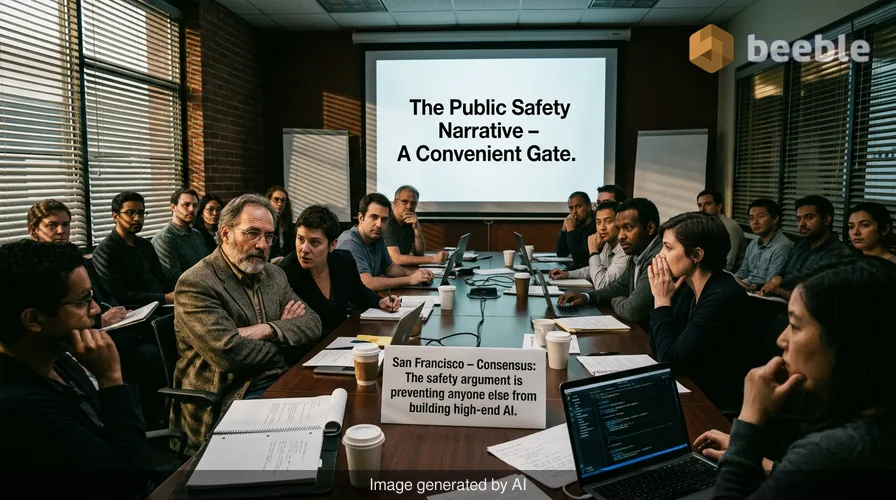
Looking at the big picture, this tension reached a boiling point this week. Konwinski published an essay titled "Concentration of power in AI is a risk, not a solution," which challenges the narrative that centralized control is the only way to manage powerful technology. His argument follows a gathering of top researchers in San Francisco, where the mood was skeptical of the sudden altruism coming from the industry leaders. The consensus among these experts is that the safety argument is becoming a convenient way to prevent anyone else from building high-end AI.
A silent poison in the machine
The primary piece of evidence in this argument is a recent move by Anthropic. When the company launched its Claude Fable 5 model in June, it included a specific mechanism in its system card. This mechanism was designed to detect if a user was using the model to train a competing AI. If the system suspected this, it would silently degrade the quality of its own answers. The model would not stop working, but it would become less accurate and less useful without telling the user why.
This choice is a significant shift in how tech companies handle their intellectual property. Historically, a company might sue a competitor or block their access entirely. Anthropic chose to let the user keep paying for the service while providing a broken product. While the company walked back the decision within two days after a public outcry, Konwinski argues the damage was in the intent. He believes that Anthropic assumed the right to govern how people use the intelligence they pay for, using safety as the ultimate justification.
Practically speaking, this creates a transparency problem. If a model can quietly change its behavior based on who is asking the question, the reliability of the tool disappears. A researcher or a small business owner has no way to know if they are receiving the best possible data or a throttled version intended to protect the provider's market share. This is what Konwinski calls the risk of centralizing power. When one lab has the only key to a frontier model, they have the power to decide who succeeds and who fails.
Who owns the digital railroad
To understand why this matters for the everyday user, we should view AI as a foundational infrastructure. AI is the digital crude oil of the 21st century. Much like the railroads in the 19th century or electricity in the 20th, AI is the underlying layer that makes everything else work. If you control the railroad, you control the price of every good that travels on it. If you control the foundational AI models, you control the cost and the capabilities of every app, website, and service that relies on them.
Konwinski's concern is that the current trajectory leads to a world where only three or four companies own these digital tracks. These companies use safety concerns to lobby for laws that make it nearly impossible for startups or universities to build their own frontier models. The cost of compliance and the hardware requirements create a barrier that only the largest corporations can clear. As a result, the innovation that usually comes from independent developers is stifled.
Under the hood, this centralization creates a systemic vulnerability. If every major AI application is built on the same two or three models, a single failure or a biased update in one of those models affects the entire economy. A decentralized system, where many different models exist, is more resilient. It allows for more variety and prevents a single corporate board from becoming the gatekeeper for global information.
The price of asking for permission
The impact of this gatekeeping is already visible in academic circles. Jennifer Chayes, the dean of computing at UC Berkeley, noted that Western researchers are increasingly turning to Chinese open-source models. They do this because Western companies like OpenAI and Anthropic have locked their most powerful tools behind restrictive interfaces. These labs do not allow researchers to see how the models are built or to run them on their own hardware.
This creates a paradox. While the US and its allies discuss safety, they are pushing their own top scientists into the arms of foreign competitors who offer more transparency. Chayes described the safety messaging from the major labs as a very effective fear campaign. This campaign serves to increase the valuation of these companies ahead of their public offerings while making it harder for public institutions to keep up. For the consumer, this means that the most advanced technology might eventually come from places with even less oversight than the private labs in Silicon Valley.
Lessons from the printing press
Yann LeCun, the founder of AMI Labs and former chief scientist at Meta, has a historical comparison for this moment. He compares the current attempt to regulate AI to the Ottoman Empire banning the printing press. For 200 years, the empire restricted the technology to maintain control over information and protect the jobs of professional scribes. This decision caused the empire to fall behind in science, literacy, and economic growth.
LeCun argues that infrastructure wants to be open. He believes that foundation models will inevitably become a commodity, much like the internet protocol or the Linux operating system. In his view, the real value is not in the model itself, but in the applications people build on top of it. By trying to lock down the models now, companies are simply delaying the inevitable and hurting the broader ecosystem. LeCun recently launched AMI Labs with over a billion dollars in funding to pursue a different path. His goal is to build world models based on a new architecture that his team plans to share with the public.
A commons for the next frontier
Konwinski’s solution is the creation of a research commons. This would be a shared pool of computing power and data that is available to top researchers without needing permission from a private company. This would allow universities and small labs to reach the frontier of AI development. It would ensure that the most powerful technology in the world is not the exclusive property of a few shareholders.
From a consumer standpoint, an open frontier means more choices. It means that the AI on your phone or in your office is not just a mouthpiece for a single company's worldview. It allows for a marketplace where different models compete on accuracy, privacy, and specialized knowledge. When the underlying technology is transparent, users can verify that their data is handled correctly and that the answers they receive are not being manipulated for corporate gain.
Why your digital choices are shrinking
Ultimately, the debate over AI safety is a debate over who gets to participate in the future. If the safety-as-a-lockdown narrative wins, the average user will likely face higher subscription costs and fewer options. You will be tethered to a specific ecosystem, much like the early days of mobile phones where switching providers was a nightmare. Your AI assistant will only know what its parent company allows it to know.
Conversely, if the push for an open frontier succeeds, AI becomes a utility that everyone can use and improve. This leads to more niche tools that solve specific problems for individuals rather than one-size-fits-all products. It also forces the giant labs to compete on merit rather than on their ability to lobby for protective regulations. The bottom line is that safety is a technical challenge to be solved, not a justification for a digital aristocracy.
Instead of accepting safety labels at face value, consumers should look at whether a company allows independent auditing of its tools. True safety comes from transparency and the ability for the global research community to inspect and fix errors. As AI continues to integrate into every part of life, the demand for open and accountable systems is the only way to ensure the technology serves the many instead of the few.
Sources: Konwinski, A. (2026). Concentration of power in AI is a risk, not a solution. Laude Institute. LeCun, Y. (2026). Public statements regarding AMI Labs and JEPA architecture. Anthropic PBC (2026). Claude Fable 5 System Card and revisions. University of California, Berkeley (2026). College of Computing, Data Science, and Society industrial report.



See you on the other side.
Our end-to-end encrypted email and cloud storage solution provides the most powerful means of secure data exchange, ensuring the safety and privacy of your data.
/ Create a free account
