


The Birth Certificate Boundary: Why Your Boss Might Not Need Your Child’s Data

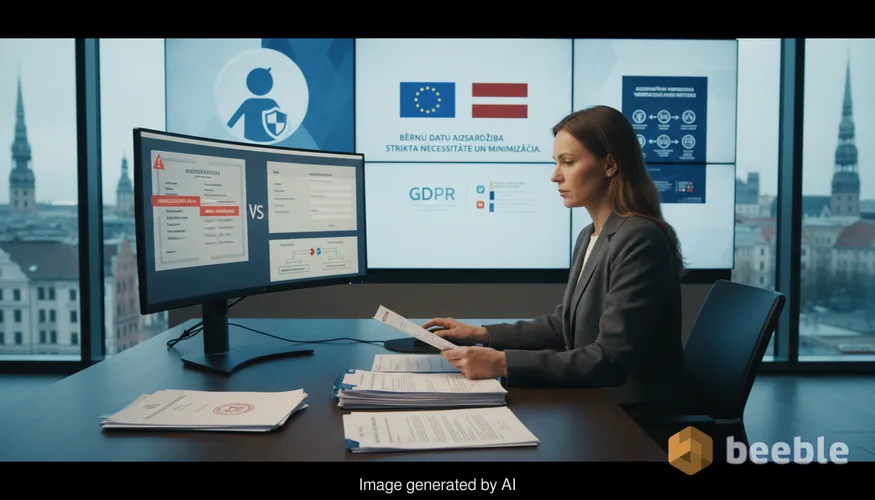
The HR Request You Never Questioned
Have you ever paused to wonder why your employer needs a full copy of your child’s birth certificate? For many of us, handing over personal documents to the Human Resources department feels like a routine part of starting a new job or claiming a benefit. We treat these papers as mere administrative keys to unlock health insurance or extra vacation days. But from my perspective as a digital detective, a birth certificate isn’t just a piece of paper; it is a dense cluster of sensitive personal data that, if mishandled, becomes a liability for everyone involved.
On March 30, 2026, the Latvian Data State Inspectorate (DVI) stepped in to draw a line in the sand. They addressed a question that has long lingered in the gray areas of office culture: Is an employer actually entitled to keep a copy of your child’s birth certificate? Their answer serves as a vital reminder that in the age of the GDPR, "just in case" is no longer a valid legal strategy.
Data as a Toxic Asset
In my years investigating data breaches, I’ve learned to view personal information through a specific lens: data is like uranium. It is incredibly valuable when used correctly to power systems, but it is a toxic asset if it leaks. The more information an employer collects—especially information about minors who are considered a vulnerable group—the higher the stakes become if their servers are compromised.
When an employer asks for a birth certificate, they are acting as a Data Controller. This is simply a legal term for the person or organization that decides why and how your personal data is processed. The DVI’s recent clarification reinforces that being a Data Controller doesn't give a company carte blanche to collect everything. Instead, they must navigate the regulatory landscape using a compass built on two fundamental principles: necessity and data minimization.
The DVI’s Clarification: A Shift in Perspective
The DVI’s guidance is nuanced but firm. They acknowledge that while a birth certificate contains personal data protected by law, an employer’s right to see it is strictly limited. The core of their argument rests on the idea that an employer may only request data that is absolutely necessary for a specific, lawful purpose.
Curiously, the DVI pointed out that in the vast majority of employment scenarios, keeping a full copy of a birth certificate is simply not necessary. If an employee needs to prove they have a child to qualify for a statutory benefit—such as additional leave—the employer’s goal is verification, not documentation storage. Consequently, once the fact is verified, the need to hold onto a photocopy of that sensitive document often evaporates.
The Principle of Data Minimization
To put it another way, the DVI is advocating for the principle of data minimization. This is the practice of ensuring that only the minimum amount of data required to achieve a goal is collected. Think of it like a security clearance: if you only need to know someone’s age to let them into a movie, you don’t need to see their entire medical history and home address.
A child’s birth certificate contains more than just a name and a date of birth. It often includes the parents' personal ID codes, places of birth, and other granular details that have nothing to do with an employment contract. By requesting a full copy, an employer is essentially over-collecting. In a regulatory context, this is considered non-compliant and creates an unnecessary privacy risk for the child.
Finding Less Intrusive Paths
When I consult with companies on their privacy-preserving practices, I always ask: "Is there a way to get what you need without taking what you don't?" The DVI suggests exactly this. If an employer must verify information about an employee's child, they should look for the least intrusive means possible.
In practice, this might mean:
- Visual Inspection: An HR manager looks at the original birth certificate to verify the details and then makes a simple note in the file that the verification occurred, without making a copy.
- Partial Extracts: Requesting a document that only shows the specific information needed (like the relationship between parent and child) rather than the full certificate.
- Self-Certification: In some cases, a signed declaration from the employee may be sufficient, backed by the knowledge that providing false information has disciplinary consequences.
The Meticulous Editor’s View
In my own work, I apply a strict "digital hygiene" principle. When I receive a leak or a set of documents for an investigation, the first thing I do is redact anything that isn't essential to the story. If I’m writing about a corporate policy, I don’t need the CEO’s home address. This same meticulous approach should be the standard for HR departments.
Ultimately, the DVI’s guidance isn't about making life harder for businesses; it’s about building a robust foundation of trust. When an employee knows their employer respects their family’s privacy and only asks for what is strictly required, it fosters a much healthier professional relationship. Privacy is a fundamental human right, not just a compliance checkbox to be ticked off and forgotten.
Practical Takeaways for the Modern Workplace
Whether you are an employer trying to stay compliant or an employee looking to protect your family’s data, here is how to navigate this clarification:
For Employers:
- Audit Your Files: Review your current employee records. If you are storing copies of birth certificates, ask if there is a specific statutory requirement for you to keep them. If not, consider securely destroying them after noting that verification was completed.
- Update Policies: Ensure your privacy policy is transparent about what documents are required and why.
- Train HR Staff: Make sure those handling sensitive documents understand the difference between "verifying" and "storing."
For Employees:
- Ask Why: If asked for a copy of a birth certificate, politely ask what specific purpose it serves and if a visual inspection would suffice instead.
- Offer Alternatives: Suggest providing an extract or allowing the employer to view the document without scanning it into their system.
- Know Your Rights: Remember that under the GDPR, you have the right to be informed about how your data is used and to object to processing that isn't legally justified.
Sources
- General Data Protection Regulation (GDPR), Article 5 (Principles relating to processing of personal data).
- General Data Protection Regulation (GDPR), Article 6 (Lawfulness of processing).
- Latvian Data State Inspectorate (DVI) Official Clarification, published March 30, 2026.
- Latvian Labour Law regarding employee benefits and documentation.
Disclaimer: This article is provided for informational and journalistic purposes only. It does not constitute formal legal advice. If you have specific concerns regarding employment law or data protection in Latvia, please consult with a qualified legal professional.



See you on the other side.
Our end-to-end encrypted email and cloud storage solution provides the most powerful means of secure data exchange, ensuring the safety and privacy of your data.
/ Create a free account
