


The Day the Algorithm Got a Job: What Singapore’s AI Agent Sandbox Reveals About Our Automated Future

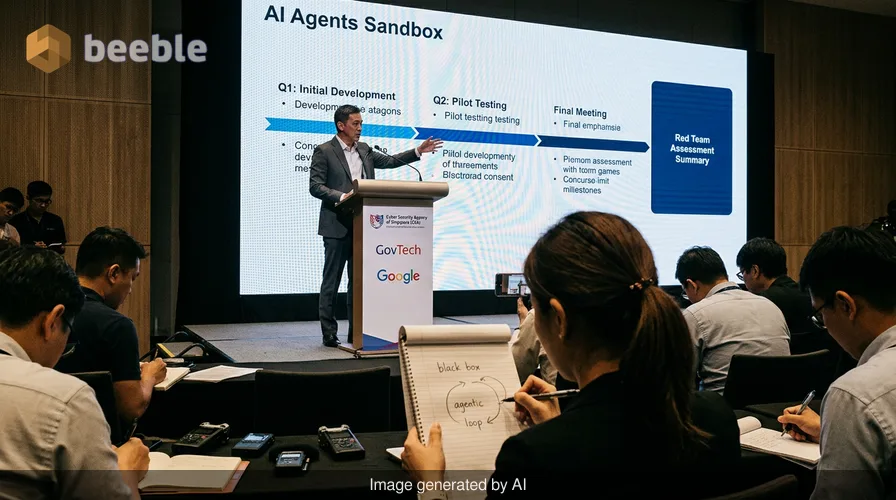
By early 2026, data scientists estimated that nearly 40% of routine administrative tasks in digitally advanced governments were being mediated by some form of artificial intelligence. Yet, until recently, most of this interaction remained conversational—users chatting with a bot to find a form. On May 20, 2026, the landscape shifted significantly. The Singapore Government and Google released the findings from a global-first 'AI Agents Sandbox,' an initiative that moved beyond simple chatbots and into the territory of 'agentic' AI systems: software that doesn't just talk, but actually acts.
Over four months, starting in August 2025, the Cyber Security Agency of Singapore (CSA), GovTech, and the Infocomm Media Development Authority (IMDA) collaborated with Google to see what happens when AI is given the keys to the office. As a journalist who spends my days dissecting the fine print of privacy policies and investigating the 'black box' of algorithmic decision-making, I find the results of this sandbox both illuminating and a necessary reality check for the private sector.
The Rise of the Digital Concierge
To understand why this sandbox matters, we must first define the 'agent.' Unlike a standard Large Language Model (LLM) that generates text based on a prompt, an AI agent is designed to achieve a goal by interacting with other software. If an LLM is an encyclopedia, an AI agent is a digital concierge. It can navigate a website, fill out a form, query a database, and click buttons just like a human user would.
In the Singaporean context, the sandbox focused on 'computer-use' agents. These systems were tested in high-stakes environments, such as social assistance applications and automated quality assurance. Imagine a system that doesn't just tell a citizen which welfare grants they are eligible for, but actually navigates the application portal on their behalf, cross-referencing their data with government records in real-time. The potential for efficiency is staggering; the potential for systemic error is equally profound.
Where Autonomy Meets Privacy
From a compliance standpoint, the leap from 'text generation' to 'taking action' introduces a patchwork quilt of regulatory challenges. During my years investigating data breaches, I’ve learned that the more 'agentic' a system becomes, the more 'opaque' its decision-making path often grows. The sandbox findings highlighted four primary areas of concern: human oversight, customization, cybersecurity, and—most critically—data protection.
In a regulatory context, the primary risk with agentic AI is the loss of the 'human-in-the-loop.' When an AI agent makes a mistake in a social assistance application, the consequences aren't just a typo; they are a denied benefit for a vulnerable family. The sandbox participants realized that we cannot treat AI agents as 'set and forget' tools. Instead, they require what I call 'granular' oversight—a method where human supervisors can intervene at specific, high-risk decision points without bottlenecking the entire process.
The Metaphor of the Master Key
Think of an AI agent as a master key. In the hands of a responsible building manager, it’s a tool of immense utility. But if that key is designed poorly, or if it can be easily copied or manipulated, every door in the building—every database of citizen information—becomes vulnerable.
Security-by-default was a cornerstone of the sandbox findings. Because these agents 'use' computers like humans, they are susceptible to 'prompt injection' attacks where a malicious user might trick the agent into bypassing security protocols. Curiously, the solution identified wasn't just 'better firewalls,' but 'distributed security safeguards.' This means security shouldn't just sit at the perimeter of the system; it must be baked into the agent’s own logic and the environment it operates in. To put it another way, the 'master key' needs to be biometric and only work on specific floors at specific times.
Data Protection: Beyond the Terms of Service
Privacy-preserving technologies were a major focus of the collaboration between IMDA and Google. When an agent moves data between different government departments to complete a task, it risks creating a trail of digital breadcrumbs that could be exploited. The sandbox findings suggest that organizations must adopt a 'robust' approach to data minimization—only giving the agent the absolute minimum amount of information required to complete the specific task at hand.
In practice, this means moving away from the 'data as Uranium' model, where information is stored in massive, toxic piles. Instead, the sandbox tested 'pseudonymous' processing, where the agent acts on data that has been stripped of direct identifiers. As a journalist who advocates for the right to be forgotten, I find this particularly heartening. If the agent doesn't 'know' exactly who you are, it cannot accidentally leak your identity during a malfunction.
The Blueprint for a Responsible Rollout
Ultimately, the Singapore-Google sandbox provides an actionable blueprint for any organization looking to deploy AI. It isn't enough to have a 'privacy policy' buried in a labyrinth of legalese. True compliance is an ongoing, systemic process.
One of the most nuanced takeaways from the report was the need for 'risk-based' oversight. Not all tasks are created equal. An AI agent sorting internal emails requires less supervision than an agent processing medical records or financial transactions. Consequently, the level of human control must be proportionate to the potential harm of a mistake.
Lessons for the C-Suite and the Citizen
For businesses watching this space, the lesson is clear: do not rush the deployment of agentic AI. The 'move fast and break things' era of tech is a precarious foundation for tools that hold such power over personal data.
Instead, consider these three steps derived from the sandbox insights:
- Start in a Controlled Environment: Use a sandbox or pilot program to test how the agent behaves in edge cases before a full-scale rollout.
- Audit for Agency: Clearly define what the AI is allowed to do and, more importantly, what it is forbidden from doing. Does the agent really need 'write' access to your main database?
- Implement Distributed Safeguards: Don’t rely on a single point of failure. Use a combination of user-level permissions, system-level monitoring, and AI-specific safety filters.
As I wrap up my analysis of these findings, I’m reminded of why I chose this beat. Technology moves at the speed of light, but our fundamental human rights—privacy, dignity, and fairness—must remain the anchor. The Singapore AI Agents Sandbox isn't just a technical achievement; it is a signal that the future of automation must be built on a foundation of transparency and accountability.
Key Takeaways for Organizations
- Human-Centric Design: Maintain a 'human-in-the-loop' for high-impact decisions to ensure accountability.
- Security by Default: Treat AI agents as high-privilege users and apply stringent cybersecurity controls accordingly.
- Data Minimization: Use privacy-preserving techniques to ensure agents only access the data necessary for their specific function.
- Continuous Monitoring: AI behavior can drift over time; regular audits are essential to ensure the system remains compliant and safe.
Sources:
- Infocomm Media Development Authority (IMDA) - AI Verify Foundation Guidelines.
- Personal Data Protection Act (PDPA) 2012, Singapore.
- Cyber Security Agency of Singapore (CSA) - Guidelines on Securing AI Systems.
- Google Cloud - Responsible AI Practices and Agentic Safety Frameworks.
Disclaimer: This article is for informational and journalistic purposes only and does not constitute formal legal advice. AI regulations are rapidly evolving; readers should consult with legal counsel for specific compliance requirements in their jurisdiction.



See you on the other side.
Our end-to-end encrypted email and cloud storage solution provides the most powerful means of secure data exchange, ensuring the safety and privacy of your data.
/ Create a free account
