


The digital iron curtain is falling on your favorite coding tools

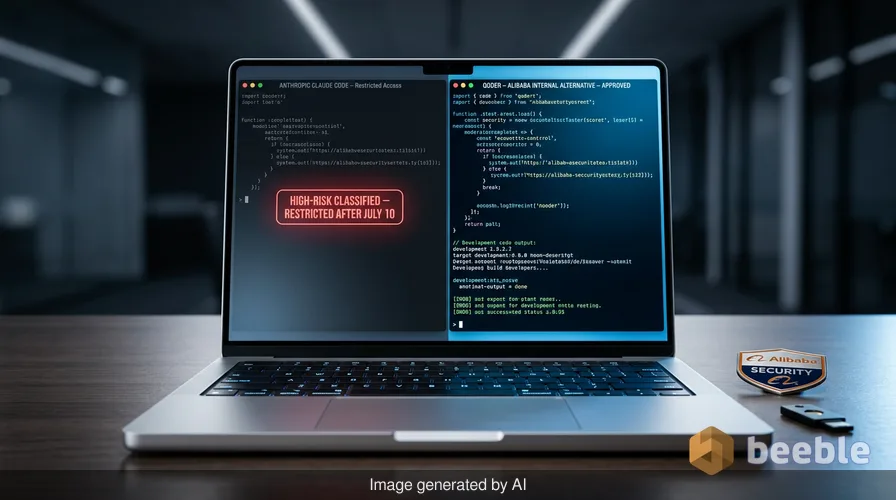
While the tech world often describes artificial intelligence as a borderless utility, the reality is a hardening of digital borders. Many developers believe that the best tools are available to anyone with an internet connection. Recent events at Alibaba prove that this era of open access is ending. The Chinese e-commerce giant will ban its employees from using Anthropic’s Claude Code starting on July 10. This decision is not a simple internal policy change. It is a signal that the infrastructure of software development is splitting into two separate, incompatible worlds.
Alibaba has officially classified Claude Code as high-risk software. This label usually applies to programs that might leak trade secrets or introduce security vulnerabilities. By telling staff to abandon the tool, Alibaba is moving to protect its intellectual property from external eyes. The company is now pushing its own internal alternative, a tool called Qoder. This shift suggests that the days of using a universal set of digital assistants are over for professional engineers in major markets.
Why Alibaba is pulling the plug on Claude
The friction between Chinese tech firms and American AI labs is growing. Anthropic already has a strict policy that prohibits Chinese companies and their foreign subsidiaries from using its models. These rules are part of a broader trend of export controls and safety protocols designed to keep advanced AI models within specific geographic boundaries. However, rules on paper are often different from reality on the ground. For months, users in restricted regions have used virtual private networks and third-party resellers to bypass these blocks.
Anthropic is now actively hunting for these loopholes. In a recent disclosure, the company admitted to running an experiment that could identify Chinese users who were accessing the tool through unauthorized channels. Thariq Shihipar, a representative from Anthropic, stated on X that the experiment began in March. Its goal was to prevent account abuse from resellers and to stop a practice known as distillation. When a company uses distillation, it takes the answers from a high-end AI and uses them to train its own cheaper model. It is essentially a way to copy the homework of a more expensive competitor at a fraction of the cost.
For Alibaba, the risk is twofold. First, there is the danger that their proprietary code could end up in Anthropic’s training data. Second, there is the risk of being caught in a game of digital cat-and-mouse. If a developer builds a workflow around a tool that could be cut off at any moment, the productivity loss is massive. Alibaba is choosing to build its own walls rather than wait for Anthropic to shut the door.
The secret experiment that exposed the loopholes
The method Anthropic used to catch unauthorized users has caused a stir in the developer community. According to reports and social media discussions, a version of Claude Code contained hidden checks to verify the origin of the user. This is a common tactic in cybersecurity, but it feels like a betrayal to developers who view their code editors as private workspaces. Anthropic claims these mitigations are now stronger and that the specific experimental code is being removed.
Behind the jargon, this is a story about digital fingerprinting. Every time a tool connects to a server, it carries a signature. Anthropic used these signatures to map out which users were likely connecting from China despite their use of proxy servers. This level of scrutiny shows how valuable these AI models are. They are the new digital crude oil, and companies are willing to monitor their users closely to ensure that this resource does not end up in the hands of rivals.
For the average user, this means your tools are no longer passive. They are active participants in corporate and national competition. The software you use to write an app or manage a database is now looking back at you to confirm you are allowed to be there. This adds a layer of complexity to tech jobs that used to be purely about logic and syntax.
Guarding the digital furnace from distillation
To understand why these companies are so protective, you have to look at how AI is built. Training a model like Claude costs hundreds of millions of dollars in electricity and hardware. Distillation is a shortcut that lets a competitor bypass those costs. If a developer at Alibaba uses Claude to solve a complex architectural problem, the resulting code could be used to improve Alibaba’s own AI, Qwen.
Essentially, Alibaba would be using Anthropic’s R&D to fuel its own growth. Anthropic sees this as a form of intellectual theft. Conversely, Alibaba sees the use of external tools as a security leak that could expose their internal systems to American sensors. Both sides are treating AI as a tireless intern that might also be a double agent.
Looking at the big picture, this is a massive change in how industry works. In the past, a hammer was just a hammer, regardless of who made it or where it was used. Today, the tools of production are intelligent and connected. They have allegiances. If you use a tool from a rival region, you are potentially giving that rival a window into your operations. Alibaba’s ban is a pragmatic response to this new reality.
The rise of sovereign coding tools
As global tech splits, we are seeing the rise of sovereign tools. Alibaba is not just banning Claude; it is promoting Qoder. This internal tool is designed specifically for Alibaba’s ecosystem. It knows the company's specific coding standards, its internal libraries, and its security protocols. By forcing employees onto Qoder, Alibaba is creating a closed loop. The data stays inside, and the improvements to the AI stay inside.
This trend will likely spread beyond China. Large banks in the US and manufacturing giants in Europe are already experimenting with their own private versions of AI assistants. They are wary of the public versions of ChatGPT or Claude for the same reasons Alibaba is. The bottom line is that the "public" AI we see today is becoming a consumer product, while the real industrial work will happen on private, locked-down systems.
For a software engineer, this means learning to be a polyglot is more important than ever. You may use one tool for your personal projects and a completely different, custom-built AI for your day job. The streamlined experience of having one great tool for everything is disappearing. Instead, we are entering a cyclical phase where every large corporation builds its own walled garden to protect its data.
What this means for your daily workflow
If you are a developer or a tech worker, the Alibaba situation is a preview of your future. The choice of which AI to use is no longer just about which one is smarter or faster. It is now a question of compliance and geography. Practically speaking, you should expect your company to implement similar restrictions if they haven't already.
| Feature | Public AI (e.g., Claude) | Corporate AI (e.g., Qoder) |
|---|---|---|
| Data Privacy | Data may be used for training | Data stays on internal servers |
| Model Logic | General purpose and broad | Customized for company code |
| Access | Subject to regional bans | Controlled by company IT |
| Cost | Subscription-based | Included in corporate overhead |
| Risk Profile | High (Potential for leaks) | Low (Controlled environment) |
From a consumer standpoint, this fractured market will lead to slower innovation in some areas. When companies cannot share the best tools, they spend time reinventing the wheel. However, it also means that the AI you use will become more specialized. A tool built by a car company will be better at writing code for engines than a general-purpose model from Silicon Valley. The trade-off for this specialization is a lack of transparency and a more complex digital life.
Ultimately, the Alibaba ban is not just about one company or one tool. It is about the end of the honeymoon phase for AI. The technology is now too powerful and too valuable to be left open. As these digital walls go up, the way we work will change. We must adapt to a world where our software has a passport and our code editors have a corporate allegiance. Observe how your own company handles AI permissions over the next few months. The shift toward private, regional tools is already underway.
Sources
- Anthropic Official Terms of Service and Usage Policy Reports
- Alibaba Group Internal Software Compliance Guidelines
- Public statements by Thariq Shihipar, Anthropic representative
- Market analysis on AI distillation and model security trends
- Technical reports on regional AI access and VPN mitigation strategies



See you on the other side.
Our end-to-end encrypted email and cloud storage solution provides the most powerful means of secure data exchange, ensuring the safety and privacy of your data.
/ Create a free account
