


The Digital Ledger of Knowledge: Latvia’s Quest for a Unified Educational Identity

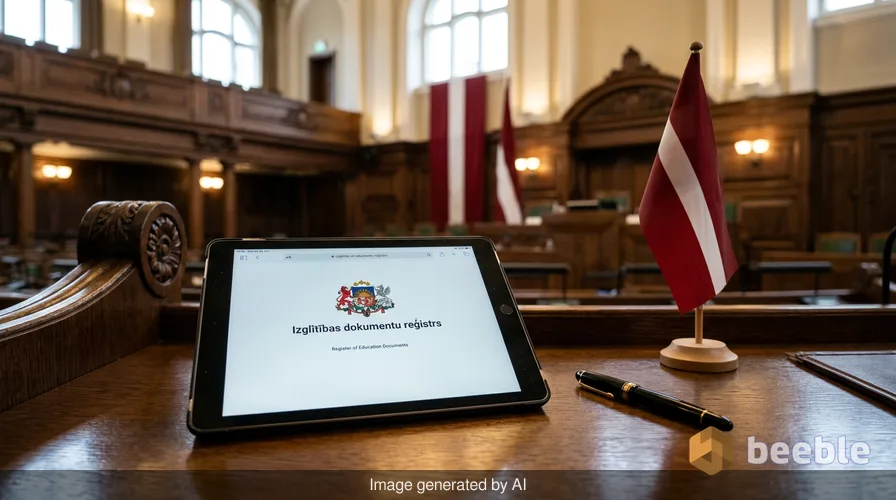
In the quiet bureaucracy of a Baltic spring, a piece of paper—once the visceral proof of a decade’s worth of study—is officially becoming an ephemeral digital record. On March 12, 2026, the Latvian Saeima adopted amendments to the Education Law that, on the surface, look like a mere administrative upgrade. Yet, for anyone who has ever spent a frantic afternoon digging through dusty folders for a primary school certificate or navigated the opaque labyrinth of municipal school applications, these changes represent a profound shift in the Latvian social fabric.
Historically, our educational achievements were anchored in the physical. We held diplomas that smelled of ink and heavy cardstock, tangible artifacts of our intellectual labor. But as of March 21, 2026, Latvia has moved toward a more transparent, systemic approach to human capital. By establishing a new national Register of State-Recognized Education Documents and a unified Application Management System, the state is not just updating its software; it is redefining how the individual interacts with the institution.
The Archaeological Site of Achievement
Linguistically speaking, the word "register" often carries a cold, clinical weight. However, through the lens of a philologist, this new Register of State-Recognized Education Documents acts as a sort of digital archaeological site. It is a repository where every layer of a citizen’s formal growth—from general basic education to professional qualification certificates—is preserved in a standardized format.
Previously, education data in Latvia was often fragmented, scattered across various local databases or locked in the physical archives of specific schools. If a school closed or a record was lost, the individual was left in a state of academic limbo. Paradoxically, in our hyper-connected era, the most important proofs of our identity remained surprisingly fragile. The new register, integrated into the State Examination Information System, ensures that a vocational secondary education diploma or a professional certificate is no longer a transient object, but a permanent, accessible data point.
Zooming Out: The End of the Application Labyrinth
On a macro level, the most significant change for families is the new Application Management System. For years, the process of enrolling a child in preschool or a vocational program was a fragmented experience, varying wildly from one municipality to another. It was a system that favored those with the time and social capital to navigate complex local rules—a classic example of how administrative friction can exacerbate social stratification.
By creating a unified service for everything from preschool to interest-education (interešu izglītība), the state is attempting to bridge these gaps. This system will handle applications for:
- Preschool and general primary education
- General and vocational secondary education
- Vocationally oriented and interest-education programs
In everyday terms, this means a parent in Daugavpils and a parent in Riga will use the same digital interface to secure their child’s future. It is an attempt to reduce the atomization of local governance, creating a more interconnected national standard for how we access the right to learn.
Liquid Modernity and the Digital Anchor
Sociologically speaking, we are living in what Zygmunt Bauman called "liquid modernity," a state where institutions, careers, and relationships are in constant flux. In such a world, the individual often feels adrift. Curiously, these new data systems act as a modern anchor. While the world around us shifts, our educational "habitus"—the collection of skills and dispositions we’ve acquired—is now codified and protected by the state.
However, this pervasive digitalization also brings a nuanced tension. As our educational history becomes more transparent to the state, it also becomes more opaque in terms of personal ownership. We no longer "possess" our diplomas in the way we once did; we are granted access to them through a portal. This shift from physical possession to digital access is symptomatic of a broader trend where our identities are increasingly stored in the cloud rather than in our homes.
Behind the Scenes of the Trend
At its core, this legislative move is a response to the attention economy and the need for efficiency. The Cabinet of Ministers now holds the responsibility of determining the categories of data, personal data processing rules, and the procedures for data exchange. This is where the structural integrity of the system will be tested. For the system to be truly resilient, it must balance the convenience of a unified portal with the visceral need for data privacy.
Ultimately, the success of these amendments won't be measured by the code itself, but by how it changes the mundane routines of Latvian citizens. Will it truly empower the marginalized student who lacks a stable home to keep track of paperwork? Will it simplify the lives of vocational teachers who are often buried under administrative burdens?
Food for Thought
As we transition into this new era of digital educational identity, it is worth reflecting on how we perceive our own growth.
- How does the shift from a physical diploma to a digital entry change your sense of accomplishment?
- In a world where the state holds a perfect record of our academic path, is there still room for the "late bloomer" or the unconventional learner whose journey doesn't fit into a standardized register?
- As we streamline applications, how can we ensure that the human element of education—the mentorship and the community—isn't lost in the pursuit of administrative efficiency?
Latvia’s new education data systems are a bold step toward a more organized future. But as we embrace this digital clarity, we must remain mindful of the messy, beautiful, and non-linear human stories that these data points represent.
Sources
- Official announcements from the Saeima of the Republic of Latvia (March 2026).
- Amendments to the Education Law of the Republic of Latvia.
- Sociological frameworks regarding "Liquid Modernity" by Zygmunt Bauman.
- General principles of the State Education Information System (VIIS) and the State Examination Information System (VIPS).



See you on the other side.
Our end-to-end encrypted email and cloud storage solution provides the most powerful means of secure data exchange, ensuring the safety and privacy of your data.
/ Create a free account
