


The Double-Edged Sword of Autonomy: Navigating the Privacy Risks of Agentic AI

The Autonomy Dilemma
Have you ever handed over the keys to your digital life to a machine and simply hoped for the best? It is a question that more organizations are asking themselves as they integrate agentic AI tools like OpenClaw into their daily operations. While the promise of a digital assistant that can autonomously manage your emails, schedule meetings, and even execute code is undeniably transformative, it also introduces a precarious set of privacy challenges.
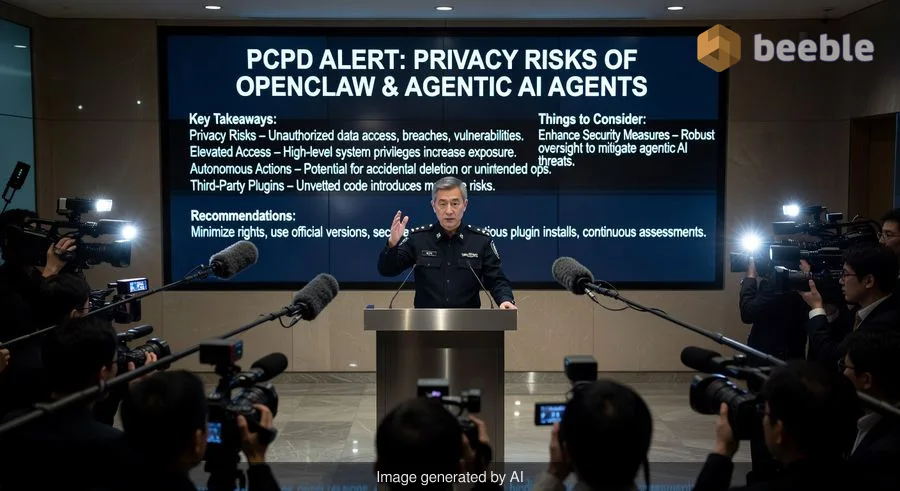
Recently, the Office of the Privacy Commissioner for Personal Data (PCPD) in Hong Kong issued a pointed alert regarding these very risks. As we move from AI that merely suggests to AI that acts, the boundary between efficiency and vulnerability begins to blur. To put it another way, we are no longer just teaching the machine to speak; we are giving it the hands to move things around in our digital house.
What Makes Agentic AI Different?
To understand the PCPD’s concern, we must first distinguish between traditional generative AI and its agentic counterparts. Most of us are familiar with the "chatbot" model: you ask a question, and the AI provides a nuanced response. Agentic AI, such as the OpenClaw framework, goes several steps further. These tools function as autonomous agents capable of planning, using tools, and executing multi-step tasks without constant human intervention.
Think of an organization as a living organism. Traditional AI acts like a sensory organ, helping the organism see or hear data more clearly. Agentic AI, however, acts like a limb. It can reach into databases, interact with third-party APIs, and modify files. Curiously, it is this very capability—the ability to act independently—that creates a significant security vacuum if not properly governed.
The PCPD’s Warning: A Deep Dive into the Risks
The PCPD’s alert highlights several intricate vulnerabilities that come with the deployment of agentic tools. Because these agents often require elevated system access to perform their duties, the potential for a data breach is magnified. If an agent has the authority to read and write to a company’s internal server, any flaw in the AI’s logic or a prompt injection attack could lead to unauthorized data exposure.
Furthermore, the autonomous nature of these tools means they can make mistakes at scale. Imagine a scenario where an agentic tool, tasked with cleaning up old files, misinterprets a command and deletes an entire directory of sensitive client information. Consequently, the risk is not just about external hackers, but about the unintended consequences of the AI’s own decision-making process.
| Feature | Traditional Generative AI | Agentic AI (e.g., OpenClaw) |
|---|---|---|
| Primary Function | Content generation and analysis | Task execution and automation |
| Human Oversight | High (Human-in-the-loop for every step) | Low (Autonomous multi-step planning) |
| System Access | Usually restricted to a sandbox | Often requires elevated/system-level access |
| Risk Profile | Primarily data leakage via prompts | Unauthorized actions and systemic breaches |
The Hidden Danger of Third-Party Plugins
In my years working with tech startups, I’ve seen how the rush to innovate often leads to a "plugin-first, security-second" mentality. We once integrated a third-party automation tool into our remote team's workflow, only to find out weeks later that a minor plugin was scraping metadata it had no business touching.
This is a central concern for the PCPD regarding OpenClaw. These frameworks often rely on unvetted third-party plugins to extend their functionality. These plugins can act as Trojan horses, introducing malicious code into a secure environment. In contrast to official software suites, the open-source ecosystem of AI agents can sometimes be a "Wild West" where security standards vary wildly between contributors.
Building a Secure AI Ecosystem
Nevertheless, the solution is not to retreat from innovation but to build more robust building blocks for our digital future. The PCPD has laid out several remarkable recommendations for organizations looking to harness agentic AI without sacrificing privacy.
First and foremost is the principle of least privilege. An AI agent should only have access to the specific data and systems required for its immediate task. If an agent is designed to summarize meeting notes, it has no business having administrative access to the HR database.
Secondly, continuous risk assessment is vital. Organizations should treat AI agents as living organisms that evolve. Regular audits of the agent’s logs and the plugins it utilizes are no longer optional—they are a necessity. As a result of these measures, companies can create a safer environment where the innovative potential of tools like OpenClaw can be realized without the looming shadow of a catastrophic data breach.
Practical Takeaways for Your Team
If you are currently managing a remote team or transitioning a corporate department toward AI automation, consider this checklist to mitigate risks:
- Use Official and Verified Versions: Avoid "forked" versions of agentic frameworks from untrusted sources. Stick to official repositories and verified builds.
- Implement Human-in-the-Loop (HITL): For high-stakes actions (like deleting data or sending external emails), require a human sign-off before the agent proceeds.
- Sandbox the Environment: Run agentic AI in isolated environments where they cannot access the broader corporate network unless absolutely necessary.
- Audit Plugin Permissions: Before installing any third-party plugin, review its source code or security certifications. If it asks for more permissions than it needs, reject it.
Moving Forward with Caution
The journey toward a fully automated workplace is an exciting one, filled with remarkable opportunities to eliminate drudgery and spark creativity. However, as the PCPD’s alert reminds us, this journey must be navigated with a nuanced understanding of the risks involved. We are the architects of this new ecosystem, and it is our responsibility to ensure that the tools we build are as secure as they are smart.
Are you ready to audit your AI permissions today? Don't wait for a breach to realize your agents have too much power. Take a moment to review your system access logs and ensure your AI strategy is built on a foundation of privacy and trust.
Sources:
- Office of the Privacy Commissioner for Personal Data, Hong Kong (PCPD) Official Press Releases.
- OpenClaw Documentation and GitHub Repository Security Guidelines.
- Hong Kong Model Ethical AI Framework for Organizations.



See you on the other side.
Our end-to-end encrypted email and cloud storage solution provides the most powerful means of secure data exchange, ensuring the safety and privacy of your data.
/ Create a free account
