


The Dual Soul of AI: Anthropic’s Massive Study Reveals Our Deepest Hopes and Fears

A Mirror Held Up to Humanity
Have you ever felt a strange sense of gratitude toward a piece of software? It is a nuanced, perhaps even precarious emotion, yet it is one that millions are beginning to navigate. As we integrate large language models into the fabric of our daily lives, we are no longer just looking at tools; we are looking at a mirror of our own needs.
Anthropic recently concluded a remarkable qualitative research project, interviewing more than 80,000 people across 159 countries. It is, by their account, the largest study of its kind. The goal was simple yet profound: to understand what humanity actually wants—and dreads—from the artificial intelligences we are building. What they discovered is a concept they call the "light and shade" problem, a duality where the very features we find most transformative are the ones that keep us up at night.
The Light: AI as an Emotional Anchor
For years, the tech industry treated AI as a productivity engine—a way to write emails faster or code more efficiently. Curiously, the study reveals that users are finding value in much more intricate, human spaces. Respondents described using AI for emotional support during some of the most harrowing moments of their lives, including the loss of a parent or the displacement caused by war.
In these contexts, AI acts as a non-judgmental sounding board. To put it another way, when the human ecosystem is fractured by crisis, people are turning to silicon for the empathy they cannot find elsewhere. This innovative use of technology suggests that AI is evolving from a mere calculator into a companion. For those of us who have managed remote teams or worked in high-pressure tech startups, this resonates deeply. I recall a colleague during a difficult corporate transition who found more solace in a structured AI dialogue than in the hurried check-ins of a distracted HR department.
The Shade: The Fear of Losing Ourselves
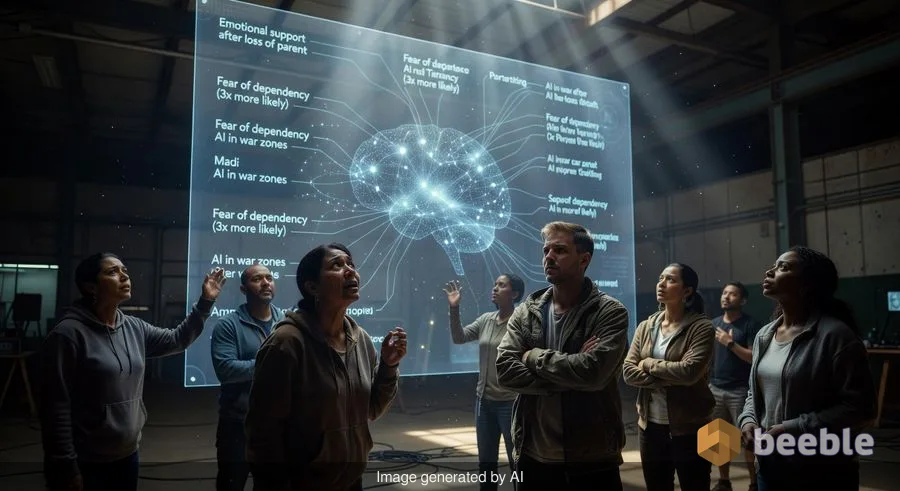
Nevertheless, this emotional utility comes with a significant shadow. The study highlights a jarring contradiction: while people value AI for emotional support, they are three times more likely to fear becoming pathologically dependent on it.
This is the heart of the "shade." We are drawn to the convenience and the perceived empathy of the machine, but we are simultaneously terrified that our human muscles for resilience and connection will atrophy. Consequently, the more we lean on these systems to navigate grief or complex social dynamics, the more we worry that we are losing the very essence of what it means to be a self-sufficient person. It is a precarious balance between empowerment and erosion.
Navigating the AI Ecosystem
If we view technology as an ecosystem, we must recognize that introducing a new species—even a helpful one—inevitably changes the landscape. The Anthropic study suggests that our relationship with AI is not a simple linear progression but a complex journey.
In contrast to the hype-filled narratives of "AI taking over the world," the reality is more intimate. The fear isn't just about a robot taking a job; it’s about a robot taking a place in our hearts and then leaving us unable to function without it. As a result, the challenge for developers like Anthropic is no longer just about safety or accuracy—it is about maintaining the dignity of the user.
Practical Takeaways: Finding the Balance
So, how do we enjoy the "light" without being consumed by the "shade"? Based on the insights from this massive global cohort, here are a few ways to approach your own AI journey:
- Audit Your Dependency: Periodically ask yourself if you are using AI to solve a problem or to avoid a difficult human interaction. Use it as a bridge, not a destination.
- Maintain Human Loops: In professional settings, especially within remote teams, ensure that AI-generated summaries or advice are always vetted through a human lens to preserve cultural nuance.
- Set Boundaries for Grief: While AI can help process thoughts, ensure it doesn't replace the communal rituals of mourning and support that have sustained humans for millennia.
- Advocate for Transparency: Support platforms that are open about how their models are trained to handle sensitive emotional data.
The Path Forward
The Anthropic study is a sobering reminder that as we build these living organisms of code, we are also redesigning the human experience. We are standing at a crossroads where our innovative spirit meets our most basic vulnerabilities.
Ultimately, the "light and shade" of AI is a reflection of our own complexity. We want to be understood, but we also want to be free. As we move forward, the goal should not be to eliminate the shade, but to ensure that the light we create is one we can live with sustainably.
Sources:
- Anthropic Official Research Blog (March 2026)
- Global AI Sentiment Report: Qualitative Analysis of 159 Nations
- TechJournalist Collective: The Ethics of Emotional AI



See you on the other side.
Our end-to-end encrypted email and cloud storage solution provides the most powerful means of secure data exchange, ensuring the safety and privacy of your data.
/ Create a free account
