


The Economic Consensus on AI Just Broke and Your Job Is the Fault Line

For years, the standard response from the ivory tower regarding automation was a polite, academic version of "don’t worry about it." Economists pointed to history as their shield. When ATMs arrived, we didn’t lose bank tellers; they just started selling mortgages instead of counting 20-dollar bills. When Excel debuted, bookkeepers didn't vanish; they became financial analysts. The narrative was foundational: technology augments human labor; it doesn't replace it.
While this story was comforting, it is increasingly looking like a relic of a simpler era. A disruptive new study—a collaborative effort between the Federal Reserve Bank of Chicago, the Forecasting Research Institute, Yale, Stanford, and the University of Pennsylvania—suggests the experts are finally changing their minds. After surveying 69 economists, 52 AI specialists, and 38 professional superforecasters, the consensus has cracked. The experts now admit that if AI continues its current trajectory, we aren't just looking at a shift in how we work—we are looking at a future with significantly fewer people working at all.
The End of the "Augmentation" Era
To understand why this shift matters, we have to look at the "Rapid Scenario" outlined in the research. This isn't a far-off sci-fi fantasy; it’s a world where AI surpasses human performance in most cognitive and physical tasks by 2030. Looking at the big picture, we are talking about a tireless intern that doesn't just fetch coffee and organize spreadsheets but eventually learns to negotiate the contracts, write the code, and manage the supply chain better than the CEO.
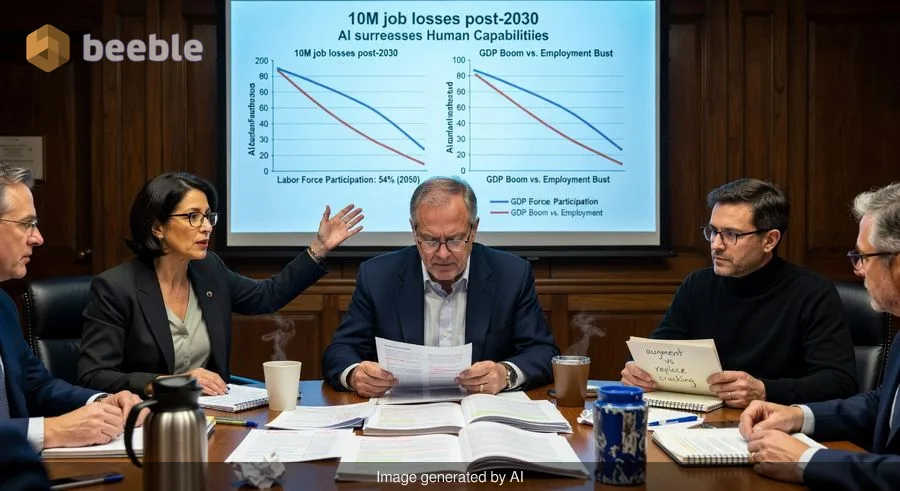
Historically, technology replaced muscle (the steam engine) or rote calculation (the computer). But AI is different because it targets the very thing that made humans unique in the labor market: our ability to reason, communicate, and adapt. In simple terms, when the tool becomes smarter than the person using it, the person becomes the bottleneck. The study suggests that under this rapid progress, the U.S. labor force participation rate could plummet from 62% today to just 54% by 2050.
Mapping the Disruption
What does a 10-million-job loss look like in everyday life? It isn't just robots in a factory. The researchers highlight that the most vulnerable roles are those we once thought were "AI-proof." Practically speaking, this includes freelance software engineers, paralegals, and customer service agents.
| Sector | Current Role of AI | The "Rapid Scenario" Impact (2030-2050) |
|---|---|---|
| Legal Services | Document review and searching | Drafting full contracts and predicting trial outcomes |
| Software | Copilots and bug fixing | End-to-end system architecture and autonomous coding |
| Creative/Gig | Generating ideas or drafts | Full-scale production of marketing, copy, and design |
| Logistics | Route optimization | Autonomous fleet management and warehouse robotics |
Behind the jargon of "labor force participation," there is a systemic shift in how value is created. If an AI can assist in a factory or a home as effectively as a human, the traditional incentive for a company to hire a person evaporates. This isn't a slow leak in a tire; it’s a fundamental change in the vehicle’s engine.
The GDP Paradox: Wealth Without Workers
Curiously, the study presents a bizarre contradiction. While jobs might vanish, the economy itself is expected to scream forward. Under the rapid AI scenario, economists project annual GDP growth could hit 3.5% by the late 2040s—levels of prosperity we haven't seen since the post-WWII boom. AI experts are even more bullish, predicting growth as high as 5.3%.
On the market side, this creates a massive wealth engine. However, the problem is where that wealth goes. The researchers warn that under rapid AI development, the wealthiest 10% of households could hold 80% of total wealth by 2050. This would result in an inequality gap wider than what was seen before World War II. Essentially, the digital crude oil of AI creates immense value, but because it doesn't require a massive workforce to refine it, the profits stay concentrated at the top.
From a Consumer Standpoint: The "So What?" Filter
For the average user, this news can feel like a distant storm cloud, but the effects are already emerging in the shifting job market. We are seeing a volatile transition where entry-level roles are being streamlined out of existence. If you are a parent wondering what your child should study, or a professional looking to pivot, the old advice of "just learn to code" is becoming obsolete.
Ultimately, the value of human labor is moving away from processing information and toward accountability and empathy. An AI can write a legal brief, but it cannot stand in front of a judge and take responsibility for it. An AI can diagnose a disease, but it cannot sit with a patient and navigate the emotional weight of a recovery plan.
Navigating the New Economic Reality
As we move toward 2030, the takeaway isn't to panic, but to observe your digital habits and professional environment with a more analytical eye. The "tireless intern" is getting better every day. If your job consists primarily of moving data from one place to another, or summarizing information for others, you are in the crosshairs of this economic U-turn.
To put it another way, we are moving from an era where we used tools to an era where we manage systems. The most resilient individuals will be those who can bridge the gap between AI-generated output and real-world application. The bottom line is that the economic safety net of "it's just a tool" has been pulled away. We are entering an unprecedented period where the growth of the economy and the growth of the workforce are no longer linked. Shifting your perspective now—from being a "doer" to being a "decider"—is the best way to stay relevant in an increasingly automated world.
Sources:
- Federal Reserve Bank of Chicago: Economic Perspectives on AI and Labor
- Forecasting Research Institute: The 2024 AI Expert Survey
- Stanford Institute for Human-Centered AI (HAI): 2025/2026 Index Report
- University of Pennsylvania: Wharton School Analysis on AI Wealth Concentration



See you on the other side.
Our end-to-end encrypted email and cloud storage solution provides the most powerful means of secure data exchange, ensuring the safety and privacy of your data.
/ Create a free account
