


The End of the Public Persona and the Rise of the Trademarked Human

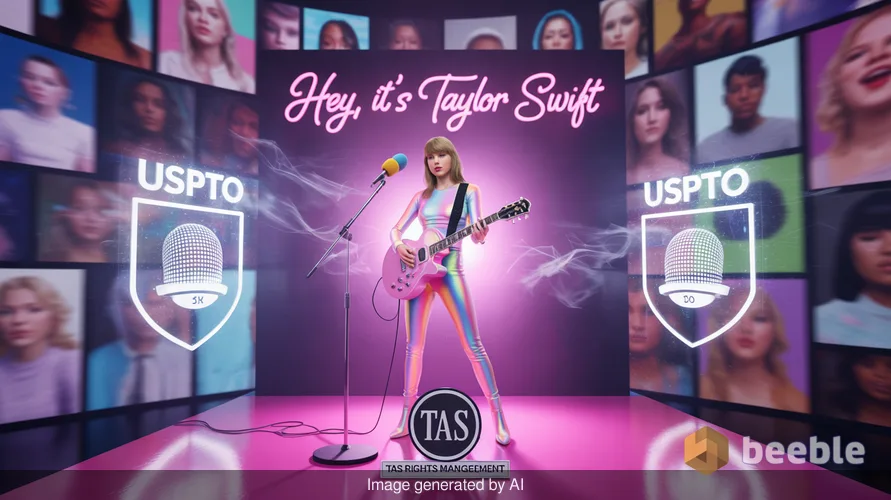
We used to view the celebrity image as a shared cultural currency, a collective shorthand for glamour, rebellion, or heartbreak that existed in the hazy space between the artist and the audience. Now, we are witnessing the transformation of the human identity into a legal fortress, a digital perimeter designed to keep the predatory nature of generative AI at bay. Behind the scenes of Taylor Swift’s latest trademark filings lies a profound shift in how we define ownership in an era where anyone with a laptop can synthesize a soul.
Historically, the battle for creative control was fought over master recordings and distribution rights. We watched as artists like Prince changed their names to symbols to escape restrictive contracts, or more recently, as Swift herself embarked on the Herculean task of re-recording her entire discography to reclaim her narrative. But as we move deeper into 2026, the battlefield has moved from the studio to the very essence of the artist's being: their voice, their posture, and their specific visual aesthetic.
The Architectural Foundation of Identity
When news broke that TAS Rights Management filed trademarks for the phrases "Hey, it’s Taylor Swift" and "Hey, it’s Taylor," alongside a hyper-specific visual description of a pink-guitar-wielding Eras Tour silhouette, it felt like a tactical maneuver in a high-stakes game of digital chess. In everyday terms, it is the equivalent of a homeowner installing a state-of-the-art security system not because they expect a burglary today, but because the neighborhood has become increasingly unpredictable.
Swift isn’t merely protecting a catchphrase; she is protecting a frequency. Paradoxically, the more ubiquitous an artist becomes, the more fragmented their identity feels. In the age of "deepfake" covers where a synthetic Swift might be heard singing a song she never wrote, or endorsing a product she never used, the "Hey, it’s Taylor" greeting acts as a digital watermark. It is an attempt to create a streamlined path for the audience to distinguish the resonant truth from the derivative noise.
Following the McConaughey Blueprint
Swift’s move follows a path recently cleared by Matthew McConaughey. Earlier this year, the Interstellar star sought to trademark his signature "alright, alright, alright" drawl. At its core, McConaughey’s strategy was an emotional autopsy of the modern fan experience. He recognized that in a world of infinite digital buffets, the only thing that retains value is authenticity.
McConaughey’s team noted that they wanted to ensure that when his voice is used, it is because he signed off on it. We used to accept that a celebrity’s voice was a part of the public atmosphere. Now, we must treat that voice as a proprietary software. This shift is a direct response to the clunky, often opaque nature of AI training models that ingest human creativity without consent. By filing these trademarks, these stars are essentially creating a "No Trespassing" sign that the law is finally beginning to recognize.
The Illusion of Choice in the AI Feed
From a creator’s standpoint, the rise of AI-generated content offers a deceptive kind of freedom. To the casual observer scrolling through a social media feed on a Tuesday night, a video of Taylor Swift seemingly performing in a local dive bar is a fun, immersive "what if" scenario. However, zooming out to the industry level, this content represents a profound disruption of the artist-audience contract.
We used to engage with media as a conversation between the creator and the consumer. Now, we are often unknowingly participating in a monologue generated by an algorithm. When a fan interacts with a synthetic version of their idol, the emotional connection is hollowed out. Swift’s iridescent bodysuit and pink guitar—elements described in her trademark filing—are not just fashion choices; they are the pillars of a multi-billion-dollar brand architecture. If those pillars are allowed to be replicated and distorted at scale, the entire structure of the modern music industry risks becoming a bloated, unrecognizable mess.
The Legality of the Digital Body
| Protection Type | Traditional Use | AI-Era Application |
|---|---|---|
| Trademark | Protecting logos and brand names. | Protecting vocal inflections and specific "stage personas." |
| Copyright | Protecting specific songs or films. | Attempting to protect the "style" of an artist (ongoing legal battle). |
| Right of Publicity | Preventing unauthorized use of a face in an ad. | Preventing the creation of a 3D digital twin or vocal clone. |
| Master Recordings | Owning the physical/digital audio file. | Irrelevant if the AI can perfectly mimic the artist from scratch. |
Through this audience lens, we can see why the legal strategies are evolving. Trademark law is traditionally used to prevent consumer confusion. If I hear a voice saying "Hey, it's Taylor," and it sounds like Swift, I assume I am hearing the real person. If it’s an AI, I am being misled. Consequently, Swift is using a 20th-century legal tool to solve a 21st-century existential crisis.
The Nostalgic Value of the Human Error
There is a certain irony in the fact that as our technology becomes more seamless, our desire for the "un-seamless" grows. We used to crave the polished perfection of a studio recording. Now, we find ourselves searching for the tiny, human imperfections—the breath between lyrics, the slight crack in a high note—that prove we are listening to a person rather than a processor.
Swift’s history of taking major steps to protect her identity, from the re-recordings to this latest AI defense, suggests she understands this better than anyone. She is not just selling music; she is selling the narrative of Taylor Swift. A narrative cannot survive if it is being written by a thousand different bots simultaneously. This is why the specific description of her stage outfit matters. It’s a way of saying: This specific moment, this specific image, belongs to the woman who lived it, not the machine that analyzed it.
Reclaiming the Human Scale
Ultimately, the maneuvers made by Swift and McConaughey serve as a wake-up call for the rest of us. We are currently living through a period of franchise fatigue and content saturation where the line between real and artificial is not just blurred—it’s being erased.
As audiences, we have to decide what we value. Do we want a world of infinite, derivative content that caters to our every whim via an algorithm? Or do we want the multifaceted, sometimes difficult, always human output of actual artists? Swift’s trademarks are a reminder that even in a world of high-speed digital replication, there are some things that should remain one-of-one.
We should take this moment to observe our own media consumption. The next time you see a "perfect" celebrity video or hear a "new" song from a late legend, ask yourself who is actually behind the curtain. We used to be passive consumers of entertainment. Now, we must be active guardians of the human experience, ensuring that when we hear a voice we love, there is a heart beating behind the microphone.
Sources:
- Variety: Industry report on TAS Rights Management filings (2024-2026 archive).
- The Wall Street Journal: Interview with Matthew McConaughey on AI and identity ownership.
- U.S. Patent & Trademark Office: Public records for trademark applications (Swift, Taylor; McConaughey, Matthew).
- Recording Industry Association of America (RIAA): Data on the impact of generative AI on music revenue.



See you on the other side.
Our end-to-end encrypted email and cloud storage solution provides the most powerful means of secure data exchange, ensuring the safety and privacy of your data.
/ Create a free account
