


The Era of Boiling Water to Make Power is Finally Coming to an End

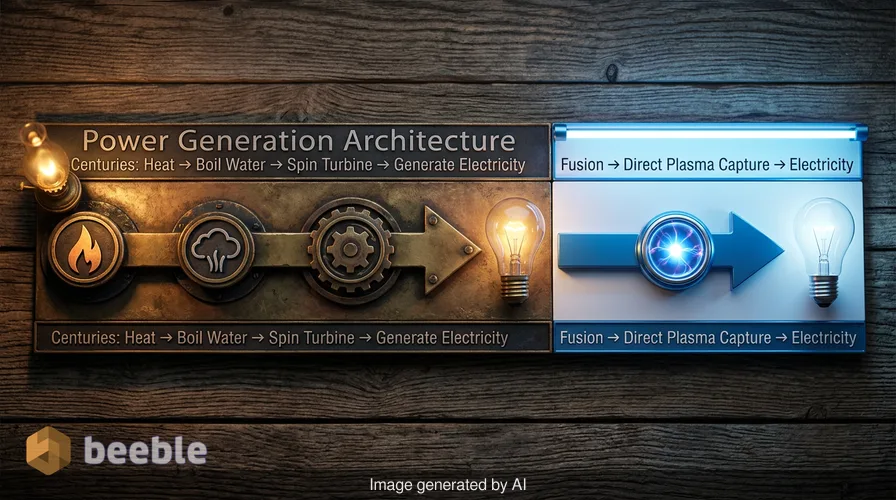
A small lightbulb glowed in a laboratory in Madison, Wisconsin, on June 19. For most people, a single illuminated bulb is a non-event. For the energy industry, this specific bulb is a sign that the fundamental architecture of the power grid is about to change. The electricity that powered that bulb did not come from a massive spinning turbine or a field of silicon panels. It came directly from a fusion reaction, skipping the centuries-old tradition of using heat to boil water.
Realta Fusion, a startup born from the University of Wisconsin-Madison, achieved what appears to be a first for a private company. They harvested electricity directly from the plasma inside their experimental reactor, known as WHAM. This method bypasses the steam cycle entirely. Looking at the big picture, this is the equivalent of moving from a complex mechanical clock to a solid-state digital watch. It removes the moving parts, the friction, and the massive energy losses that have defined power generation since the Industrial Revolution.
Why the steam engine is a dying middleman
To understand why this matters for your future utility bill, you have to look at how a standard power plant works today. Whether it is fueled by coal, natural gas, or nuclear fission, the process is roughly the same. You burn something or split an atom to create heat. That heat boils water into steam. The steam expansion spins a massive metal turbine. That turbine spins a generator, which finally creates electricity.
This process is inefficient. A typical nuclear fission plant today has an efficiency of about 33%. This means for every three units of energy the fuel creates, two units are lost as waste heat. It is a messy, mechanical workaround. Practically speaking, we have been using high-tech fuels to power low-tech teakettles for over a hundred years.
Realta Fusion is moving toward a different model. Their reactor uses a magnetic mirror design to contain a plasma of deuterium and tritium. When these atoms fuse, they release energy. About 20% of that energy is in the form of alpha particles, which are essentially helium nuclei with a positive charge. Because these particles have an electrical charge, they can be captured by a specialized converter at the end of the reactor. The converter turns the kinetic energy of those moving particles directly into a flow of electrons. There is no steam, no turbine, and very little waste.
The ninety percent efficiency advantage
Kieran Furlong, the CEO of Realta Fusion, estimates that this direct conversion process is 90% efficient. This number is a systemic shift in energy physics. If a reactor can convert 90% of its potential energy into usable power, the entire economic math of a power plant changes.
For the average user, this translates to smaller, cheaper hardware. In the current energy sector, the turbine hall is often the most expensive and largest part of a power plant. It requires massive foundations, constant maintenance, and specialized cooling systems. By eliminating the steam cycle, a fusion plant becomes a streamlined piece of industrial equipment. It is more akin to a large battery or a data center than a traditional power station.
This efficiency is also the secret to making fusion profitable. Every fusion reactor is a power-hungry beast. It takes immense amounts of energy to heat plasma to 100 million degrees and keep it contained with magnets. To reach "net gain," where the plant produces more power than it consumes, the machine must be incredibly efficient at recirculating its own energy. Furlong describes this as spinning a flywheel of electricity. By catching the alpha particles and immediately turning them back into power to heat the plasma, the reactor becomes self-sustaining with much less effort.
Inside the magnetic mirror
Under the hood, Realta’s device uses a technology called the Wisconsin High-field Axisymmetric Mirror, or WHAM. While many fusion projects use a donut-shaped reactor called a tokamak, the mirror design is a long, straight tube with powerful magnets at each end. These magnets act like a reflection point for the hot plasma, bouncing it back and forth.
Some of the particles eventually leak out of the ends of the tube. In older designs, this was a flaw. In Realta's design, this leakage is the source of the power. By placing the direct energy converter right where the particles escape, the company turns a waste stream into a revenue stream. During the June experiment, this setup produced multiple amps of electricity at 100 volts. It was just enough to power a few lightbulbs, but it proved the hardware works in a real-world setting.
This approach is tangible and scalable. While larger fusion projects like ITER in France are decades away from completion, smaller startups like Realta are building modular units. Their goal is not just to build one giant sun on earth, but to create industrial heat and power units that can sit next to a factory or a small city.
The quiet race for direct conversion
Realta is not alone in this pursuit, though they are currently the most transparent about their progress. Helion Energy, a high-profile startup backed by OpenAI’s Sam Altman, has also centered its entire business model on direct energy conversion. Helion uses a different reactor shape, but the goal is the same: use magnets to squeeze the plasma and then use the expanding magnetic field to push electricity back into the circuits.
So far, Helion has shared impressive computer simulations and partial test data, but Realta's public demonstration of a lit bulb puts a concrete win on the board for the mirror design. This competition is healthy for the industry. It moves the conversation away from "can we do fusion?" to "how cheaply can we sell fusion power?"
On the market side, this is why investors are still pouring money into the sector despite high interest rates. Realta raised $36 million in a Series A round in 2025 and is currently seeking more capital. Investors see that the first company to master direct conversion will have a massive price advantage over any other energy source on the planet. If you can build a power plant that is 90% efficient and has no fuel costs, you win the game.
What this means for your future energy bill
From a consumer standpoint, the success of direct conversion simplifies the path to cheap electricity. Traditional nuclear power is expensive largely because of the complexity of the plumbing and safety systems required for high-pressure steam. Fusion with direct conversion removes those layers of complexity.
In the long run, this means energy prices could become decoupled from the cost of raw materials. Currently, your electricity bill fluctuates based on the price of natural gas or the supply of coal. Fusion fuel is derived from water and lithium, which are abundant. The only real cost of fusion power is the cost of building the machine itself. When that machine is 90% efficient, the capital cost per megawatt drops significantly.
Essentially, we are looking at a future where energy is a fixed-cost infrastructure rather than a volatile commodity. This would be a foundational change for everything from the price of groceries to the cost of charging an electric vehicle. When energy is cheap and abundant, the cost of manufacturing and transport drops for everyone.
Moving toward a solid state grid
Ultimately, the milestone in Wisconsin is about more than just lightbulbs. It is a proof of concept for a decentralized and resilient energy grid. Direct conversion allows for smaller reactors that can be turned on and off more quickly than a massive steam turbine that takes days to heat up.
As you look at your own home and the gadgets you use, realize that almost all of them are already "solid-state." Your phone, your computer, and your LED lights don't have moving parts. The power plant, however, is a relic of the age of steam and gears. Realta Fusion is trying to bring the power source into alignment with the technology it fuels.
Observe the invisible industrial mechanics next time you flip a light switch. For now, that power likely came from a spinning metal wheel miles away. But if the results from the WHAM reactor scale as expected, the next generation will see electricity as something harvested directly from the source. This transition will likely be the most important industrial shift of the twenty-first century. It moves us away from the era of burning things to the era of capturing the fundamental forces of the universe directly.
Sources
- Official press release from Realta Fusion regarding the June 19 experiment.
- Technical specifications for the WHAM (Wisconsin High-field Axisymmetric Mirror) project.
- TechCrunch interview with CEO Kieran Furlong on Series A funding and direct conversion efficiency.
- Market analysis reports on fusion energy investment trends for 2025-2026.
- Comparative data on steam turbine efficiency vs. direct energy conversion from the Department of Energy.



See you on the other side.
Our end-to-end encrypted email and cloud storage solution provides the most powerful means of secure data exchange, ensuring the safety and privacy of your data.
/ Create a free account
