


The era of expensive AI coding agents is about to end

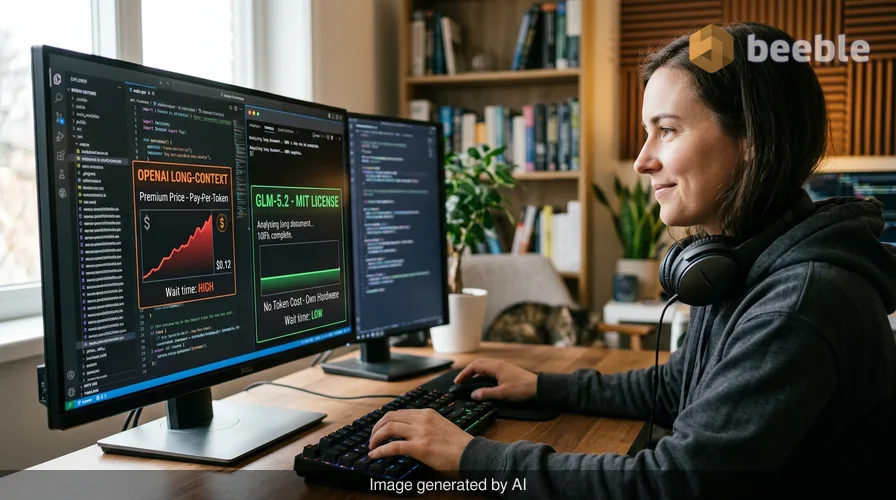
While the technology world often focuses on which AI can write the most creative poem or pass a bar exam, these benchmarks miss the practical reality of modern software development. Most professional coding happens inside massive, messy projects where a single change impacts thousands of lines of hidden code. Silicon Valley giants want you to believe that paying for a proprietary subscription is the only way to manage this complexity. Z.ai is challenging this narrative with GLM-5.2, an open-source model that targets the high cost of long-context reasoning.
Historically, developers had to choose between power and price. If you wanted an AI to understand an entire software repository, you had to pay for a top-tier model that charged a premium for every piece of information it processed. Z.ai is flipping this script. By releasing GLM-5.2 under an MIT license, the company provides a tool that matches the performance of the most expensive systems while allowing users to run it on their own terms. This shift is more than just a price war. It is a fundamental change in how engineering teams can afford to build at scale.
The architect navigating a massive blueprint library
To understand why GLM-5.2 matters, we must look at the problem of context. In AI terms, context is the amount of information a model can hold in its active memory at once. If you ask an AI to fix a bug in a single function, a small context window is fine. However, if you ask it to upgrade an entire application to a new version of a programming language, the AI must understand how every file connects to the others.
Think of a software codebase as a massive library of blueprints. A standard AI can only look at one page at a time. It forgets the front door's dimensions by the time it reaches the master bedroom. GLM-5.2 has a one million-token context window. This is the equivalent of an architect who can lay out every single blueprint for a skyscraper on a single table and see the entire structure at once. This capacity allows the AI to perform agentic coding workflows, where it acts as a tireless intern that can navigate thousands of files to find a single logical error.
Behind the jargon, the ability to process one million tokens means the AI is less likely to lose its train of thought during complex tasks. It can read through legacy codebases, legal contracts, or technical manuals that are thousands of pages long without needing to chop the text into smaller, disconnected pieces. This continuity is essential for software engineering because bugs often hide in the spaces between different modules. When an AI can see the whole picture, it makes fewer mistakes and provides more coherent solutions.
Solving the efficiency problem with IndexShare
The technical barrier to large-scale AI has always been the cost of compute. Every time an AI reads a token, it uses a specific amount of processing power. When you increase the context window to a million tokens, that cost usually explodes. Z.ai introduced a technique called IndexShare to fix this. Practically speaking, this method reduces the compute required per token by 2.9 times when the model handles its maximum capacity.
For the average user or a small business, this means the AI is not just smarter. It is faster and cheaper to operate. On the market side, high costs have prevented many companies from using AI for long-term projects like legacy modernization. If it costs hundreds of dollars in API fees to have an AI analyze an old database system, most managers will stick with human labor. By lowering the compute floor, GLM-5.2 makes these complex projects financially viable for the first time.
Another update involves speculative decoding. This is a process where the AI predicts multiple possible next steps in a sequence and verifies them simultaneously. Z.ai says changes to the multi-token prediction layer increased the speed of this process by 20%. In everyday life, this translates to an AI that spends less time thinking and more time writing. When a developer is waiting for an agent to refactor a repository, those seconds of saved time aggregate into hours of saved productivity over a work week.
Performance benchmarks versus the real world
Z.ai claims that GLM-5.2 is now a direct competitor to the biggest names in the industry. On the FrontierSWE benchmark, which tests how well AI can handle long-term software engineering tasks, GLM-5.2 ranked just 1% behind Anthropic’s Claude Opus 4.8. More interestingly, the model edged out OpenAI’s GPT-5.5 by 1%. While these small percentages may seem like academic noise, they represent a significant closing of the gap between open-source and proprietary technology.
| Model | Context Window | Benchmark Performance (FrontierSWE) | License |
|---|---|---|---|
| Claude Opus 4.8 | High | 1st Place | Proprietary |
| GLM-5.2 | 1 Million Tokens | 2nd Place | MIT (Open Source) |
| GPT-5.5 | High | 3rd Place | Proprietary |
Looking at the big picture, benchmark scores are only part of the story. Tulika Sheel at Kadence International noted that the real test is stability. An AI might pass a test in a controlled environment but fail when it encounters the messy, undocumented code found in most corporate environments. To be a credible alternative, GLM-5.2 must prove it can handle these real-world scenarios without hallucinating or losing track of the user's original goals during extended tasks.
The geopolitics of code and security
Because Z.ai is a Chinese company, the conversation around GLM-5.2 is also a conversation about security and governance. For Western enterprises, using a hosted AI API from a foreign provider involves risks related to data privacy and national security laws. Pareekh Jain at Pareekh Consulting mentioned that Chinese rules could require domestic companies to share data with the government if requested. This makes a hosted service a difficult sell for industries like banking or defense.
However, the MIT license changes the math. Unlike a closed model that only lives on a specific provider's servers, an MIT-licensed model allows a company to download the code and run it on their own internal hardware. This gives the user total control over their data. It removes the need to send sensitive intellectual property across borders. For companies with strict compliance requirements, this open-source nature is a major advantage.
Conversely, as Lian Jye Su at Omdia points out, this issue of control is not exclusive to one country. Recent restrictions on some American models have shown that enterprises in Europe or Asia can also lose access to AI services overnight due to shifting trade policies. In this context, open-source models like GLM-5.2 are a form of insurance. They offer a way to maintain operations even if global trade tensions lead to service shutdowns. This resilience is a key factor for engineering teams that cannot afford to have their core tools disappear at the whim of a foreign government.
What this means for the everyday developer
For the individual developer or the lead of a small engineering team, the arrival of GLM-5.2 is a signal that high-end AI tools are becoming democratized. You no longer need a massive budget to experiment with repository-scale AI agents. You can run these models on local servers or private clouds to audit logs, modernize old code, or generate complex documentation. This lowers the barrier to entry for small firms that want to compete with larger enterprises in terms of technical efficiency.
Ultimately, the value of a one million-token context window depends on how you use it. For simple, daily coding tasks, a smaller and faster model with a good retrieval system is often enough. But for the deep, structural work of software engineering, the ability to see the whole system is a foundational shift. GLM-5.2 proves that the next phase of the AI revolution will not be defined just by how much a model knows, but by how long it can stay focused on a single, massive task. This is the practical side of AI progress.
Sources: Z.ai official technical release, Omdia Market Analysis, Pareekh Consulting Industrial Report, Kadence International Enterprise Study.



See you on the other side.
Our end-to-end encrypted email and cloud storage solution provides the most powerful means of secure data exchange, ensuring the safety and privacy of your data.
/ Create a free account
