


The Ethics of Autonomy: Is the US Government Trying to 'Cripple' Anthropic?

A Question of Conscience or Control?
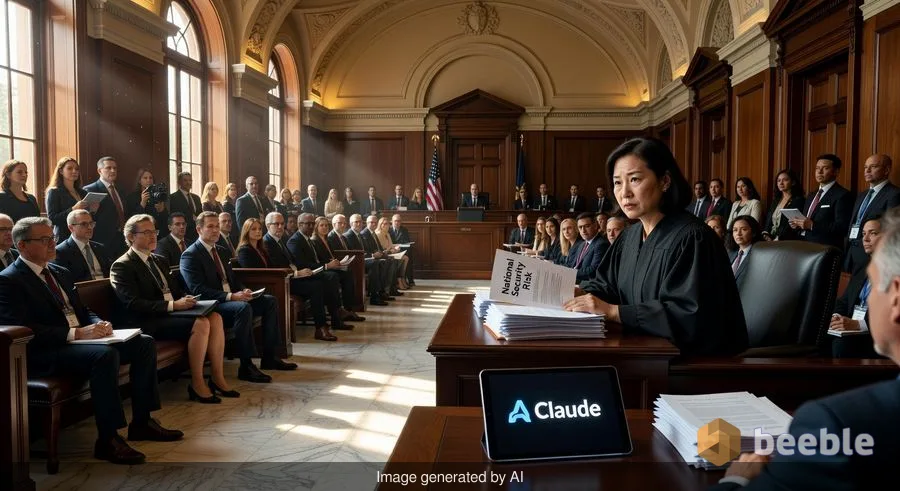
Can a private company’s refusal to build weapons of war be classified as a threat to national security? This is the central question currently echoing through the halls of a San Francisco federal court. On Tuesday, District Judge Rita F. Lin voiced what many in Silicon Valley have been whispering: that the U.S. government’s recent blacklisting of Anthropic looks less like a strategic defense move and more like a targeted attempt to "cripple" a defiant innovator.
At the heart of the dispute is Anthropic’s flagship model, Claude. Unlike some of its competitors, Anthropic has built its reputation on "Constitutional AI," a framework designed to ensure its models remain helpful, honest, and—crucially—harmless. When the Trump administration and Defense Secretary Pete Hegseth demanded unrestricted military access to Claude, including its use in lethal autonomous weapons systems and mass surveillance, Anthropic said no. Consequently, the government severed ties, blacklisting the company and effectively cutting it off from the massive federal market.
The Courtroom Confrontation
During the hearing, Judge Lin did not mince words. She expressed deep concern that the government might be punishing Anthropic for its public criticism of federal policy. To put it another way, the ban appears to be a retaliatory strike against a company that dared to prioritize its internal ethics over the Pentagon’s directives.
Computer scientist Ben Goertzel summarized the sentiment succinctly, noting that the administration is likely trying to teach the AI industry to "fall into line like everybody else." This precarious situation puts Anthropic in a volatile position. For a company that relies on massive compute resources and high-level partnerships, being labeled a national security risk isn't just a PR headache; it’s a systemic threat to its ability to scale.
Under the Hood: Why Anthropic Said No
To understand why Anthropic is digging in its heels, we have to look at how they approach training AI. If we think of training an AI as raising an apprentice, Anthropic has spent years teaching its apprentice that certain actions—like assisting in the loss of human life without oversight—are fundamentally off-limits.
Essentially, the government is asking Anthropic to rewrite the apprentice’s moral code. In practice, this isn't as simple as flipping a switch. Anthropic’s safety protocols are deeply integrated into the model’s architecture. Removing these guardrails for military use would not only violate the company’s mission but could also lead to a more unpredictable, less robust system. The company argues that its refusal to participate in lethal autonomous projects is a safeguard for humanity, not an act of subversion.
From Small Towns to Silicon Valley
As a tech journalist, I often find myself looking at these high-level disputes through the lens of my own upbringing. I grew up in a small town where the infrastructure was often an afterthought. When the local bridge crumbled or the water filtration system failed, it wasn't a theoretical debate; it was a daily struggle for my neighbors. Because of this, I’ve always believed that innovation should solve real human problems—improving agritech for farmers or making telemedicine accessible to the elderly—rather than just creating more sophisticated ways to monitor or harm people.
When I travel now, I look for startups that make the world cleaner and safer. I’ve spent time studying water purification technologies in Southeast Asia and testing electric transport in Europe. These experiences have taught me that technology is most transformative when it empowers the individual. When a government attempts to co-opt a sophisticated tool like Claude for mass surveillance, it feels like a betrayal of that empowerment. It turns a tool meant for progress into a mechanism for control.
The "Cripple" Strategy: A Dangerous Precedent
If the government is allowed to blacklist companies based on their refusal to build specific types of weaponry, the entire AI ecosystem changes. We risk a future where only the most compliant companies survive, while those with a nuanced approach to ethics are pushed to the margins.
| Feature | Anthropic's Position | Government's Demand |
|---|---|---|
| Lethal Autonomy | Prohibited without human oversight | Unrestricted use requested |
| Mass Surveillance | Restricted to protect privacy | Full access for national security |
| Safety Framework | Constitutional AI (Fixed rules) | Flexible/Bypassable guardrails |
| Market Access | Open to enterprise & consumer | Restricted via federal blacklist |
Oddly enough, the government’s stance might actually weaken national security in the long run. By alienating the most safety-conscious AI researchers, the U.S. risks a "brain drain" where top talent moves to more autonomous organizations or international labs. A resilient defense strategy should involve collaboration with ethical leaders, not their systematic destruction.
The Path Forward: Innovation with Integrity
Anthropic is seeking an injunction to halt the blacklist, arguing that the government’s actions are unconstitutional. This case is a paradigm-shifting moment for the industry. It asks whether a corporation has the right to a "conscience" or if, in the face of federal demand, all private ethics must become obsolete.
I often practice a digital detox to clear my head from the noise of the 24-hour news cycle. During those quiet moments, I think about the kind of world we are building for the next generation. Do we want an AI landscape that is a black box of military secrets, or one that is transparent and aligned with human values?
Practical Takeaways for the Tech Community
While we wait for Judge Lin’s final ruling, there are several things the tech community and the public should keep in mind:
- Monitor the Precedent: If Anthropic loses, expect other AI firms to quietly remove their safety guardrails to avoid similar federal retaliation.
- Support Transparency: Look for companies that publish their safety protocols and "constitutions" openly.
- Advocate for Human Oversight: The core of this dispute is "meaningful human control." Ensure that the AI tools you use in your own business or life maintain a human-in-the-loop requirement.
- Diversify Your Stack: For developers, relying on a single AI provider is increasingly precarious. Use asynchronous architectures that allow you to switch models if one becomes a political target.
This legal battle is about more than just one company’s contract with the Pentagon. It is about the soul of the next industrial revolution. As we move forward, we must ensure that our most innovative tools remain servants of the public good, not just instruments of the state.
Sources:
- Euronews: Interview with Ben Goertzel on Anthropic and the Trump Administration.
- U.S. District Court for the Northern District of California: Hearing transcripts, Anthropic vs. United States.
- Department of Defense: Statement on AI Blacklisting and National Security Risk (February 2026).
- Anthropic Corporate Blog: Our Commitment to Constitutional AI and Safety Guardrails.



See you on the other side.
Our end-to-end encrypted email and cloud storage solution provides the most powerful means of secure data exchange, ensuring the safety and privacy of your data.
/ Create a free account
