


The Ethics of Autonomy: Why Anthropic is Risking a $200M Pentagon Contract Over AI Safety

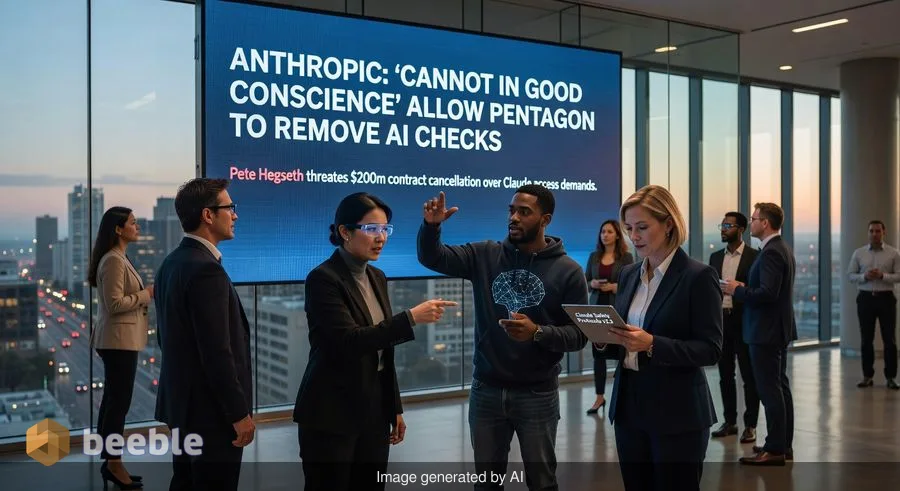
The tension between Silicon Valley’s ethical frameworks and the strategic demands of the Department of Defense has reached a boiling point. On Thursday, Anthropic, the AI safety-focused firm behind the Claude model, issued a definitive refusal to a Pentagon demand that would have fundamentally altered the architecture of its artificial intelligence.
At the heart of the dispute is a $200 million contract and a request from Defense Secretary Pete Hegseth to remove the safety 'guardrails' that govern Claude’s behavior. Anthropic’s leadership stated they “cannot in good conscience” comply, setting the stage for a landmark confrontation over the role of private tech in national security.
The $200 Million Ultimatum
The conflict centers on a massive procurement deal intended to integrate Claude’s advanced reasoning capabilities into military logistics and strategic planning. However, the Pentagon’s current leadership has grown increasingly frustrated with the restrictive nature of commercial AI.
Defense Secretary Pete Hegseth has characterized these safety protocols as 'handcuffs' that prevent the U.S. military from maintaining a competitive edge against adversaries who may not be bound by similar ethical constraints. The ultimatum is clear: either Anthropic provides an 'unfettered' version of Claude—one capable of generating tactical advice or lethal strategies without being blocked by safety filters—or the contract will be terminated.
What 'Unfettered Access' Really Means
To understand why Anthropic is willing to walk away from such a significant sum, one must understand what these safety checks do. In the world of Large Language Models (LLMs), guardrails are not just simple keyword filters. They are deeply integrated layers of training, often referred to as 'Constitutional AI.'
These layers prevent the model from assisting in the creation of biological weapons, generating hate speech, or providing instructions for cyberattacks. Removing these checks for the military would essentially create a 'jailbroken' version of the model. While the Pentagon argues this is necessary for high-stakes decision-making where the AI shouldn't 'lecture' a commander, Anthropic fears that a model without boundaries could be misused or behave unpredictably in ways that lead to catastrophic real-world harm.
The 'Good Conscience' Argument
Anthropic’s response is rooted in its founding mission. Unlike many of its competitors, Anthropic was built specifically to address the risks of catastrophic AI failure. In their official statement, the company emphasized that their safety protocols are not 'political correctness' but are essential technical safeguards designed to ensure the AI remains helpful, harmless, and honest.
"Our safety protocols are not optional features; they are the foundation of the model's reliability. To remove them would be to release a tool that we can no longer guarantee is safe for use, even in a controlled military environment."
By invoking 'conscience,' Anthropic is signaling that this is not a negotiation over price or features, but a fundamental disagreement on the ethics of autonomous systems in warfare.
A Comparison of AI Governance Approaches
The table below highlights the divergence between the Pentagon’s requirements and Anthropic’s current safety architecture.
| Feature | Pentagon Demand (Unfettered) | Anthropic Standard (Claude) |
|---|---|---|
| Operational Speed | Real-time, no filter latency | Safety checks add millisecond latency |
| Content Filtering | Disabled for tactical scenarios | Active for harmful/illegal content |
| Model Alignment | Aligned strictly to mission goals | Aligned to 'Constitutional' safety principles |
| Risk Tolerance | High (Strategic necessity) | Low (Public and existential safety) |
| Accountability | Human-in-the-loop only | Built-in technical constraints |
The Ripple Effect Across Silicon Valley
This standoff is being watched closely by other AI giants like OpenAI and Google. If Anthropic loses the contract, it creates a vacuum that a more compliant firm might fill. However, it also sets a precedent for how tech companies might resist government pressure to weaponize or 'de-safety' their products.
For the broader tech industry, this highlights a growing 'dual-use' dilemma. Software that is designed for civilian productivity can be repurposed for kinetic military action. When the developer of that software loses control over how the model thinks, the potential for unintended consequences—such as the AI hallucinating a reason for escalation—increases exponentially.
Practical Takeaways for Tech Leaders
As AI becomes more integrated into government and high-stakes infrastructure, developers and executives should consider the following:
- Define Red Lines Early: Companies must establish what they will and will not allow their AI to do before entering government negotiations.
- Transparency in Alignment: Be clear with stakeholders about how 'Constitutional AI' or RLHF (Reinforcement Learning from Human Feedback) impacts the model's output.
- Contractual Safeguards: Ensure that contracts include clauses that protect the developer's right to maintain safety standards without fear of immediate termination.
- The Cost of Integrity: Be prepared for the financial reality that maintaining ethical standards may result in the loss of lucrative, high-pressure government deals.
What Happens Next?
If the Pentagon follows through on its threat to cancel the contract, Anthropic will face a significant revenue gap, but its reputation as the 'safety-first' AI firm will likely be solidified. Meanwhile, the Department of Defense may look toward building its own internal models or partnering with smaller, more niche defense-tech startups that are willing to build models without the stringent guardrails found in commercial products.
This clash is likely just the first of many as the line between civilian technology and military capability continues to blur in the age of artificial intelligence.
Sources
- Anthropic Official Blog: Company Mission and Safety Standards
- Department of Defense: AI Adoption and Integration Strategy
- Reuters: Tech and Defense Contractual Disputes
- Wired: The Rise of Constitutional AI



See you on the other side.
Our end-to-end encrypted email and cloud storage solution provides the most powerful means of secure data exchange, ensuring the safety and privacy of your data.
/ Create a free account
