


The Expiration Date of Employment: Navigating CNIL’s New HR Data Retention Rules

Do you know what happens to your CV after you’ve been rejected for a job, or where your payroll records go once you’ve moved on to a new company? For years, the answer was often a digital attic—a disorganized collection of folders and servers where personal information gathered dust, largely forgotten until a data breach turned that dust into a firestorm. In the eyes of France’s data protection authority, the CNIL, this 'keep everything forever' mentality is no longer just poor hygiene; it is a regulatory liability.
Recently, the CNIL published a comprehensive reference framework specifically for HR personal data retention. This isn't just another dry checklist for the legal department. It is a fundamental shift in how organizations must view the lifecycle of their most sensitive asset: the people who power the business. From a compliance standpoint, the message is clear: personal data is like a toxic asset. It is incredibly valuable when you need it, but the longer you hold onto it past its expiration date, the more dangerous it becomes if leaked.
The Three-Tiered Lifecycle of HR Data
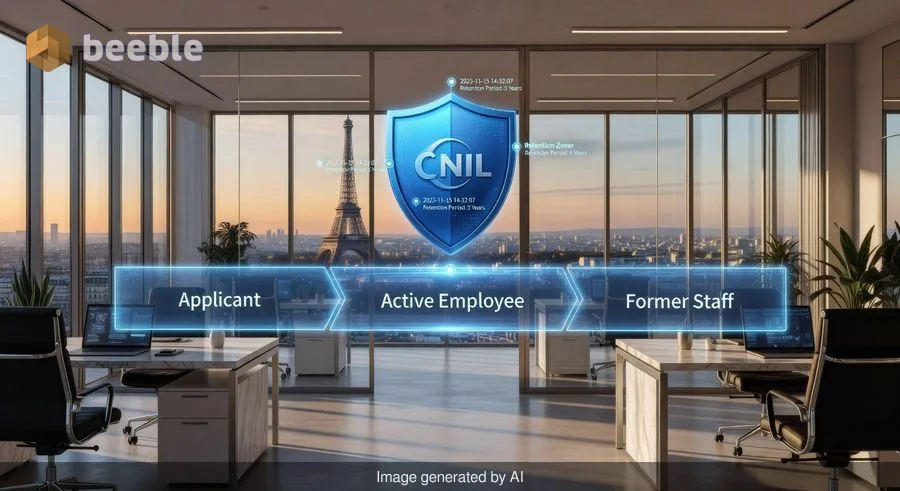
Under this framework, the CNIL introduces a structured approach to how data should age. To put it another way, data shouldn't just exist in one giant bucket. Instead, it moves through three distinct stages of a lifecycle.
First, there is the active database. This is the information HR needs for daily operations—your current address for the next paycheck or your performance reviews for an upcoming promotion. Once the immediate need passes, the data shouldn't necessarily be deleted, but it must move to intermediate archiving. This is a separate, restricted-access zone where data is kept only because the law requires it (such as for tax audits) or because it might be needed for a legal dispute.
Ultimately, once those statutory periods expire, the data must reach its final destination: definitive deletion or a digital witness protection program, otherwise known as anonymization. In this state, the data is stripped of all identifying markers so it can no longer be traced back to an individual, allowing the company to keep statistical trends without infringing on privacy.
The Recruitment Clock: Two Years and Out
One of the most nuanced areas of the new guidance concerns job applicants. When I investigate how companies handle recruitment, I often find 'ghost' profiles of candidates who applied for a role five years ago and were never contacted again.
In practice, the CNIL suggests that a candidate’s data should generally not be kept for more than two years after the last contact with the applicant. This gives the company a reasonable window to reconsider a candidate for a future role while respecting the individual's right to move on. Curiously, if a company wants to keep the data for that full two-year period, they must inform the candidate and give them the opportunity to request its deletion. Transparency is the foundation of this house; without it, the entire structure of trust collapses.
Managing the 'Afterlife' of an Employment Contract
What happens when an employee walks out the door for the last time? The relationship might be over, but the data trail remains. The CNIL’s framework provides a roadmap for this transition. While payroll records often need to be kept for five years to comply with the French Labor Code, other documents, like disciplinary records, have a much shorter shelf life.
Consequently, organizations must become meticulous editors. As a digital detective, I often look for inconsistencies in how companies purge these files. A common pitfall is keeping a copy of an employee’s ID badge photo or their emergency contact details long after they’ve left. These are unnecessary breadcrumbs that serve no legal purpose once the contract is terminated. The principle of data minimization dictates that if you don't need it to fulfill a legal obligation, you shouldn't have it.
Workplace Monitoring and the Intrusive Edge
Workplace monitoring—ranging from CCTV in the lobby to software that tracks keyboard strokes—is perhaps the most precarious area of HR data management. The CNIL is particularly stringent here. Data collected through monitoring must be proportionate to the goal. For example, if a company uses a badge system to track building access, keeping those logs for months is rarely justified.
Usually, a retention period of a few weeks is sufficient for security purposes. Keeping this data longer creates a systemic risk where an employer could use historical data to reconstruct an employee's every movement, turning a security tool into an intrusive surveillance mechanism. Compliance acts as a compass here, ensuring that the company’s need for security doesn't veer off-course into a violation of fundamental human rights.
Practical Steps for a Privacy-Preserving HR Department
Navigating this regulatory maze requires more than just a policy update; it requires a change in culture. Here is how organizations can begin to align with the CNIL’s expectations:
- Audit the Attic: Conduct a granular review of all HR data currently stored. Identify what is in the active database and what should have been archived or deleted years ago.
- Define Clear Timelines: Create a formal retention schedule that differentiates between different types of data (e.g., recruitment, payroll, health data, monitoring logs).
- Automate the Purge: Don't rely on human memory to delete files. Use software tools that automatically flag or delete data once it reaches its retention limit.
- Inform the Subjects: Update your privacy notices. Employees and applicants should know exactly how long their data will be kept and, more importantly, why.
- Document the Justification: If you decide to keep data longer than the standard CNIL recommendation, you must document your specific legitimate interest or the statutory requirement that justifies it.
Summary Table: Common Retention Benchmarks
| Data Category | Typical Retention Period (Active) | Justification |
|---|---|---|
| Job Applications | 2 years from last contact | Future recruitment needs |
| Payroll Records | 5 years post-employment | French Labor/Tax Code |
| Disciplinary Actions | Varies (often 3 years) | Labor law limitations |
| CCTV Footage | 1 month | Security & safety |
| Access Badge Logs | 3 months | Security monitoring |
Ultimately, respecting these retention periods is about recognizing that information is not just an asset, but a liability. By cleaning up our digital footprints, we protect not only the company from regulatory fines but also the individuals whose lives are mapped out in those files.
Sources:
- CNIL: Reference framework for the processing of personal data for the purpose of HR management.
- GDPR Article 5(1)(e): Storage Limitation Principle.
- GDPR Article 17: Right to Erasure ('Right to be Forgotten').
- French Labor Code (Code du travail).
Disclaimer: This article is for informational and journalistic purposes only and does not constitute formal legal advice. Privacy laws are complex and subject to change; please consult with a qualified legal professional regarding your specific compliance needs.



See you on the other side.
Our end-to-end encrypted email and cloud storage solution provides the most powerful means of secure data exchange, ensuring the safety and privacy of your data.
/ Create a free account
