


The False Promise of the Digital Nutrition Label

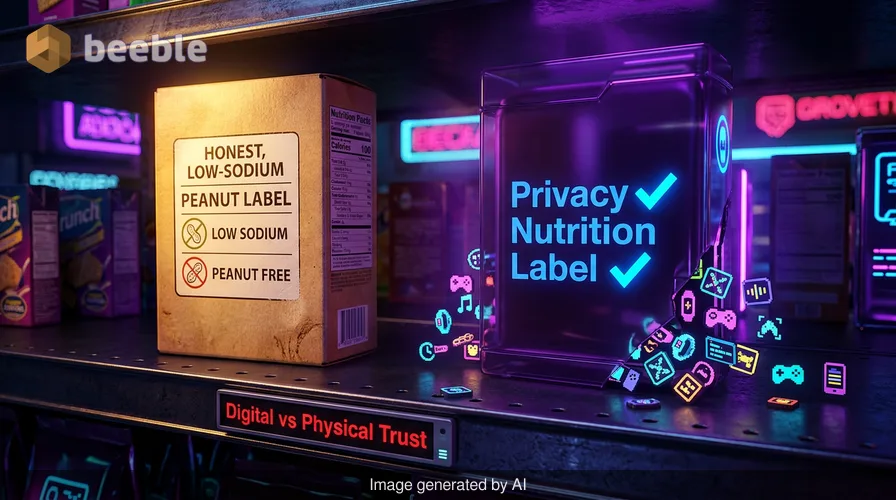
When you walk down a grocery store aisle and pick up a box of crackers, you have a reasonable expectation of honesty. If the label says 'low sodium,' it must meet a specific regulatory threshold. If it lists peanuts as an ingredient, you trust that the facility actually tracks allergen cross-contamination. This is because, in the physical world, we have spent decades refining the laws that govern transparency. We have built a system where what is on the box generally matches what is in the box.
But as we step into the digital marketplace, this intuition fails us. We download a fitness tracker or a mobile game, glance at the 'Privacy Nutrition Label' in the app store, see a series of comforting blue checkmarks, and assume we are safe. Curiously, recent investigations suggest that these digital labels are often more akin to a 'suggestion' than a factual record. In the digital realm, the label on the box and the contents inside are frequently living in two different realities.
The Illusion of Transparency
For years, privacy advocates pushed for a simplified way to understand data practices. The result was the 'Privacy Nutrition Label'—a standardized format pioneered by Apple and later adopted by Google. The goal was noble: distill a forty-page, jargon-filled privacy policy into a digestible summary.
However, a growing body of research, including significant studies from Carnegie Mellon University’s CyLab, has revealed a troubling trend of inconsistency. These labels are often self-reported by developers, creating a 'honor system' in an industry where data is the primary currency. From a compliance standpoint, this creates a precarious environment. When developers are asked to summarize their own complex data flows without strict auditing, the nuances of data collection often get lost in translation—or intentionally obscured.
Essentially, these labels have become a patchwork quilt of disclosures. Some apps claim they do not collect 'Sensitive Info' while simultaneously requesting access to your precise geolocation and health data. To put it another way, the 'nutrition label' might say zero calories, while the 'ingredients list' (the actual code) is full of high-fructose data harvesting.
The Semantic Dance: Sharing vs. Selling
One of the most significant hurdles in making these labels accurate is the linguistic gymnastics surrounding what happens to your data once it leaves your device. Most users see a label that says 'Data Not Shared' and feel a sense of relief. But in the tech-legal world, the word 'shared' has a very specific, and often narrow, definition.
Under frameworks like the California Consumer Privacy Act (CCPA), 'selling' data involves an exchange of money or 'other valuable consideration.' Some companies argue that if they give your data to a third-party analytics firm in exchange for services rather than cash, they haven't 'sold' anything. Consequently, they might check the 'No Data Sold' box on a privacy label while still feeding your digital footprint to a network of shadow cartographers—data brokers who build 360-degree profiles of your life without you ever knowing their names.
Then there is the concept of a 'Data Controller.' This is the entity that decides why and how your personal data is processed. If an app acts as a data controller but uses a 'Service Provider' to process that data, they may feel legally justified in saying they don't 'share' data with third parties, even if that service provider is a global advertising giant. This granular legal distinction is lost on the average user who just wants to know if their data is staying on their phone.
Why Developers Get It Wrong
It is tempting to view every inconsistent label as an act of malice, but the reality is often more nuanced. As someone who investigates these systems meticulously, I’ve found that many development teams simply don't have a robust understanding of their own 'data supply chain.'
A modern mobile app is rarely built from scratch. It is a digital Frankenstein’s monster, assembled using various Software Development Kits (SDKs) and libraries. A developer might integrate a simple map feature or an ad-network plugin without fully realizing that the plugin is silently siphoning off MAC addresses or signal strength data for fingerprinting.
In practice, the person filling out the privacy label in the App Store Connect dashboard is often a product manager or a marketer, not the engineer who audited the telemetry of every integrated third-party library. This leads to a systemic gap where the 'official' disclosure is disconnected from the technical reality. Privacy by design—the principle that privacy should be the foundation of a house, not a coat of paint applied at the end—is frequently ignored in favor of 'compliance as a checkbox.'
The Regulatory Gap and the 'Legitimate Interest' Loophole
While the Federal Trade Commission (FTC) has begun to crack down on deceptive privacy claims, the enforcement is often reactionary. They act after a breach or after a high-profile report exposes a lie. This leaves a vast middle ground of 'mostly-accurate' but 'mildly-misleading' labels that go unchecked.
In European contexts, we see another layer of complexity with 'Legitimate Interest.' This is a legal basis under the GDPR that allows a company to process data without your explicit consent if they have a valid business reason that doesn't outweigh your rights. Many apps use this as a 'get out of jail free' card. They may list data collection as 'optional' on a label, but then bury a 'Legitimate Interest' claim in the fine print that makes it nearly impossible for a user to actually opt out.
This makes the privacy label more like a sealed envelope; it looks official on the outside, but you have no idea what’s actually being signed away on the inside until it’s too late. The lack of a binding, automated verification process means that, de facto, the labels are more about branding than they are about consumer protection.
Actionable Steps for the Privacy-Conscious
So, where does this leave us? If we cannot trust the blue checkmarks, how do we navigate the digital world? As a journalist who applies data minimization to my own life—removing every unnecessary metadata tag before I hit 'publish'—I recommend a more skeptical approach to digital hygiene.
For the Individual User:
- Look Beyond the Label: Treat the privacy label as a starting point, not the final word. If an app's label says 'No Data Collected' but the app asks for your microphone, camera, and contacts upon opening, that is a major red flag.
- Audit Your Permissions: Every few months, go into your smartphone settings and look at which apps have access to what. Use the 'Privacy Report' features built into iOS and Android to see how often apps are actually pinging your location or sensors.
- Use 'Privacy Pro' Tools: Consider using DNS-based ad blockers or 'Private Relay' services that can identify and block the invisible trackers that these labels often fail to mention.
For Businesses and Developers:
- Conduct a Data Audit: Don't guess. Use automated tools to scan your app's binary and identify exactly what data every integrated SDK is transmitting.
- Be Radical with Transparency: If you collect data for analytics, say so. Users are increasingly sophisticated and value honesty over a 'perfect' but false label.
- Embrace Data Minimization: The most robust way to be compliant is to simply not collect the data in the first place. If your app doesn't need a user's birthday to function, don't ask for it.
The Path Toward Robust Disclosure
Ultimately, privacy labels are a failed experiment in their current, self-reported form. For them to truly serve as a compass for users, we need a shift toward systemic verification. Imagine a world where an app cannot be listed on a major store unless its code has been cryptographically verified to match its disclosure.
Until that day, the burden remains on us to be our own digital detectives. We must remember that in the world of big tech, terms of service are often a labyrinth designed to confuse, and privacy labels are often just the wallpaper. True privacy isn't something that is given to you by a checkmark on a screen; it is something you must actively defend by questioning the gap between what companies say and what they do.
Sources:
- Carnegie Mellon University CyLab: Research on Privacy Label Inconsistencies (2023-2025).
- Federal Trade Commission (FTC): Policy Statement on Deceptive Disclosures and the 'Dark Patterns' of Data Collection.
- General Data Protection Regulation (GDPR): Article 5 (Principles relating to processing of personal data) and Article 12 (Transparent information).
- California Consumer Privacy Act (CCPA/CPRA): Definitions of 'Selling' vs. 'Sharing' personal information.
Disclaimer: This article is for informational and journalistic purposes only. It tracks the evolution of digital rights and tech-legal trends but does not constitute formal legal advice. For specific compliance requirements, consult with a qualified data protection officer or legal counsel.



See you on the other side.
Our end-to-end encrypted email and cloud storage solution provides the most powerful means of secure data exchange, ensuring the safety and privacy of your data.
/ Create a free account
