


The Finnish AI Frontier: Why a 310MW 'Factory' Matters to Your Digital Life

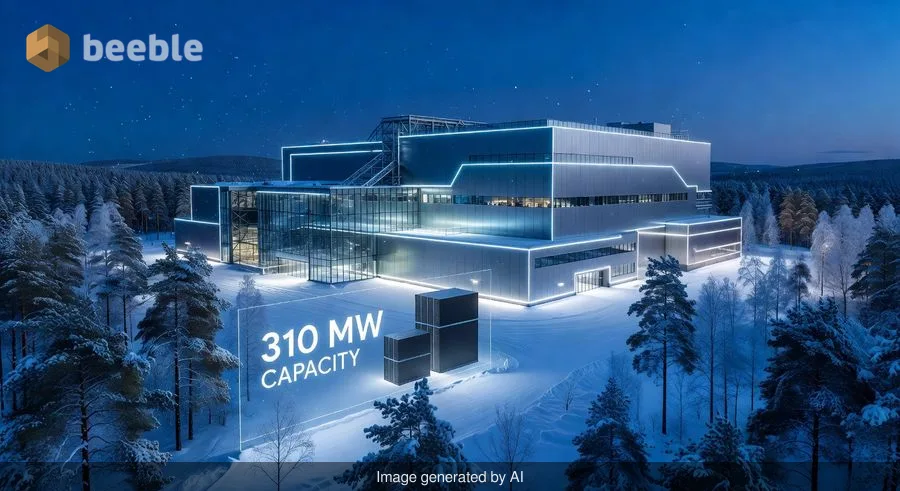
Despite the endless hype around sleek AI interfaces and conversational bots, the reality of the artificial intelligence revolution is surprisingly heavy, metallic, and power-hungry. While we interact with AI as a series of pixels on a screen, the industry itself relies on an invisible backbone of massive industrial infrastructure. Recently, the Dutch cloud provider Nebius announced a project that brings this reality into sharp focus: the construction of one of Europe’s largest AI data centers in Lappeenranta, Finland.
This isn't just another server farm. With a planned capacity of 310 megawatts (MW), this facility is designed to perform at a scale roughly equivalent to three traditional hyperscale data centers combined. To put that in perspective, 310 MW is enough to power hundreds of thousands of homes simultaneously. Looking at the big picture, this project signals a shift in how we build the digital world—moving away from general-purpose storage toward specialized 'AI factories' designed for the sheer brute-force computation that modern machine learning requires.
Under the Hood: The Mechanics of an AI Factory
In simple terms, an AI factory differs from a standard data center the way a high-performance racing garage differs from a public parking lot. Standard data centers spend much of their time 'waiting'—storing your old emails or hosting a website. An AI factory, however, is built for continuous, high-intensity labor. It houses thousands of specialized chips (GPUs) that work like a tireless intern, processing mountains of data 24/7 to train the models that eventually power your grammar checkers, image generators, and search engines.
This intensity creates a massive byproduct: heat. Historically, data centers have used giant fans to blow air over servers, which is both noisy and inefficient. Nebius is opting for a more robust solution in Lappeenranta—a closed-loop liquid cooling system. Instead of air, a specialized coolant circulates directly near the hardware to absorb heat. This is far more efficient at keeping the 'brain' of the facility from melting down, and curiously, it allows the facility to operate with minimal water consumption, a stark contrast to the billions of gallons often evaporated by traditional cooling towers.
From Server Heat to Living Room Comfort
One of the most tangible social impacts of this project is how it integrates with the local community. Usually, the heat generated by computers is wasted, vented into the atmosphere like the exhaust from a car. In Lappeenranta, however, the system is designed to capture this excess energy and feed it into the local district heating network.
What this means is that the energy used to train a new language model or process a complex data set doesn't just vanish. It is repurposed to heat homes and water for the city’s residents. For the average user, this represents a shift toward a more circular economy where heavy industry isn't just a neighbor taking up space and power, but a systemic contributor to local infrastructure. It’s a rare moment where the digital and physical worlds overlap in a way that benefits a person’s utility bill.
Why Finland? The Geopolitics of Cool Air
On the market side, the choice of Finland is far from accidental. Data center developers are increasingly looking for regions that offer three things: political stability, renewable energy, and a naturally cold climate. Finland’s climate acts as a natural heat sink, reducing the energy needed to keep hardware at optimal temperatures.
Furthermore, as Europe seeks to establish 'digital sovereignty,' having massive AI infrastructure within its borders is foundational. Relying on data centers in the US or Asia can lead to latency (the delay you feel when a website takes a second to load) and complex legal hurdles regarding data privacy. By building a scalable hub in Lappeenranta, Nebius is positioning itself as a key player in a volatile market where the demand for local, high-performance computing is skyrocketing.
The Consumer Impact: Will This Make AI Better?
For the average user, a 310MW factory in Finland might seem distant, but its existence directly affects your digital wallet and experience. Currently, the 'cost' of AI is subsidized by venture capital and massive corporate spending. However, as these models grow, the price of using them—whether through a monthly subscription or the data you trade for access—is tied to the efficiency of the hardware running them.
| Feature | Traditional Hyperscaler | Nebius AI Factory (Lappeenranta) |
|---|---|---|
| Primary Purpose | General cloud storage/apps | High-intensity AI training/inference |
| Cooling Method | Often air-cooled (high water use) | Closed-loop liquid cooling (low water use) |
| Energy Recovery | Usually vented as waste | Redirected to district heating |
| Scale | ~100 MW per site | Up to 310 MW |
Ultimately, more efficient infrastructure leads to a more streamlined user experience. When AI factories become more powerful and energy-efficient, the 'tireless intern' gets faster and cheaper to manage. This could lead to more intuitive AI tools that don't require a $20-a-month subscription to be useful, or simply more resilient services that don't crash when millions of people try to use them at once.
Looking Ahead: A Practical Perspective
As we watch these massive projects rise, it’s worth moving past the corporate PR to see the real-world trade-offs. The expansion of the Lappeenranta site is a reminder that our digital habits have a physical footprint. While the heat-recovery system is a transparent effort to be sustainable, the sheer power draw of 310 MW remains a significant demand on the grid.
In everyday life, we should begin to view our digital tools through this lens of 'industrial weight.' The next time you ask an AI to summarize a long document or generate a piece of art, remember that somewhere in a cold climate like Finland, a liquid-cooled server is humming, and that energy might just be heating someone’s morning shower. We are no longer just users of software; we are participants in a global relay race of energy and data that is reshaping the very infrastructure of our cities.
Sources:
- Nebius Official Press Release regarding Lappeenranta expansion.
- International Energy Agency (IEA) report on Data Centres and Data Transmission Networks.
- City of Lappeenranta energy infrastructure and district heating overview.
- Industry analysis on the shift from general cloud to AI-specific infrastructure.



See you on the other side.
Our end-to-end encrypted email and cloud storage solution provides the most powerful means of secure data exchange, ensuring the safety and privacy of your data.
/ Create a free account
