


The Ghost in the Editor: Cursor 3 and the Dawn of the Agentic Era

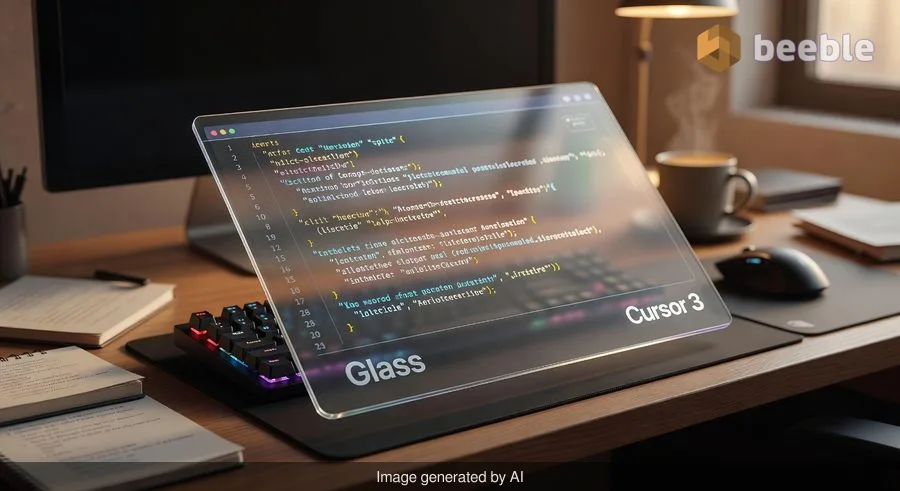
You are staring at a blinking cursor, the rhythmic heartbeat of a blank document. For decades, this tiny vertical line has been a silent demand for human input. It waited for you to type every semicolon, to debug every logic error, and to laboriously copy-paste boilerplate code from a browser tab. But on Thursday, that relationship changed. With the launch of Cursor 3—developed under the code name Glass—the cursor is no longer just waiting; it is starting to think for itself.
Cursor, the AI-native code editor that has recently become the darling of the developer world, has introduced a new agentic experience. This isn't just another autocomplete feature or a chat sidebar. It is a fundamental shift in how we interact with the building blocks of our digital world. If the previous generation of AI tools were like high-end kitchen appliances that helped you cook, Cursor 3 is more like a sous-chef who can take a vague request for 'something Italian' and handle the chopping, sautéing, and plating while you supervise the flavor profile.
From Autocomplete to Autopilot
To understand why this matters, we have to look at the evolution of the developer’s workflow. Historically, coding has been a game of high-fidelity translation. You have an idea in your head, and you spend hours translating that idea into a language a machine can understand. When you hit a snag, you go to a search engine, find a solution, and manually adapt it to your specific context. It is a process defined by digital friction—the constant context-switching between the editor, the terminal, and the documentation.
Cursor 3 aims to dissolve that friction. Under the hood, the new 'Glass' interface allows users to spin up AI agents that don't just suggest code, but execute tasks. If you tell the agent to 'refactor this entire module to use a different database schema,' it doesn't just give you a snippet of advice. It navigates your file tree, understands the interconnected dependencies, and begins rewriting the files on your behalf. Behind the screen, the software is performing a complex orchestration of large language models (LLMs) and local file indexing, essentially creating a 'digital twin' of your codebase to experiment on before presenting you with the results.
The Battle of the Agents: Cursor vs. the Giants
This launch places Cursor in a direct collision course with the titans of the industry. For months, Anthropic’s Claude Code and OpenAI’s Codex-powered tools have been the de facto standards for agentic assistance. These tools are robust, but they often feel like external appendages—tools you 'call upon' rather than environments you live in. Paradoxically, while OpenAI and Anthropic provide the raw 'brainpower' (the models), Cursor is winning by focusing on the 'nervous system' (the user interface).
| Feature | Cursor 3 (Glass) | Claude Code / OpenAI Codex |
|---|---|---|
| Interface Type | Integrated IDE Agent | CLI / API-driven |
| Context Awareness | Deep local codebase indexing | Variable (depends on prompt/tool) |
| Execution | Direct file system manipulation | Guided suggestions / Terminal-based |
| User Friction | Low (Seamless UI integration) | Moderate (Requires context-switching) |
Zooming out to the industry level, we are witnessing a pivot from 'Generative AI' to 'Agentic AI.' It is no longer enough for a model to generate a clever poem or a functional function. The new metric of success is agency: the ability to navigate complex, fragmented environments and complete a multi-step goal with minimal hand-holding. In everyday terms, we are moving from a world where we use tools to a world where we manage collaborators.
The Architecture of Trust
Technically speaking, giving an AI agent the keys to your codebase is a terrifying proposition. Code is a blueprint; one wrong ingredient ruins the dish. We’ve all experienced the frustration of an automated update that breaks a favorite app, or a 'smart' feature that makes a simple task more opaque. This is where the UX of Cursor 3 becomes critical.
Through this user lens, the 'Glass' interface isn't just about transparency in name; it’s about making the AI’s thought process visible. As the agent works, you see its progress—which files it’s reading, what logic it’s questioning, and where it’s stuck. This reduces the 'black box' effect that plagues many AI tools. It turns the act of programming into a high-level review process. You are no longer the bricklayer; you are the architect walking the construction site, ensuring the vision remains intact while the heavy lifting happens automatically.
Technical Debt and the Automated Future
However, there is a hidden cost to this seamlessness. In the software world, we talk about 'technical debt'—the messy closet of quick fixes that eventually makes a house uninhabitable. When an AI can churn out hundreds of lines of code in seconds, the risk of accumulating debt grows exponentially. If a developer doesn't fully understand the code their agent just wrote, they can't effectively maintain it when things inevitably break.
Consequently, the role of the human programmer is shifting from 'writer' to 'editor.' This requires a different kind of digital literacy. It’s no longer just about knowing the syntax of Python or TypeScript; it’s about understanding system architecture and being able to spot the subtle hallucinations that an AI might bake into a complex pull request. At its core, Cursor 3 is a bet that the speed of development gained by agents outweighs the risks of this abstracted complexity.
Reclaiming the Creative Spark
Ultimately, the launch of Cursor 3 tells us something profound about our relationship with technology. We are increasingly comfortable with software that acts on our behalf, delegating the 'how' so we can focus on the 'why.' This isn't just happening in coding; it's the same trend we see in automated email sorting, algorithmic music curation, and smart home routines. We are trading granular control for streamlined efficiency.
As we navigate this transition, it’s worth pausing to observe our own digital habits. When the friction disappears, do we become more creative, or just more prolific? When the 'clunky' parts of our work are smoothed over by an agent, what do we do with the time we save? Cursor 3 is a powerful tool, but like any disruptive technology, its value isn't just in what it can do, but in how it changes what we do.
Food for Thought:
- Observe the Friction: Next time you use a digital tool, notice where you feel 'stuck.' Is that friction a hurdle to be removed, or a necessary moment of reflection that improves your final output?
- The Editor Mindset: As AI agents handle more 'execution' tasks in your life (from writing emails to organizing schedules), practice the art of critical review. Are you still the pilot, or have you become a passenger?
- Understand the 'Why': When a tool makes a choice for you, ask yourself if you know the engineering logic behind it. Reclaiming a sense of control starts with understanding the mechanics of the magic.
Sources:
- Cursor Official Product Announcements and Release Notes (March-April 2026).
- Anthropic Developer Documentation for Claude Code.
- OpenAI Technical Blog on Codex and Agentic Workflows.
- Industry Analysis: The Shift from LLMs to AI Agents in Software Engineering.



See you on the other side.
Our end-to-end encrypted email and cloud storage solution provides the most powerful means of secure data exchange, ensuring the safety and privacy of your data.
/ Create a free account
