


The GitHub Star Is No Longer a Metric of Quality

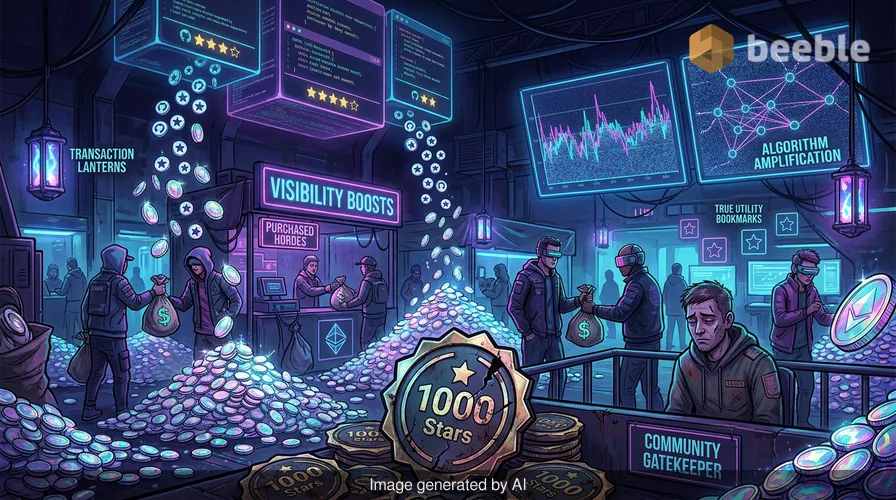
In the early days of the social coding revolution, the yellow star in the top-right corner of a GitHub repository was a humble tool for personal organization—a digital breadcrumb left by a developer to find their way back to a clever library or a useful utility. It was a private bookmark that incidentally functioned as a public signal of trust; if a project had a thousand stars, you could reasonably assume a thousand humans had found it worthy of their attention. But as we move deeper into the 2020s, that signal has been drowned out by a deafening amount of noise.
Today, the GitHub star has transitioned from a mark of utility to a unit of speculative currency. Where once we starred repositories to remember them, we now star them to promote them; where once the community served as a gatekeeper for quality, the algorithm now serves as a platform for visibility. This shift has birthed a sprawling, opaque shadow market: the fake star economy.
The Quiet Inflation of Digital Approval
Historically, the open-source ecosystem operated on a hierarchy of merit, where the most robust and resilient tools naturally rose to the top through word-of-mouth and genuine adoption. Technically speaking, a star was never meant to be a proxy for security or performance, yet it became the de facto standard for measuring a project's health. Consequently, as open-source software became the backbone of global infrastructure, the pressure to look healthy became an economic necessity rather than a community goal.
In practice, this pressure has led to a paradigm shift in how new software is launched. For a modern startup, a high star count is not just a vanity metric; it is a prerequisite for venture capital interest and a lubricant for developer recruitment. If a new AI framework launches with ten thousand stars in its first week, it creates a sense of momentum that attracts real users—even if the initial surge was entirely manufactured. This is the central paradox of the modern web: to attract a real community, you often have to simulate one first.
The Architecture of Deception
Under the hood, the mechanics of the fake star economy are surprisingly sophisticated, moving far beyond the primitive bot scripts of the previous decade. Modern "star farms" employ networks of aged accounts that mimic human behavior with disturbing accuracy; these accounts do not merely click a button, but instead perform a series of choreographed actions designed to bypass GitHub’s fraud detection. They follow other users, fork popular repositories, and even make minor commits to README files to create a digital paper trail of legitimacy.
From a developer's standpoint, the ease with which one can purchase these metrics is alarming. For the price of a modest lunch, a project lead can acquire five hundred stars from accounts that appear, at a cursory glance, to belong to active engineers. Zooming out to the industry level, this creates a fragmented reality where the "Trending" tab on GitHub—once a curated list of the world's most innovative code—is now frequently cluttered with bloated "open-core" projects that have optimized for the algorithm rather than the user.
When Marketing Overwhelms Engineering
To put it another way, the gamification of GitHub has turned software development into a branch of digital marketing. Paradoxically, the more a project focuses on its star count, the more its actual code quality tends to suffer. We are seeing a rise in what many call "README-driven development," where the aesthetic of the documentation and the count of the stars are prioritized over the stability of the API or the resolution of critical bugs.
Behind the screen, this trend is driven by the "Open Core" business model. In this setup, a company releases a limited version of its software for free to build a top-of-funnel audience, while keeping the most robust features proprietary. In this environment, stars are the primary lead generation tool; the engineering team’s success is measured by GitHub engagement metrics rather than the technical elegance of their solutions. Essentially, the code has become a recipe where the presentation matters more than the nutritional value of the dish.
The High Cost of Cheap Popularity
Ultimately, the proliferation of fake stars creates a profound sense of digital friction for the everyday developer. When every library claims to be the most popular and every framework boasts a five-digit star count, the process of choosing a tech stack becomes an exercise in cynicism. We can no longer trust the ubiquitous signals of the platform; instead, we must spend hours auditing dependencies and reading through issue trackers to find the truth hidden beneath the hype.
This trend also contributes to the growing mountain of technical debt in modern organizations. When teams choose a library based on its perceived popularity—only to find out months later that it is a hollow project maintained by a skeleton crew—they are left with a legacy of unmaintained code. In everyday terms, it is like buying a house because the curb appeal was perfect, only to discover that the infrastructure was never actually inspected. The pipes are leaking, the wiring is frayed, but the sign in the front yard looks magnificent.
Reclaiming the Signal from the Noise
As we navigate this landscape, the burden of discernment has shifted back to the individual. We must learn to look past the star count and examine the deeper metrics of a project’s health. How quickly are pull requests merged? Is the documentation clear, or is it just a collection of flashy badges and marketing copy? Through this user lens, we can begin to see GitHub not as a scoreboard, but as a living repository of human collaboration.
On an individual level, we need to rethink our own starring habits. If we treat the star as a cheap "like," we contribute to its devaluation. If, however, we return to using it as a deliberate act of endorsement for tools that actually make our lives easier, we can begin to restore some of the signal that has been lost. The cloud might be our digital storage unit, but the tools we use to manage it should be chosen for their utility, not their popularity.
In the end, the fake star economy is a symptom of a larger shift in our relationship with technology: the transition from a world of tools to a world of platforms. But code, at its core, is still a craft. While algorithms can be gamed and stars can be bought, the real value of software still lies in its ability to solve problems reliably and elegantly. By looking beneath the surface, we can reclaim our agency in the digital world and ensure that the tools we build our futures on are made of more than just empty numbers and bot-driven hype.
Sources:
- GitHub Engineering Blog: Updates on platform integrity and bot detection.
- AwesomeAgents.ai: Investigation into the GitHub star-for-hire marketplace (2026).
- Open Source Security Foundation (OpenSSF): Reports on project health metrics and supply chain trust.
- Developer Survey Data 2025: Trends in open-source discovery and library adoption.



See you on the other side.
Our end-to-end encrypted email and cloud storage solution provides the most powerful means of secure data exchange, ensuring the safety and privacy of your data.
/ Create a free account
