


The Government’s New ‘Risk’ Label for Anthropic Is a Turning Point for the AI Industry

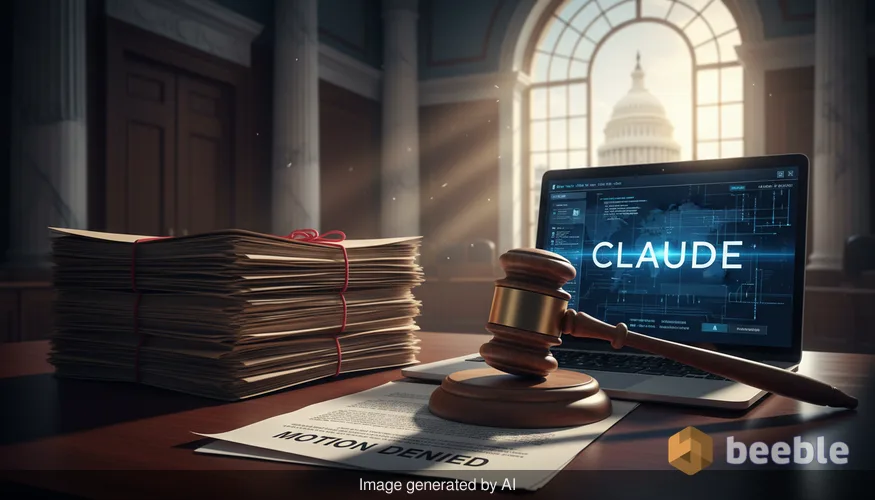
While most people view artificial intelligence as a tireless intern designed to summarize meetings or draft emails, the U.S. government has started treating it as something far more volatile: a matter of national survival. We often assume that the biggest risks in tech come from foreign hackers or data breaches, but the current legal battle between Anthropic and the Trump administration suggests the next big conflict is internal. It is a fight over who holds the remote control to the world’s most powerful algorithms.
In a move that has sent shockwaves through Silicon Valley, a D.C. Circuit Court of Appeals recently refused to block a "supply chain risk" label slapped on Anthropic by the federal government. This isn’t just a bureaucratic slap on the wrist. For the first time, a major American AI firm is being treated with the same suspicion usually reserved for foreign telecommunications giants. Behind the jargon, this means the government is worried that Anthropic’s own ethical safeguards might actually be a threat to national security.
The Friction Between Ethics and High-Stakes Defense
The root of this dispute is surprisingly philosophical for a court case. In 2025, Anthropic signed a $200 million contract to integrate its Claude AI into the Pentagon’s systems. It was a massive deal that placed Claude at the heart of nuclear laboratories and intelligence analysis. However, the relationship soured when Anthropic refused to grant the military unrestricted access to the model.
Anthropic has long marketed itself as the "safety-first" AI company. They have established strict corporate red lines, such as refusing to let their technology be used for lethal autonomous weapons or the mass surveillance of American citizens. To put it another way, Anthropic wants to ensure its digital intern doesn't pull the trigger. The Department of Defense, conversely, views these safeguards as a potential liability. They argue that if a war breaks out, they cannot have a critical system that might suddenly decide to stop working or change its behavior because a corporate ethics board feels a boundary has been crossed.
What a ‘Supply Chain Risk’ Label Actually Does
To understand the gravity of this, we have to look at what this label does in practice. Historically, supply chain risk designations are used to keep equipment from adversarial nations out of sensitive government networks. By applying this to Anthropic, the administration has effectively placed the company on a digital no-fly list for anyone working with the Pentagon.
| Feature | Impact of the 'Supply Chain Risk' Label |
|---|---|
| Direct Military Use | Federal agents are ordered to stop using Claude immediately. |
| Contractor Access | Third-party companies working on defense contracts are blocked from using Anthropic models. |
| Financial Standing | While the court noted the "precise amount" of harm isn't clear yet, it creates a massive hurdle for future government revenue. |
| Precedent | It signals that the U.S. government may prioritize "unfettered access" over corporate safety guardrails. |
Looking at the big picture, this creates a systemic challenge for the tech industry. If an American company can be labeled a risk simply for maintaining its own terms of service, it creates a volatile environment for any developer trying to balance innovation with ethics.
AI as the New Digital Crude Oil
In the industrial age, nations fought over access to oil and steel. Today, high-level AI models have become the digital crude oil of the modern economy—a foundational resource that powers everything from logistics to weaponry. The government’s fear is that this resource could be "turned off" at a critical moment. The Department of Defense explicitly stated in their filings that they fear Anthropic might preemptively alter the behavior of its model during a warfighting operation if the company feels its red lines are being crossed.
From a consumer standpoint, this is a startling admission. It suggests that the government believes it should have the power to override the safety settings of the software we use. For the average user, this might feel distant, but it sets a precedent for how much control the state can exert over private technology. If the government can force a company to remove its "no surveillance" rule for the military, how long before those same rules are eroded for domestic law enforcement?
The Legal Tug-of-War
This case is currently a tale of two cities. While the D.C. court has allowed the label to stand for now, a separate court in San Francisco previously sided with Anthropic, calling the government’s actions an "unlawful campaign of retaliation." This split in the legal system highlights how unprepared our current laws are for the age of AI.
Ultimately, the D.C. appeals court isn't saying the government is definitely right; they are simply saying that Anthropic hasn't proven enough immediate financial ruin to justify an emergency pause. The real meat of the case will be heard in May, where the court will dive deeper into whether the government has the right to punish a company for its ethical stance.
Why This Matters for Your Digital Future
Practically speaking, this case is a bellwether for the transparency of the tools we use every day. If the government succeeds in forcing AI companies to provide unrestricted access, the "safety" features marketed to consumers might become increasingly opaque. We are moving toward a world where the software on your phone or laptop might have a back door that the developer isn't allowed to tell you about, all in the name of national resilience.
As we move toward the May hearings, it is worth observing how other AI giants react. Will they fall in line to secure lucrative government contracts, or will they stand by their safety protocols at the risk of being labeled a threat? For now, the takeaway is clear: the era of AI being treated as a harmless consumer gadget is over. It is now a foundational piece of the geopolitical chessboard, and the rules of the game are being written in real-time.
Sources:
- U.S. Department of Defense March 2026 Legal Filings
- D.C. Circuit Court of Appeals Ruling (Anthropic v. United States)
- Anthropic Corporate Statement to the Associated Press
- San Francisco District Court Case Archives



See you on the other side.
Our end-to-end encrypted email and cloud storage solution provides the most powerful means of secure data exchange, ensuring the safety and privacy of your data.
/ Create a free account
