


The Great Convergence: When Cinema Finally Learned to Speak Fluent Video Game
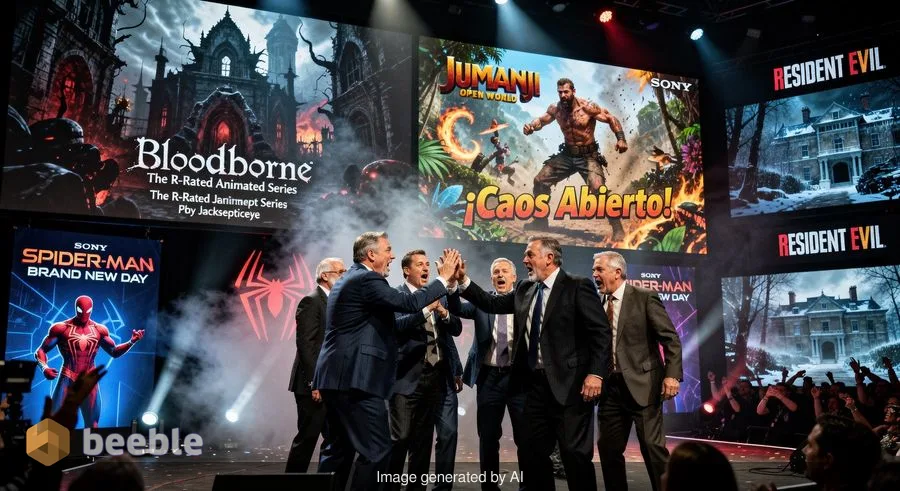
We used to view the relationship between Hollywood and the gaming industry as a one-way street, a clumsy process where nuanced digital experiences were flattened into two-hour spectacles for a passive audience. Now, we are witnessing a fundamental shift where the logic of the controller is dictating the rhythm of the silver screen. Sony Pictures’ presentation at CinemaCon 2026 was not merely a slate of upcoming releases; it was a manifesto for an era where the boundary between playing and watching has become beautifully, and perhaps irreversibly, porous.
Historically, the 'video game movie' was a punchline, a derivative product that failed to capture the agency of the player. Today, through the lens of Sony’s latest reveals, we see a studio that has stopped trying to translate games into movies and has instead started building movies that inhabit the soul of gaming. From the glitch-heavy humor of Jumanji to the atmospheric dread of a reimagined Raccoon City, the industry is no longer just selling us a ticket; it is inviting us into a systemic, interconnected ecosystem.
The Architecture of the Multiverse and the Burden of Canon
Spider-Man: Beyond the Spider-Verse arrived at CinemaCon with the weight of a generation’s expectations. We used to accept sequels as simple continuations of a brand. Now, we treat them as architectural expansions of a complex narrative foundation. The footage shown—a raw, visceral look at Miles Morales facing off against a Prowler-version of himself—highlights a profound shift in how we consume superhero media. This is no longer about a guy in a suit saving a city; it is an exploration of identity through the lens of 'ludonarrative' choice, even in a non-interactive medium.
The exchange between the two Miles regarding the pronunciation of 'Morales' is a microscopic detail that speaks to a macroscopic trend. It grounds the high-concept multiverse in the lived, everyday experience of cultural identity. When Miles 1 explains 'canon events' to a skeptical Miles 2 and Uncle Aaron, he isn't just talking to them; he’s talking to the audience. He is questioning the very tropes that have kept franchise storytelling in a fragmented, repetitive loop for decades.
Sony’s decision to push the release to June 18, 2027, might frustrate the instant-gratification cravings of the modern consumer, but it reflects a deeper industry realization. We once prioritized the assembly line of annual releases. Now, we recognize that a seamless, resonant masterpiece requires the kind of labor-intensive craft that cannot be rushed by an algorithm. The 'final chapter of Miles’ story' promises to be less of a movie and more of a cultural milestone that deconstructs the very idea of what a hero is 'supposed' to be.
The Creator Economy Enters the Hunter’s Dream
Perhaps the most disruptive announcement of the night was the R-rated animated Bloodborne film. We used to see film production as an opaque process controlled by legacy executives in high-rise offices. Now, we are seeing the rise of the 'Creator-Producer,' exemplified by Jacksepticeye’s involvement in bringing Yharnam to life. This isn't just a celebrity cameo; it is a recognition that those who have spent thousands of hours engaging with a game’s mechanics are often the best suited to translate its atmosphere.
Bloodborne is a game defined by its opaque lore and its unforgiving difficulty—a conversation between player and developer that often ends in frustration and eventual triumph. By choosing an R-rated animated format, Sony is signaling that they understand the 'vibe' is more important than a sanitized, four-quadrant appeal. Animation allows for a visual fidelity to the source material that live-action often struggles to replicate without looking clunky or over-processed. In everyday terms, it’s the difference between a home renovation that tries to hide the original character of a house and one that celebrates its gothic, crumbling foundations.
The Glitch in the Mainstream Matrix
Jumanji: Open World offers a more lighthearted but equally significant look at our changing media habits. We used to see 'open world' as a technical term reserved for sprawling digital maps like those in Elden Ring or Grand Theft Auto. Now, it is a ubiquitous cultural concept that even our parents understand. The footage of animals running loose in the real world and characters stuck in a 'Spanish demo mode' is a brilliant use of observational humor that taps into our collective experience with buggy software.
There is something profoundly relatable about the image of Dwayne Johnson’s Bravestone shouting in Spanish because of a system error. It mirrors our own daily frustrations with technology—the smartphone that freezes during a crucial call or the streaming app that defaults to the wrong language. By leaning into the 'clunky' nature of early video game logic, Jumanji: Open World bridges the gap between the high-tech spectacle of Hollywood and the often-messy reality of our digital lives. It treats the game world not as a magical land, but as a piece of software that is fundamentally broken, making the characters’ struggle feel more human and less derivative.
The Survival Horror Renaissance and the Indie Sensibility
When Zach Cregger took the stage to discuss Resident Evil, the atmosphere in the room shifted. We used to see horror franchises as bloated, action-heavy spectacles that lost sight of their frightening roots. Now, by hiring the director of Barbarian, Sony is signaling a return to the 'gold standard' of survival horror. Cregger’s admission of his 'embarrassing number of hours' played is a badge of honor that resonates with a fanbase tired of being patronized by creators who don't 'get' the source material.
The footage shown—a lone man in the snow, a broken-down car, a giant, Baron Harkonnen-esque figure in the shadows—suggests a pivot toward pacing and atmosphere over narrative gymnastics. This is a crucial distinction. In an era of 'The Content Walled Garden,' where every film feels like it’s setting up five spin-offs, a focused, claustrophobic horror experience feels revolutionary. It’s an architectural approach to tension: one weak pillar of logic ruins the immersion, but Cregger seems intent on building a fortress of dread.
Reclaiming the Spectator’s Choice
Zooming out to the industry level, Sony’s CinemaCon presentation reveals a studio that is no longer afraid of its audience’s intelligence. We are moving away from the era of the 'passive spectator' who simply consumes what is put in front of them. We are entering the age of the 'literate fan,' an audience that understands frame rates, canon consistency, and the difference between a cash-grab and a passion project.
Paradoxically, as our entertainment becomes more interconnected and complex, the value of a singular, well-crafted experience increases. Whether it’s the emotional autopsy of Miles Morales’ journey or the visceral terror of a snowy Raccoon City, these stories work because they ground their high-concept mechanics in universal human emotions. We see ourselves in Miles’ struggle to define his own path, and we feel the man’s desperation in the snow as he leaves a final voicemail for someone he loves.
As we navigate an endless digital buffet of content, it is easy to feel overwhelmed by the sheer volume of choice. However, the reveals from CinemaCon 2026 suggest that the future of entertainment isn't just about more content; it’s about more meaningful engagement. It’s about movies that respect the time we’ve invested in these worlds and creators who aren't afraid to break the mold to keep the experience resonant.
Ultimately, we should look at these upcoming films not just as products to be consumed, but as opportunities to reflect on how we spend our leisure time. In a world of algorithmic curation, choosing to engage with a story that challenges our expectations—or even one that just makes us laugh at a well-placed glitch—is a small act of reclaiming our own narrative. The screen may be getting bigger, and the worlds may be getting more 'open,' but the most important part of the experience remains the person holding the ticket, or the controller.
Sources:
- Sony Pictures Entertainment: CinemaCon 2026 Presentation Transcript
- Industry Report: The Evolution of Transmedia Storytelling (2025)
- Box Office Mojo: Historical Trends in Video Game Adaptations (1993-2025)
- Interview: Zach Cregger on Survival Horror and Narrative Pacing



See you on the other side.
Our end-to-end encrypted email and cloud storage solution provides the most powerful means of secure data exchange, ensuring the safety and privacy of your data.
/ Create a free account
