


The Great Firewall of Talent: Why China Blocked the Founders of Meta’s Newest AI Acquisition

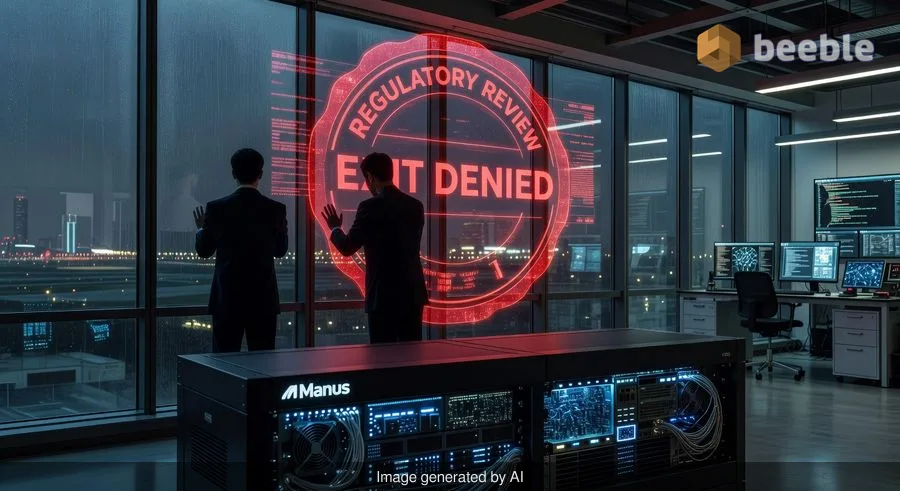
What happens when a nation’s most promising digital apprentice is sold to a foreign rival? For the founders of Manus, a startup once hailed as China’s answer to the next generation of artificial intelligence, the answer is a sudden and firm grounding.
Growing up in a small town, I realized early on that the internet erodes borders; it promised a world where a clever line of code written in a bedroom could reach a user halfway across the globe in milliseconds. But as I’ve traveled from tech expos in Las Vegas to coworking spaces in Bali, I’ve seen that while data may flow like water, the people who build the pipes are still bound by the physical realities of geography and geopolitics. The recent news that China has blocked Manus CEO Xiao Hong and Chief Scientist Ji Yichao from leaving the country is a stark reminder that in the high-stakes world of AI, talent is the most guarded resource of all.
The Rise of the Autonomous Apprentice
Manus catapulted into the global tech consciousness by promising something far more sophisticated than a simple chatbot. While most AI models are content to summarize text or generate images, Manus unveiled what it called the world’s first fully autonomous AI agent. Essentially, the company was training an apprentice capable of navigating the messy, friction-heavy world of human digital tasks.
According to the company’s initial demonstrations, this AI wasn't just answering questions; it was executing workflows. It could allegedly buy property, program entire video games from scratch, analyze complex stock portfolios, and plan intricate travel itineraries. In practice, this represents a paradigm-shifting leap from generative AI to agentic AI. If a standard LLM is a library, Manus was marketed as the librarian who could actually go out and run your errands.
Meta’s Bold Move and the Regulatory Backlash
In December 2025, Meta announced its intention to acquire Manus, a move designed to bolster its own cutting-edge AI development. For Meta, the acquisition was a way to secure a robust, performant engine for its future ecosystem. Curiously, the deal was seen as a win-win: a massive payday for the founders and a technological injection for the American social media giant.
Nevertheless, the Chinese government viewed the transaction through a much more skeptical lens. Following the global impact of DeepSeek, Beijing has become increasingly protective of its domestic AI architecture. To put it another way, if data is the new oil, then the algorithms that process it are the refineries. China’s regulators have now stepped in to review the acquisition, effectively placing the founders in a state of professional limbo.
The Exit Ban: A Precarious Position
Reports from the Financial Times indicate that Xiao Hong and Ji Yichao were informed they could not leave the country while the review is ongoing. This is not an unprecedented move in the volatile landscape of international tech, but it highlights how vulnerable individual innovators can be when caught between two superpowers.
Security, in this context, acts as a national immune system. China is concerned that the transfer of Manus’s intellectual property to Meta could constitute a loss of a strategic national asset. As a result, the founders find themselves at the center of a multifaceted tug-of-war. While they likely envisioned a seamless transition into Meta’s global structure, they are now navigating an intricate web of export controls and national security audits.
Living Between the Lines
As someone who frequently tests the latest gadgets for remote work—often while checking my sleep patterns on a smart ring or using meditation apps to manage jet lag—I find the human element of this story the most compelling. We often treat software architecture as a blueprint that can be easily moved, but the creators of that code are living organisms with their own lives and limitations.
During my travels studying how technology impacts different cultures, I’ve noticed a growing tension. We want the sleek, intuitive benefits of a borderless digital world, yet we are retreating into a more deterministic, protected version of the internet. The network, once seen as the wild west of total freedom, is being fenced in by governments that view AI as a pillar of sovereignty.
What This Means for the AI Ecosystem
This situation creates a ripple effect across the startup world. If founders fear that a successful exit through a foreign acquisition will lead to travel restrictions or regulatory lockdowns, it may change how they build their companies from day one.
| Aspect | Impact of the Exit Ban |
|---|---|
| Investment | Venture capital may become more cautious about cross-border AI deals. |
| Talent Mobility | Top-tier researchers might prefer to work in jurisdictions with fewer exit risks. |
| Innovation | Fear of regulatory intervention could stifle the development of disruptive, "exportable" tech. |
| Geopolitics | AI remains the primary battlefield for technological supremacy between the US and China. |
Finding a Healthy Balance
Despite my deep immersion in the tech world, I’ve learned the importance of a healthy balance. After a long day of tracking the latest asynchronous software updates or writing about food-tech innovations, I know when to turn off the notifications and go for a run or practice yoga. It is a reminder that while the digital world is fast and often volatile, our physical well-being and freedom are what truly matter.
For Xiao Hong and Ji Yichao, the path forward is currently obscured. The review of the Meta-Manus deal will likely be a long, nuanced process. It serves as a warning to the tech industry at large: in the race to build the most sophisticated AI, the most important building blocks are still the people—and those people are no longer free to move as they please.
What do you think about the intersection of national security and private tech acquisitions? Should founders have the right to sell their innovations to the highest bidder regardless of borders?
Sources:
- Financial Times reporting on Manus founders and Meta.
- Meta's official press releases regarding AI acquisitions (December 2025).
- Regulatory filings from the Cyberspace Administration of China (CAC).
- TechCrunch analysis of autonomous AI agent trends.



See you on the other side.
Our end-to-end encrypted email and cloud storage solution provides the most powerful means of secure data exchange, ensuring the safety and privacy of your data.
/ Create a free account
