


The Great Reset: Why Elon Musk is Rebuilding xAI from the Foundations Up

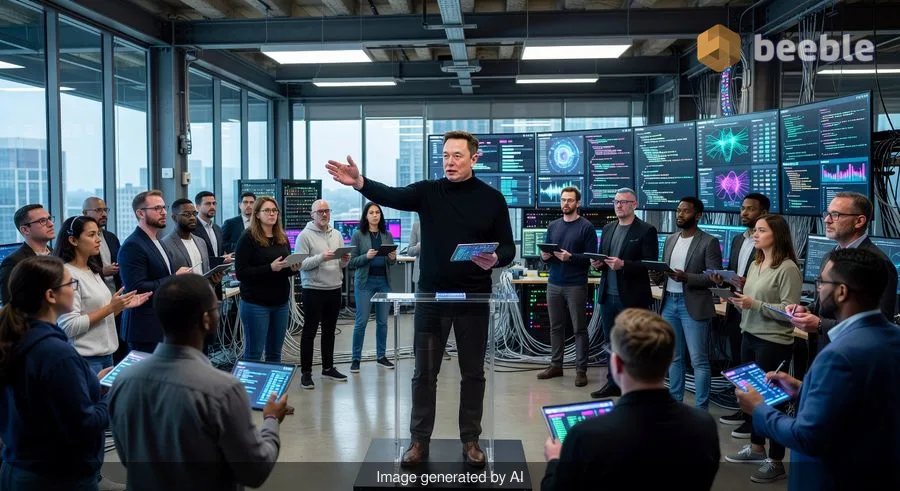
Elon Musk has never been one for half-measures or quiet pivots. In a move that has sent ripples through Silicon Valley, the billionaire entrepreneur recently admitted that xAI, his ambitious artificial intelligence venture, was "not built right the first time." This admission comes alongside a significant personnel overhaul, leaving only two of the original eleven co-founders at the helm.
As of mid-March 2026, the departure of key architects Zihang Dai and Guodong Zhang marks a turning point for the company. While Musk frames this as a strategic "rebuilding from the foundations up," the industry is left wondering if xAI can truly close the widening gap between its offerings and the dominant tools from Anthropic and OpenAI.
The Exodus of the Original Eleven
When xAI launched three years ago, it was touted as a dream team of researchers scouted from DeepMind, Google Research, and Microsoft. Today, that roster is a shadow of its former self. The recent exits of Dai and Zhang are particularly stinging; both were instrumental in the deep learning frameworks that were supposed to give xAI a competitive edge.
In the high-stakes world of AI development, personnel turnover is common, but a loss of nearly 82% of the founding technical leadership suggests a deeper cultural or architectural misalignment. Musk’s insistence that the company is being rebuilt "by design" suggests that the original technical roadmap reached a dead end, necessitating a fresh start with a leaner, perhaps more compliant, team.
The Coding Assistant Crisis
The immediate catalyst for this internal friction appears to be the performance—or lack thereof—of xAI’s coding tools. During a recent all-hands meeting, Musk reportedly expressed frustration that the company’s programming assistants were failing to keep pace with Claude Code and OpenAI’s Codex.
In 2026, AI coding is no longer just about autocompleting lines of Python; it is about autonomous agentic workflows. Developers now expect AI to debug entire repositories and suggest architectural shifts. If xAI’s underlying models are struggling with these complex logic tasks, they risk becoming irrelevant in the developer ecosystem. Musk has set an ambitious deadline of mid-2026 to achieve parity, a timeline that many industry veterans view with skepticism given the current state of the rebuild.
What Does 'Rebuilding from the Foundations' Actually Mean?
In the context of large language models (LLMs), a "foundational rebuild" usually implies one of three things:
- Architectural Shift: Moving away from standard Transformer architectures toward more efficient state-space models or hybrid systems that handle long-context windows more effectively.
- Data Curation: Acknowledging that the quality of the training data—perhaps sourced too heavily from social media—was insufficient for high-level reasoning and coding.
- Compute Optimization: Redesigning how the model interacts with massive GPU clusters, like the Colossus supercomputer, to reduce latency and training costs.
By starting over, xAI is essentially discarding years of fine-tuning in hopes that a more modern "V2" architecture will leapfrog the incremental updates of its rivals.
Competitive Landscape: xAI vs. The Giants
To understand the pressure xAI is under, we must look at how the primary players compare in the current market.
| Feature | xAI (Grok/Coding Suite) | Anthropic (Claude/Claude Code) | OpenAI (GPT-5/Codex) |
|---|---|---|---|
| Current Status | Foundation Rebuild | Market Leader in Coding | Integrated Ecosystem |
| Key Strength | Real-time X Integration | Nuanced Reasoning | Multi-modal Dominance |
| Founder Retention | Low (18%) | High | Moderate |
| Primary Focus | "Truth-seeking" AI | Safety & Reliability | General Intelligence |
The Risks of the 'Again, Again' Strategy
This is not the first time a Musk-led venture has faced a "production hell" moment. We saw it with the Tesla Model 3 ramp-up and the early iterations of Starship. However, the AI race moves at a much faster cadence than automotive manufacturing or aerospace.
Every month spent rebuilding the foundation is a month where Anthropic and OpenAI are collecting user data, refining their agents, and locking in enterprise contracts. The primary pitfall for xAI is the "moving target" problem: by the time they catch up to today’s Claude Code, the industry may have moved on to fully autonomous software engineering firms.
Practical Takeaways for Developers and Investors
If you are tracking xAI’s progress or considering their API for your workflow, keep the following in mind:
- Expect Volatility: API endpoints and model behaviors are likely to change significantly as the "rebuild" rolls out. Avoid hard-coding dependencies on current xAI outputs.
- Watch the Talent Migration: Keep an eye on where the departing co-founders land. Their next moves often signal where the next breakthrough in AI architecture might occur.
- The Mid-Year Benchmark: Musk has staked his credibility on a mid-2026 turnaround. Use June and July as the litmus test for whether xAI has actually closed the gap or if this was another case of over-promising.
- Diversify Your AI Stack: Given the instability at xAI, developers should maintain a multi-model approach, using tools like LangChain or LiteLLM to switch providers if xAI’s performance dips during the transition.
Sources
- X (formerly Twitter) - Official statements from Elon Musk regarding xAI restructuring.
- TechCrunch - Analysis of xAI founder departures and recruitment trends.
- The Verge - Reports on the internal all-hands meeting at xAI.
- Bloomberg Technology - Competitive analysis of AI coding assistants in 2026.



See you on the other side.
Our end-to-end encrypted email and cloud storage solution provides the most powerful means of secure data exchange, ensuring the safety and privacy of your data.
/ Create a free account
