


The Hidden Reason Your Favorite Software Might Be Heading for a Crash

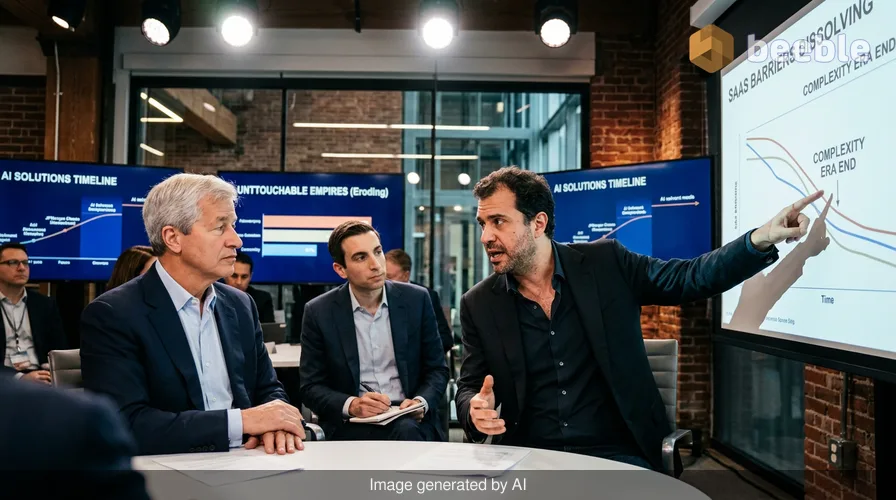
While many investors and tech enthusiasts believe that the current software giants are untouchable because of their massive, complex codebases, the reality is becoming far more volatile. For decades, the tech industry operated on a simple rule: the more complex and deeply integrated a software suite was, the harder it was to replace. This complexity was the ultimate moat—a defensive wall that kept competitors out and customers locked in. However, the rise of agentic AI is acting as an industrial-strength solvent, dissolving the very glue that once made these software empires feel permanent.
According to Anthropic CEO Dario Amodei, the era of relying on software complexity for protection is over. During a high-level briefing with JPMorgan Chase CEO Jamie Dimon and journalist Andrew Ross Sorkin, Amodei warned that the technical barriers that once defined the Software-as-a-Service (SaaS) industry are crumbling. In simple terms, if a company’s only competitive edge is that its software is too difficult for anyone else to replicate, that company is essentially living on borrowed time.
The Erosion of the Digital Fortress
Historically, when a company like Salesforce or ServiceNow built a massive platform, they created a labyrinth of features that required specialized knowledge to navigate and maintain. For the average user, this meant that switching to a rival was a nightmare. This architectural density was a feature, not a bug, for the companies selling it. It provided a robust barrier to entry for any startup looking to challenge them.
Looking at the big picture, AI is changing the fundamental physics of software development. Tools like Anthropic’s Claude Code and other agent-based systems are becoming the digital crude oil of our time—a raw power that fuels the creation and understanding of code at an unprecedented pace. When an AI can analyze millions of lines of code in seconds, the "difficulty" of writing that code evaporates. Practically speaking, what once took a team of fifty engineers three years to build might soon be replicable by a small team and a powerful AI model in a weekend.
This shift is what industry insiders are calling the "SaaS-pocalypse." It’s a systemic change where the value of the software isn't in how hard it was to build, but in how much actual work it can autonomously perform. If an AI agent can simply "reach over" a complex user interface and get the job done, the complexity of that interface becomes a liability rather than an asset.
Why the Market Is Panicking
On the market side, the tremors are already visible. Despite the overarching hype surrounding AI, many of the companies we would expect to lead the charge are seeing their stock values tumble. ServiceNow has seen a staggering 39% drop, while heavyweights like Snowflake and Thomson Reuters are facing similar downward pressure. Even Microsoft, the primary backer of OpenAI, hasn't been immune to the software sell-off, with its stock down 15% year to date as it struggles to meet the massive infrastructure demands of the AI era.
To put it another way, the stock market is acting as a global mood ring, reflecting a deep-seated anxiety about the long-term viability of current business models. Investors are starting to realize that being an "AI-first" company isn't enough if your core product is still a traditional, menu-heavy software tool. If the future of work is a tireless intern (an AI agent) that does the task for you, why would you pay a premium for a complex dashboard you no longer need to look at?
Behind the jargon, the problem is one of relevance. Many SaaS incumbents are in a race to integrate AI into their existing systems, but they are doing so while weighed down by legacy code. Conversely, new startups are building from the ground up with AI as the foundation, allowing them to be more streamlined and scalable than their predecessors.
Finance: The Next Frontier for Automation
Anthropic isn't just sounding the alarm; they are actively positioning themselves to capitalize on the fallout. Amodei revealed that the financial services sector is now their second-largest client base, accounting for 40% of their top 50 customers. This is a deliberate move. Finance, much like software coding, is built on layers of complex rules, legacy data, and high-stakes calculations.
At the briefing, a slide succinctly captured the threat: "Coding has changed forever. Finance is next." What this means is that the same AI tools currently dismantling the software industry are now being aimed at banking and insurance. Anthropic’s Claude Mythos model has already identified tens of thousands of vulnerabilities across various sectors, demonstrating a level of technical intuition that was previously thought to be uniquely human.
For the financial world, this represents an emerging paradox. On one hand, AI can make operations cheaper and faster, potentially leading to massive growth. On the other hand, the individual firms that fail to adapt will be blindsided. Amodei was blunt about this, noting that while the industry might grow, individual giants could easily go bust if they remain stagnant. They are essentially operating in an environment where the rules of the game are being rewritten while the game is still in progress.
Breaking Down the Mythos of Security
Under the hood, one of the most disruptive aspects of this new era is how AI handles security and vulnerabilities. Traditionally, finding bugs in software was a slow, manual process. Amodei’s mention of the Mythos model finding tens of thousands of vulnerabilities suggests that AI can now act as both the ultimate locksmith and the ultimate burglar. This is why he is calling for more robust regulations around powerful AI releases.
For the everyday user, this has a tangible impact. We are entering a period where our digital tools will become more powerful but also more opaque. As software becomes "self-writing" and "self-healing," the ability for a human to understand exactly what is happening behind the screen diminishes. It’s a shift from transparent logic to intuitive results.
What This Means for You
So, what is the "So What?" for the person who just wants to get their work done? The implications are foundational to how we view our careers and our tools.
| Area | Old Reality | New AI Reality |
|---|---|---|
| Job Skills | Knowing how to navigate complex software. | Knowing how to direct AI agents to perform tasks. |
| Software Value | Paid for features and "moats." | Paid for speed, accuracy, and autonomy. |
| Security | Periodic updates and patches. | Constant AI-driven vulnerability hunting. |
| Cost of Entry | High cost to build competing tools. | Low cost; AI levels the playing field for startups. |
From a consumer standpoint, the software you use today might look very different in eighteen months. You might stop "using" software in the traditional sense and instead start "managing" agents that interact with that software for you. This means the time you spent learning the ins and outs of a specific platform like Excel or Salesforce might be less valuable than your ability to articulate complex problems to an AI.
Ultimately, the takeaway from the Anthropic briefing is that we are moving away from an era of digital fortresses toward an era of digital fluidity. The companies that survive won't be the ones with the most complex code, but the ones that are most resilient to change. As the SaaS-pocalypse continues to unfold, it is a reminder to all of us—whether we are investors, workers, or casual users—to stop valuing the complexity of the tool and start focusing on the efficiency of the outcome.
Zooming out, the message is clear: the walls are down. Whether that leads to a more open, innovative tech landscape or a chaotic collapse of the old guard depends entirely on how quickly these institutions can learn to stop defending their moats and start building for a world where moats no longer exist.
Sources:
- Anthropic Official Press Release: "The Briefing: Financial Services"
- Market Data: NYSE and NASDAQ Software Sector Reports (May 2026)
- Transcripts: Conversation between Dario Amodei, Jamie Dimon, and Andrew Ross Sorkin
- Anthropic Product Documentation: Claude Code and Claude Mythos Capability Overview



See you on the other side.
Our end-to-end encrypted email and cloud storage solution provides the most powerful means of secure data exchange, ensuring the safety and privacy of your data.
/ Create a free account
