


The High Cost of Privacy: Why Decentralized Email Pioneer Dmail is Calling it Quits

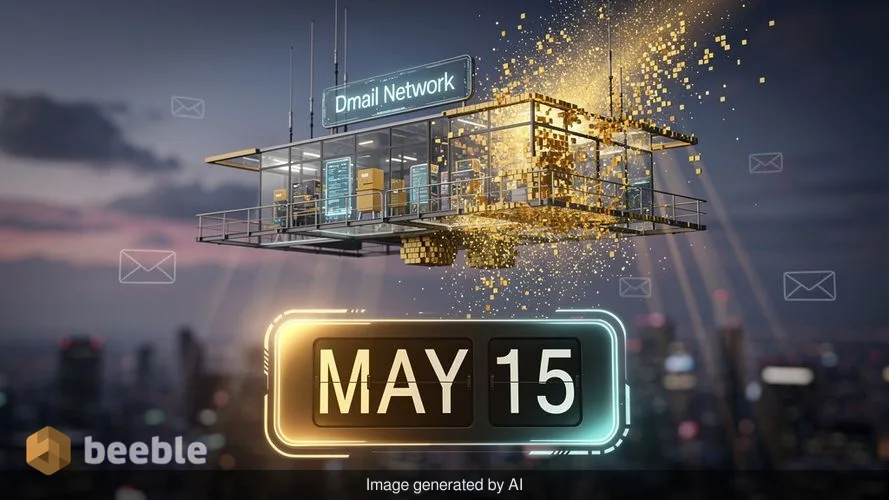
While the headlines scream that blockchain is the inevitable future of everything from finance to file sharing, the actual earnings reports and shutdown notices from the front lines tell a much more grounded story. For five years, Dmail Network attempted to do something remarkably ambitious: build a messaging service that didn't rely on a central company like Google or Microsoft. It was a bold promise of a world where your inbox was truly yours, encrypted and hosted on a distributed web.
However, that dream hit a wall of cold, hard reality this week. The Dmail team announced that they will begin winding down operations on May 15, citing a lethal combination of skyrocketing infrastructure costs and a failure to find a business model that actually worked. For the average user, this isn't just another failed startup; it is a case study in why the 'decentralized' version of the tools we use every day is so difficult to build and even harder to pay for.
The Digital Vending Machine That Ran Out of Change
To understand why Dmail failed, we have to look under the hood at how decentralized services work. Think of a traditional email service like a massive apartment complex owned by one landlord (Google). The landlord provides the lights, the water, and the security because they make money by showing you ads or selling you other services.
In contrast, a decentralized service is more like a digital vending machine. In theory, you put in a token, and the machine automatically gives you the service without needing a middleman. But for Dmail, the cost of keeping that vending machine stocked—paying for the bandwidth, storage, and computing power across a global network of computers—was astronomical. Unlike a central server that gets cheaper as it grows, Dmail found that the more users they attracted, the more their costs grew exponentially.
The Hidden Price of 'Free' Services
We often forget that 'free' email isn't actually free; it’s just subsidized. Big Tech companies use massive economies of scale to bring the cost of storing your 10,000 unread newsletters down to fractions of a cent. Dmail didn't have that luxury. Because they were using decentralized infrastructure, they had to pay market rates for every megabyte of data stored on the blockchain or distributed networks.
Practically speaking, the team tried to find a way to make users pay for the service, but they ran into a classic consumer hurdle: the 'convenience gap.' Most people value privacy, but very few are willing to pay a monthly subscription or deal with the friction of crypto tokens for an inbox when Gmail works 'well enough' for free. Curiously, even the most privacy-conscious users often balk when the tangible cost of that privacy is higher than the perceived benefit of leaving a centralized platform.
Why the Token Couldn't Save the Ship
On the market side, Dmail launched its own cryptocurrency to help power the ecosystem. In the world of Web3, these tokens are often intended to act as the fuel for the network. However, Dmail’s token never achieved what industry insiders call 'product-market fit.'
Essentially, the token became a solution in search of a problem. It didn't have a clear, large-scale use case that made people want to hold or use it. As a result, the token's value plummeted to new lows following the shutdown announcement. This created a systemic failure: the team couldn't fund operations through the token, and the users weren't paying enough in cash to cover the bills. It was a cyclical struggle that eventually exhausted the project's resources.
Lessons from the Invisible Backbone
This shutdown highlights a broader truth about the invisible backbone of our digital lives. We take for granted the massive industrial-scale hardware that keeps our data moving. When a project tries to move away from that centralized backbone, it has to recreate the entire supply chain of computing from scratch.
Looking at the big picture, Dmail’s exit suggests that the 'decentralized' label isn't a magic wand. For a service to survive, it needs more than just disruptive technology; it needs a streamlined way to balance the books.
| The Dmail Challenge | The Reality Check |
|---|---|
| Infrastructure | Decentralized storage costs rose faster than user growth. |
| Monetization | Users were unwilling to pay for privacy at the price point required. |
| Tokenomics | The project token lacked a practical, everyday utility. |
| Competition | Centralized giants offer 'free' services that are hard to beat. |
What This Means for You
If you are one of the users who experimented with Dmail, the immediate priority is data migration. With services ending in mid-May, the window to export your contacts or archive important messages is closing.
For the rest of us, Dmail’s story is a reminder to be skeptical of 'forever' promises in the emerging tech space. When a service claims to be decentralized and permanent, always ask: Who is paying the electricity bill? If there isn't a clear answer, you might be looking at a digital hotel that’s about to close its doors.
Ultimately, the collapse of Dmail doesn't mean decentralized tech is dead, but it does mean it’s entering a more mature, resilient phase where 'cool' isn't enough to replace 'sustainable.' As consumers, we should continue to support privacy-focused tools, but we must also be prepared for the reality that true digital independence might come with a price tag we aren't used to paying.
Sources
- Dmail Network Official Shutdown Announcement and Project Roadmap.
- Market data reports on DMAIL token performance and historical lows.
- Technical analysis of decentralized storage and bandwidth costs in Web3 environments.
- Industry reports on the failure of token-incentivized communication platforms.



See you on the other side.
Our end-to-end encrypted email and cloud storage solution provides the most powerful means of secure data exchange, ensuring the safety and privacy of your data.
/ Create a free account
