


The high price of a clean desktop

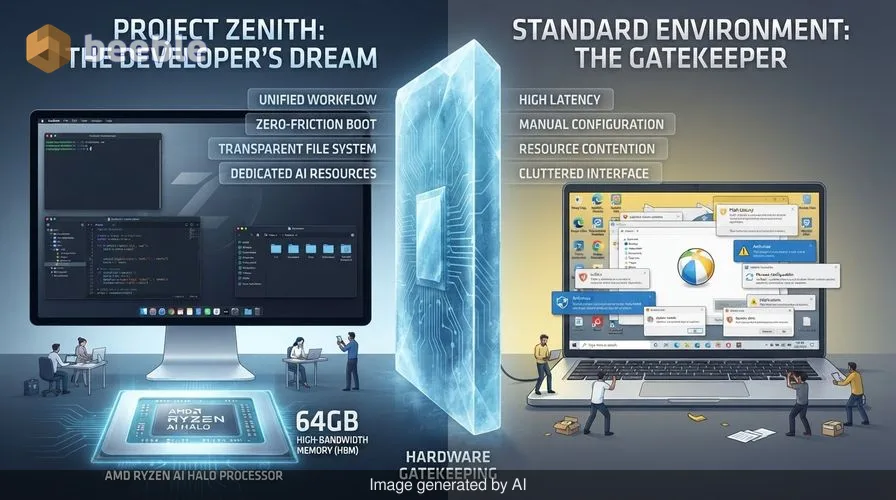
Windows users dream of an operating system that stays out of the way, offering a blank canvas for code and a transparent file system that treats the developer like an adult. Project Zenith is this dream realized, a streamlined environment where terminal windows snap perfectly into place and system resources remain dedicated to the task at hand. It creates a frictionless path from a fresh boot to a functional development environment, pre-configuring the runtimes and settings that once required hours of manual tweaking.
However, this seamless experience is locked to a specific class of expensive hardware. It requires the presence of AMD's Ryzen AI Halo silicon. It demands a minimum of 64GB of high-bandwidth memory, a threshold that excludes the vast majority of current laptops and desktops. Unless a developer is willing to invest in these specific, high-end workstations, the clutter-free version of Windows remains an inaccessible luxury. This hardware-software integration creates a new kind of gatekeeping, where the privilege of a distraction-free interface is a reward for buying the most expensive hardware on the market.
The developer tax and the hardware barrier
Microsoft Logan Ayer describes Project Zenith as a baseline for high-performance work. For years, the standard Windows installation was a messy closet. It was full of pre-installed trial software, hidden file extensions that confused build processes, and system notifications that interrupted focused thought. Cleaning this closet was the first task for any new hire at a software firm. We spent hours disabling telemetry, installing package managers like Winget or Chocolatey, and fighting the operating system to show us the actual file names of our scripts.
Zenith changes this default state. It flips the switch on settings that developers have requested for a decade. Full file extensions are visible. Hidden files are shown. The terminal is the primary interface. These are simple software toggles, yet Microsoft has bundled them into a package that requires 64GB of RAM. This is a curious choice. A text editor and a compiler do not need 64GB of memory. The requirement is not for the clean UI, but for the local AI models that Microsoft intends to run alongside the code.
| Feature | Project Zenith | Standard Windows 11 |
|---|---|---|
| Minimum RAM | 64GB | 8GB (recommended 16GB) |
| Processor | AMD Ryzen AI Halo (Initial) | Any Compatible X64/ARM64 |
| File Extensions | Enabled by default | Hidden by default |
| AI Capability | Local 30B+ Parameter Models | Cloud-reliant Copilot |
| Bloatware | Minimal/Developer-focused | Consumer-heavy |
Local intelligence and the death of the cloud credit
Under the hood, the push for 64GB of RAM reflects a major shift in the software industry business model. For the last two years, we lived in the age of the cloud API. We sent our data to remote servers, paid for tokens, and waited for an answer. This was a sustainable model until the sheer volume of requests made cloud compute costs astronomical. Now, companies want to move that burden to the user.
By requiring 64GB of RAM and high memory bandwidth, Microsoft enables developers to run large language models locally. A 30B parameter model is a heavy lift for a standard laptop. It is a digital city infrastructure that requires massive amounts of data to flow through the processor every second. When this model runs locally, the developer pays no token costs. The latency vanishes. The privacy risks of sending proprietary code to a third-party server disappear. This is a pragmatic evolution, but it comes with a steep entry fee.
The irony of the memory market
Historically, memory was the cheapest way to make a slow computer feel fast. We called it the RAM upgrade, a fifty-dollar fix for a sluggish machine. Today, we are in the middle of what industry analysts call the RAMaggedon. Memory prices have stayed high because the demand for AI-capable hardware has outpaced the supply of high-density chips.
Microsoft is a major driver of this demand. Their partnership with OpenAI and the integration of AI into every corner of the Office suite created a hunger for HBM (High Bandwidth Memory) that the market still struggles to satisfy. There is a profound irony in Microsoft releasing a version of Windows that requires 64GB of RAM when their own corporate strategy helped make that much RAM unaffordable for the average indie developer. The cleaner, more intuitive interface is essentially a bonus for those who can afford the AI entry fee.
Digital literacy and the new baseline
Zooming out to the industry level, Project Zenith is a response to the fragmentation of the Windows experience. For years, developers moved to macOS or Linux because those systems were more transparent. They did not hide the mechanics of the machine behind colorful icons and consumer-facing suggestions. Windows was the OS you used because you had to, not because it was the best tool for the craft.
Zenith is an attempt to reclaim that professional respect. By removing forced Copilot integration and focusing on local runtimes, Microsoft acknowledges that developers want control. A junior developer often struggles with Windows because the OS hides the very things they need to understand. If a file extension is hidden, a student might not understand why their index.html file is actually index.html.txt. If the system path is obscured, they cannot understand how the terminal finds the Python interpreter. Digital literacy is about seeing these mechanics. Zenith makes these mechanics visible by default, which is a victory for education, even if the hardware requirement is a defeat for accessibility.
The cost of removing the crud
Technically speaking, there is no reason a 4GB RAM machine cannot show hidden files. There is no reason a budget laptop cannot have a distraction-free start menu. These are interface choices, not computational requirements. Microsoft has coupled the clean UI with the heavy AI requirements to create a tier of professional hardware. This is a classic ecosystem play.
In everyday terms, it is like a car company offering a steering wheel that is easier to grip, but only if you buy the V12 engine. The steering wheel has nothing to do with the engine, but the bundle creates a premium feel that justifies the higher price tag. Microsoft wants the professional Windows experience to be synonymous with the AI Windows experience. They are defining the modern developer not by the code they write, but by the size of the models they can host locally.
Reclaiming the digital workspace
Ultimately, Project Zenith represents a crossroad for the desktop experience. It is a sign that the era of the general-purpose, one-size-fits-all operating system is ending. We are moving toward specialized environments. One version of Windows is for the consumer who wants a digital television and a shopping mall. Another version, Zenith, is for the person who treats the computer as a forge.
This shift is welcome, but we must remain hyper-observant of the strings attached. When a company tells you that a cleaner, more efficient way of working is only possible on the most expensive hardware, they are selling you a lifestyle, not just a tool. The real innovation in Zenith is not the ability to run a 30B parameter model. The real innovation is the admission that the standard Windows experience has become too bloated for professional work.
As users, we should question why a distraction-free environment is a premium feature. We should look at our own habits and recognize how much of our daily digital friction is a result of corporate choices rather than technical limitations. If you can afford the 64GB machine, Zenith will likely be the best version of Windows you have ever used. If you cannot, you are left to wonder why a clean desk has become such an expensive piece of furniture. Digital tools should empower the user regardless of their hardware budget. When the software industry begins to gate basic usability behind high-end hardware specs, it is a signal that we are no longer the customers. We are the inhabitants of a walled garden, and the rent is going up.
Sources: Microsoft Windows Developer Blog, AMD Ryzen AI Halo Specification Sheets, Logan Ayer Project Zenith Official Announcement, 2026 Semiconductor Industry Memory Supply Report.



See you on the other side.
Our end-to-end encrypted email and cloud storage solution provides the most powerful means of secure data exchange, ensuring the safety and privacy of your data.
/ Create a free account
