


The Human Bottleneck: Why Skills Are the Real Engine of the AI Economy

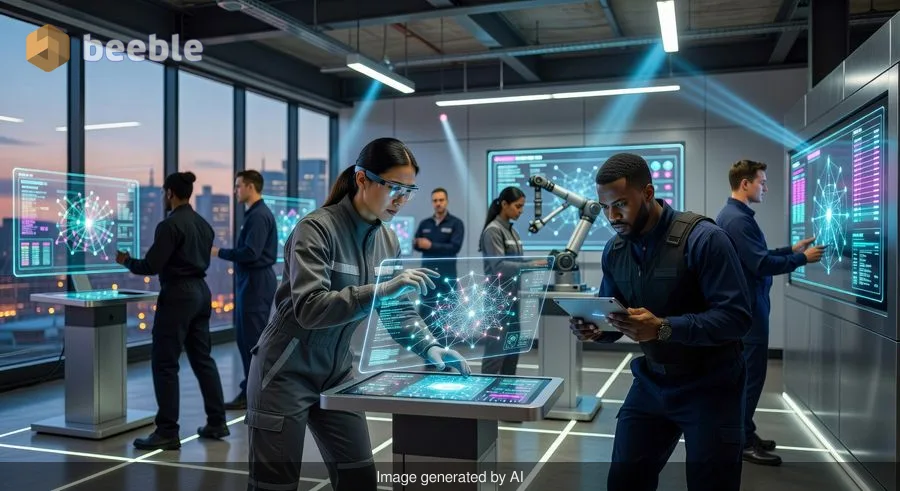
In the early months of 2026, the corporate narrative around Artificial Intelligence has undergone a fundamental shift. The era of frantic experimentation—where companies scrambled to integrate any Large Language Model (LLM) they could find—has matured into a period of sober reflection. As organizations look at their balance sheets, a stark pattern has emerged: the divide between AI leaders and laggards isn't defined by the size of their compute clusters, but by the proficiency of their people.
We have reached a point where the software is often more capable than the workflows it is meant to enhance. This disconnect is the "human bottleneck," and solving it has become the most critical investment for the mid-decade economy.
The Productivity J-Curve
Economists often speak of the "Productivity J-Curve." When a transformative technology like electricity or the internet arrives, productivity often dips or stagnates before it soars. This happens because businesses must reorganize their entire way of working to accommodate the new tool.
In 2026, we are seeing this play out with AI. Simply giving an employee access to a sophisticated agentic workflow doesn't automatically result in 20% more output. In fact, without the proper skills, it can result in "shadow work"—time spent fixing AI hallucinations or managing poorly automated tasks. The upward swing of the J-curve only begins when the workforce develops the intuition to know when to lean on AI and when to apply human oversight.
Beyond Prompt Engineering: The Rise of AI Orchestration
Two years ago, "prompt engineering" was touted as the must-have skill of the future. Today, that view seems quaint. As models have become better at understanding intent and context, the technical act of writing a prompt has been commoditized.
Instead, the market now demands AI Orchestration. This is the ability to design multi-step processes where AI agents and humans hand off tasks seamlessly. It requires a blend of systems thinking, domain expertise, and data literacy. For example, a marketing manager in 2026 doesn't just ask an AI to "write a campaign." They must be able to audit the data feeding the model, evaluate the ethical implications of the output, and integrate the AI’s creative suggestions into a broader strategic framework.
The Cost of the Skills Gap
The financial implications of the skills gap are becoming impossible to ignore. Recent industry reports suggest that nearly 60% of enterprise AI projects are currently stalled or underperforming. The primary reason cited by CTOs is not technical failure, but a lack of internal expertise to manage the transition.
When employees lack AI literacy, they tend to fall into two dangerous camps: the Over-Trusters and the Skeptics. Over-trusters offload critical thinking to the machine, leading to costly errors and brand damage. Skeptics ignore the tools entirely, leaving efficiency gains on the table. Both groups represent a failure of training, not a failure of the technology itself.
How AI is Reshaping Employer Demand
The job market has responded to this reality with a pivot toward "durable skills." While technical coding skills remain valuable, employers are increasingly prioritizing:
- Critical Evaluation: The ability to fact-check and verify machine-generated logic.
- Interdisciplinary Synthesis: Combining insights from different fields that AI might treat in isolation.
- Emotional Intelligence: Managing the human elements of a project—empathy, negotiation, and leadership—that AI cannot replicate.
We are seeing a move toward the "Centaur" model of work, where the most successful professionals are those who have learned to gallop with the machine, rather than racing against it.
A Roadmap for Investing in Skills
For businesses looking to turn the tide, the path forward requires more than a one-off seminar. It requires a sustained culture of learning. Here is how leaders are successfully bridging the gap in 2026:
- Audit the Workflow, Not the Job: Instead of trying to "AI-proof" a job title, look at specific tasks. Identify which tasks are ripe for augmentation and train specifically for those intersections.
- Internal Mobility Programs: Rather than hiring expensive external AI consultants, top firms are reskilling their domain experts. It is often easier to teach an experienced accountant how to use AI than it is to teach an AI expert the nuances of forensic accounting.
- Reward Experimentation: Create a "sandbox" environment where employees can fail safely. If workers fear that an AI error will cost them their job, they will never develop the skills needed to use it effectively.
- Continuous Micro-Learning: AI moves too fast for annual training cycles. Successful organizations are integrating 15-minute weekly updates into their schedules to keep pace with model updates and new tool capabilities.
The Bottom Line
As we move further into 2026, the competitive advantage of "having AI" is vanishing. It is becoming a utility, as common as high-speed internet or word processing. The real competitive advantage now lies in the human layer. Investing in skills isn't just a HR initiative; it is the fundamental engine of growth in the AI era. The companies that thrive will be those that realize the smartest thing about AI is the person using it.
Sources
- World Economic Forum: The Future of Jobs Report
- McKinsey & Company: The Economic Potential of Generative AI
- LinkedIn Learning: 2025 Workplace Learning Report
- MIT Sloan Management Review: The AI Productivity Paradox



See you on the other side.
Our end-to-end encrypted email and cloud storage solution provides the most powerful means of secure data exchange, ensuring the safety and privacy of your data.
/ Create a free account
