


The Human Moat: Why High Productivity and Transferable Skills Still Outpace AI in 2026

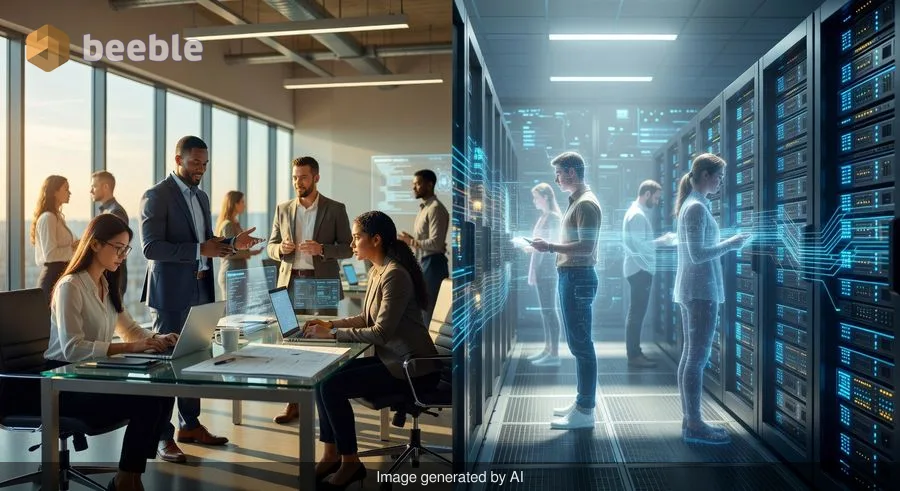
As we navigate the spring of 2026, the tech industry finds itself at a crossroads that many predicted but few were fully prepared for. The integration of generative AI into the white-collar workforce has moved past the 'experimental' phase and into the core of operational strategy. While the headlines often focus on the sheer speed of algorithmic output, a more nuanced reality is emerging in the labor market: the gap between those who are being replaced and those who are becoming indispensable is widening.
Recent data suggests that the 'AI displacement' narrative is not a universal blanket. Instead, it is a surgical strike on specific roles, particularly at the entry level. Yet, for those who have mastered the art of high productivity and the agility of transferable skills, the age of automation is proving to be an era of unprecedented leverage rather than obsolescence.
The Entry-Level Paradox
For decades, the standard career path involved 'paying your dues' through repetitive, foundational tasks—drafting basic reports, conducting initial research, or writing boilerplate code. In 2026, these tasks are almost entirely the domain of sophisticated AI agents. This shift has created a precarious environment for recent graduates.
Stanford researchers recently highlighted a sobering trend: early-career workers aged 22 to 25 in AI-impacted sectors have seen a relative employment decline of 16%. This aligns with the warnings issued years ago by industry leaders like Anthropic CEO Dario Amodei, who suggested that up to half of entry-level white-collar jobs could vanish as AI capabilities scaled. When a junior analyst's week-long research project can be synthesized by a model in thirty seconds, the traditional 'on-the-job training' model breaks down.
However, a contradiction remains. Despite the pressure, many top-tier firms are still aggressively recruiting graduates. Why? Because they have realized that while AI can perform the task, it cannot yet manage the context. Companies are pivoting toward hiring 'AI Orchestrators'—young professionals who may lack decades of experience but possess the digital fluency to direct multiple AI systems toward a complex goal.
Redefining Productivity: From Output to Outcome
In the pre-AI era, productivity was often measured by volume: how many lines of code were written, how many tickets were closed, or how many pages were produced. In 2026, volume is a commodity. If an AI can produce infinite volume, the value of human productivity shifts from output to outcome.
High-productivity employees today are those who use AI to bypass the 'blank page' problem. They are the editors, the strategists, and the quality controllers. They don't spend four hours writing a proposal; they spend thirty minutes prompting a model and three hours refining the strategy, checking for hallucinations, and ensuring the tone aligns with the client’s specific, unstated needs. This 'augmented productivity' is what keeps employees safe from the chopping block.
The Power of Transferable Skills
If technical skills are the 'hard' currency of the job market, transferable skills are the 'gold standard' that backs them up. As specific technical tools evolve or become automated, the ability to move between domains becomes the ultimate job security.
Consider the role of a project manager. The scheduling and resource allocation are now handled by autonomous agents. However, the ability to navigate a high-stakes conflict between two department heads, or to interpret the subtle hesitation in a client’s voice during a video call, remains uniquely human. These 'soft' skills—negotiation, empathy, and complex ethical judgment—are not easily distilled into training data.
Workers who can bridge the gap between technical execution and human strategy are seeing their value skyrocket. They are the 'translators' who can explain a machine-learning output to a non-technical board of directors or pivot from marketing to product development because they understand the underlying principles of human behavior.
The Skills Comparison: Human vs. AI
| Capability | AI Agent (2026) | High-Productivity Human |
|---|---|---|
| Speed | Near-instantaneous | Moderate (Augmented by AI) |
| Consistency | High (within parameters) | Variable |
| Contextual Nuance | Limited/Pattern-based | High (Cultural/Emotional) |
| Innovation | Combinatorial (New mixes of old ideas) | Divergent (True 'out-of-the-box' thinking) |
| Accountability | Zero | Total |
How to Build Your 'Human Moat'
To survive and thrive in this landscape, professionals must move beyond being 'users' of technology and become 'architects' of their own workflows. Here is a practical checklist for maintaining relevance in an automated economy:
- Master AI Orchestration: Don't just learn how to prompt; learn how to chain AI tools together to solve multi-step problems.
- Double Down on 'High-Touch' Communication: In a world of automated emails, a thoughtful, personalized phone call or an in-person meeting carries more weight than ever.
- Cultivate Domain Breadth: Don't just be a 'coder.' Be a coder who understands supply chain logistics or healthcare regulations. Cross-disciplinary knowledge is harder for AI to synthesize effectively.
- Focus on Critical Thinking: Treat AI outputs as a first draft, never the final word. The ability to spot a subtle logical fallacy in an AI-generated report is a high-value skill.
- Prioritize Emotional Intelligence (EQ): The more we interact with machines, the more we value genuine human connection. Leadership, mentorship, and team cohesion cannot be automated.
Looking Ahead
The narrative that AI is coming for everyone’s job is too simplistic. The truth is that AI is coming for tasks, not necessarily careers. The workers who are being displaced are those whose value proposition was built entirely on routine execution. Conversely, those who view AI as a power-suit—an exoskeleton that enhances their existing expertise and human intuition—are finding themselves more productive and more employable than ever before. The future belongs not to the fastest typist, but to the most effective thinker.
Sources
- Stanford University: Research on Early-Career Employment Trends (2025-2026)
- Anthropic: CEO Dario Amodei on AI and the Future of White-Collar Work
- Bureau of Labor Statistics: 2026 Workforce Productivity Reports
- MIT Sloan Management Review: The Shift from Technical to Transferable Skills



See you on the other side.
Our end-to-end encrypted email and cloud storage solution provides the most powerful means of secure data exchange, ensuring the safety and privacy of your data.
/ Create a free account
