


The Humanoid Gap: Is Europe Losing the Robotics Race to China?

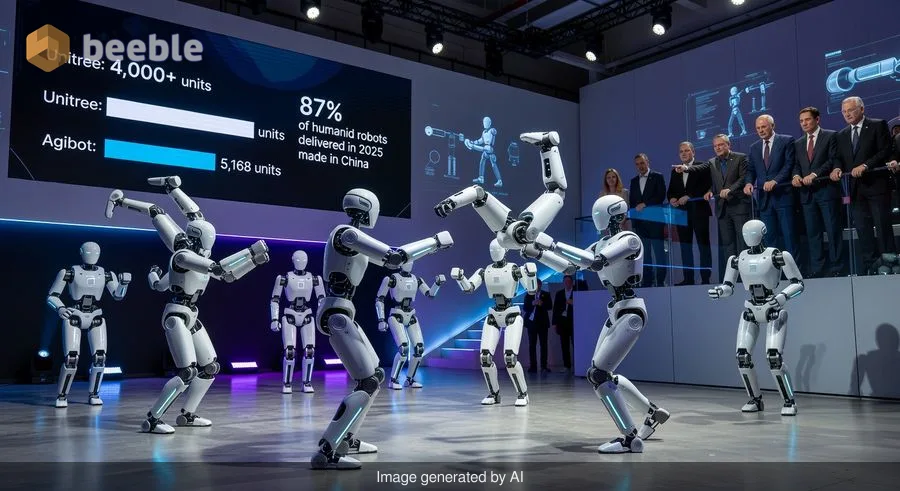
In February 2026, during a high-profile visit to Hangzhou, Germany’s Chancellor Friedrich Merz witnessed a spectacle that would have seemed like science fiction only a few years prior. Humanoid robots, developed by Chinese firms, performed a choreographed routine of backflips, boxing maneuvers, and fluid dance steps. The display was more than just a celebration of the Chinese New Year; it was a demonstration of industrial dominance.
Upon his return, Merz’s assessment was blunt: Germany—and by extension, much of Europe—is "simply no longer productive enough." As we cross the first quarter of 2026, the data suggests he isn't just being pessimistic. The robotics landscape has shifted, and the center of gravity is now firmly in the East.
The 87 Percent Reality
To understand the scale of the shift, one must look at the delivery numbers from 2025. While the market for humanoid robots is still in its early commercial stages, the trajectory is unmistakable. Last year, global manufacturers shipped just over 13,000 humanoid units. Of those, a staggering 87 percent were manufactured in China.
Two companies have emerged as the clear frontrunners: Agibot and Unitree. Agibot led the pack with 5,168 units delivered, followed closely by Unitree with over 4,000. These figures might seem modest compared to smartphone sales, but in the context of high-end, general-purpose robotics, they represent a critical first-mover advantage. China isn't just building prototypes; it is building a supply chain.
Why China is Moving Faster
China’s dominance isn't an accident of geography. It is the result of a deliberate convergence of three factors: aggressive capital injection, a vertically integrated supply chain, and a regulatory environment that favors rapid iteration.
While European firms often spend years in the R&D phase, perfecting the safety and precision of a single joint or sensor, Chinese firms like Unitree have adopted a "fail fast" approach. They iterate in public, releasing new versions of their hardware every few months. This allows them to gather real-world data at a pace that European legacy manufacturers find difficult to match.
Think of it as the difference between traditional watchmaking and modern smartphone manufacturing. Europe excels at the former—high-precision, high-cost, specialized machines. China is treating humanoid robots like the latter—commoditized, scalable, and rapidly evolving hardware platforms.
The European Productivity Crisis
Chancellor Merz’s comments highlight a deeper anxiety within the Eurozone. For decades, Europe’s industrial strength was built on mechanical engineering and automotive excellence. However, the humanoid robot represents the ultimate integration of AI and hardware.
If Europe loses the ability to manufacture the "bodies" that will house the next generation of AI, it risks becoming a mere consumer of foreign technology. The concern isn't just about losing a few thousand robot sales; it’s about the erosion of the broader manufacturing ecosystem. When a country dominates robotics, it also dominates the production of the specialized motors, sensors, and actuators that power everything from medical devices to defense systems.
Does the Lead Actually Matter?
Critics argue that the "humanoid race" is overhyped. They point out that 13,000 units is a drop in the bucket compared to the millions of industrial robotic arms already working in factories. In this view, humanoid robots are still "expensive toys" looking for a problem to solve.
However, this perspective misses the long game. Humanoid robots are designed to operate in environments built for humans. As populations in Europe and East Asia age, the labor shortage in logistics, elder care, and maintenance will become a systemic threat. The nation that can provide an affordable, capable robotic workforce will hold the keys to economic stability in the 2030s.
The Path Forward for Europe
Is the race already over? Not necessarily. Europe still holds significant leads in specialized robotics, software safety, and ethical AI frameworks. To close the gap, a strategic pivot is required. Here are the practical steps industry leaders are now considering:
- Consolidation of Research: Moving away from fragmented national projects toward a unified European Robotics Initiative that pools resources and data.
- Supply Chain Resilience: Reducing dependence on Chinese-made actuators and rare-earth magnets by incentivizing local production of high-torque motors.
- Focus on "Cobots": Rather than trying to beat China at general-purpose humanoids immediately, Europe can dominate the "collaborative robot" market—machines designed to work safely alongside humans in existing factories.
- Regulatory Sandboxes: Creating zones where robots can be tested in real-world scenarios (like delivery or construction) without the stifling burden of current bureaucratic hurdles.
The Bottom Line
The events of early 2026 have served as a wake-up call. China’s 87 percent market share in humanoids is a testament to what happens when industrial policy meets rapid-fire innovation. Europe has the talent and the history to compete, but as Friedrich Merz noted, the clock is ticking. Productivity is no longer just about working harder; it’s about building the machines that will do the work for us.
Sources:
- Forbes: The State of Global Robotics 2025/2026
- International Federation of Robotics (IFR) Annual Report
- Unitree and Agibot Investor Relations and Shipment Data
- German Chancellery Press Briefings, February 2026



See you on the other side.
Our end-to-end encrypted email and cloud storage solution provides the most powerful means of secure data exchange, ensuring the safety and privacy of your data.
/ Create a free account
