


The Idle Architect: How Nvidia’s New Auto-Shader Compilation Quietly Fixes PC Gaming’s Greatest Friction

You’ve likely been there: after a long day, you finally sit down, launch your favorite game, and prepare to lose yourself in another world. Instead, you’re greeted by a progress bar. It’s not a download or a patch, but a message that feels like a bureaucratic hurdle: "Compiling Shaders." For five, ten, perhaps fifteen minutes, your high-end PC—a machine capable of trillions of calculations per second—is reduced to a glorified space heater while you stare at a loading screen.
This digital friction is the tax we pay for the staggering complexity of modern graphics. However, Nvidia’s latest update to its beta Nvidia App suggests a shift in how we manage this technical debt. By introducing an "Auto Shader Compilation" system, the company is attempting to turn our PC’s downtime into a proactive maintenance window, effectively moving the "renovation work" of gaming to when we aren't in the room.
The Recipe and the Kitchen: Why Shaders Stutter
To understand why this update matters, we have to look under the hood at what a shader actually is. In the early days of gaming, graphics were relatively static. Today, a shader is essentially a small program—a recipe—that tells the GPU how to render light, shadows, and textures. The catch is that these recipes are often written in a generic language (like HLSL) that your specific graphics card doesn't speak natively.
When you update your drivers or install a new game, the system must translate these generic instructions into machine code optimized for your specific hardware. Historically, this happened in one of two ways: either the game forced you to wait at the start (the dreaded loading bar) or it tried to do it on the fly while you played. The latter often resulted in "shader struggle stutter," where the game momentarily freezes because the CPU is too busy translating code to actually run the world. It’s the digital equivalent of a chef trying to translate a foreign cookbook while simultaneously service a hundred hungry customers; eventually, something gets burned.
Zooming Out: The Fragmentation of the PC Ecosystem
Paradoxically, the very thing that makes PC gaming great—its open, fragmented nature—is what makes shaders such a headache. Unlike a PlayStation or Xbox, where every user has the exact same hardware, the PC market is a chaotic landscape of thousands of GPU and CPU combinations. Developers cannot pre-compile every shader for every possible user; the file sizes would be astronomical, and the permutations infinite.
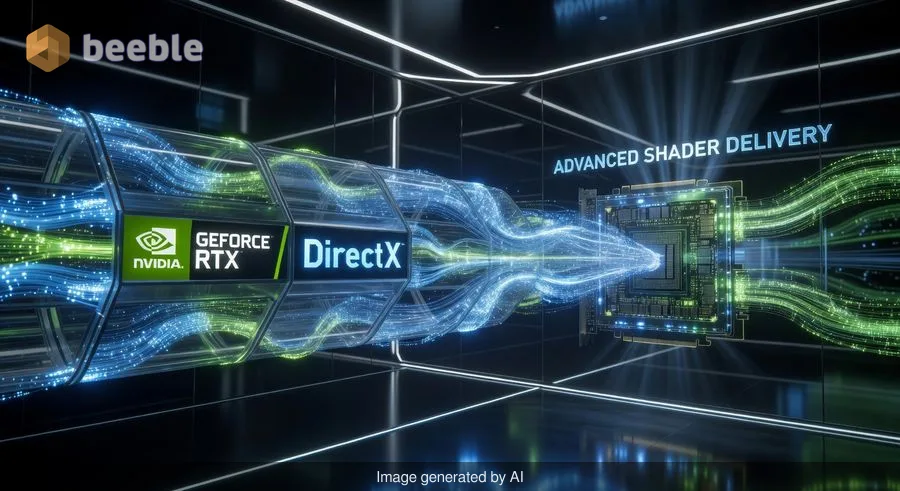
Nvidia’s new feature, tucked away in the Graphics Tab under Global Settings, allows the Nvidia App to monitor your system. When the machine goes idle, it begins rebuilding these DirectX drivers in the background. Technically speaking, Nvidia is leveraging the "idle cycles" of your processor to handle the heavy lifting before you even click 'Play.' It’s a pragmatic solution to a legacy problem, transforming a reactive frustration into a background utility.
The Limits of Automation
In practice, however, this isn't a total magic wand. Nvidia is careful to note that this system primarily targets the recompilation needed after driver updates. If you download a brand-new game, you’ll still likely face that initial first-run wait. The Auto Shader Compiler is designed to solve the "recurring tax"—that annoying moment when a routine driver update forces you to re-compile everything you’ve already played.
| Feature | Nvidia Auto Shader Compiler (Beta) | Microsoft Advanced Shader Delivery |
|---|---|---|
| Primary Goal | Background compilation after driver updates | Pre-compiled database downloads |
| Trigger | System idle time or manual force | Game installation/update |
| Hardware | Nvidia RTX/GTX (Driver 595.97+) | Cross-vendor (Developer implementation) |
| Status | Available now in Beta | Rolling out later in 2026 |
Curiously, this move by Nvidia sits alongside a broader industry push. Microsoft is working on "Advanced Shader Delivery," which aims to let developers host pre-compiled shader databases in the cloud. We are seeing a shift from local, manual labor to a more streamlined, cloud-integrated infrastructure. Behind the screen, the industry is finally admitting that the "just-in-time" compilation model is broken for modern, high-fidelity titles.
From Developer Standpoint to User Experience
From a developer's standpoint, shader compilation is a classic example of technical debt. For years, the industry relied on the increasing power of CPUs to mask the inefficiency of on-the-fly compilation. But as games grew more complex, the "closet" of uncompiled code became too messy to ignore. The result was a fragmented user experience where even a $3,000 rig could feel clunky and unoptimized.
Through this user lens, Nvidia’s update is more than just a performance tweak; it’s an exercise in technical empathy. It acknowledges that a user’s time is the most valuable resource. By allowing us to set aside disk space and decide how many system resources the background process should consume, Nvidia is giving us a more transparent relationship with our hardware. We are no longer just passive victims of a loading bar; we are the managers of our machine's maintenance schedule.
Reclaiming the Digital Flow
Ultimately, the evolution of shader management reflects a larger trend in software: the disappearance of the "wait." Much like how modern operating systems download updates in the background or how web browsers pre-fetch links they think you’ll click, gaming is moving toward a state of constant readiness.
As we move toward the full release of these features later in 2026, it’s worth reflecting on our own digital habits. We’ve become accustomed to a certain level of friction—the stuttering frame, the spinning wheel, the progress bar. When these annoyances vanish, they often leave a vacuum where we forget the immense engineering required to make a digital world feel seamless.
Next time you update your drivers and find your game launches instantly, take a moment to appreciate the "idle architect" working in the background. It’s a reminder that good software isn't just about what it does while you're using it, but how it prepares the way for you when you're not.
Sources:
- Nvidia GeForce Game Ready Driver 595.97 Release Notes
- Nvidia App Beta Documentation (Graphics Global Settings)
- Microsoft DirectX Developer Blog: Shader Management Evolution
- Intel Graphics Community Update on Precompiled Shader Delivery



See you on the other side.
Our end-to-end encrypted email and cloud storage solution provides the most powerful means of secure data exchange, ensuring the safety and privacy of your data.
/ Create a free account
