


The Infinite Power Grid Won't Be Built With Today’s Lasers

Imagine a world where your monthly utility bill is a flat, negligible fee—much like a basic software subscription—rather than a volatile expense that fluctuates with global geopolitics. In this future, the air in our industrial hubs is as clear as a mountain morning, and the energy powering our heavy industry is sourced not from burning ancient carbon, but from the same process that fuels the stars.
This is the promise of nuclear fusion. But to get from this finished vision of a decarbonized society back to the reality of 2026, we have to trace a very specific trail of hardware. We have to move past the pristine control rooms and the theoretical physics papers, through the massive concrete shielding of reactor halls, and arrive at the true bottleneck of the entire operation: the laser.
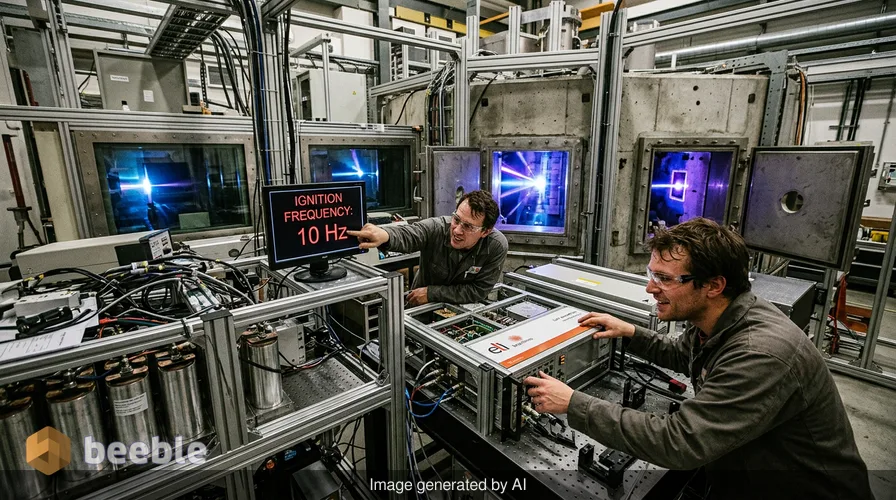
For decades, the "engine" required to start a fusion reaction was the size of a stadium and could only fire once every few hours. To make fusion a foundational part of our lives, we need that engine to fire ten times every second. This is where solid-state laser technology, currently being perfected at facilities like ELI Beamlines, is quietly staging an industrial revolution.
The Muzzleloader vs. The Machine Gun
To understand why the latest breakthroughs in solid-state lasers are so disruptive, we have to look at the history of how we’ve been trying to create "star power" on Earth. Most of the famous fusion breakthroughs of the last few years—like the historic gain achieved at the National Ignition Facility (NIF) in California—relied on flashlamp-pumped lasers.
In simple terms, these lasers are like old-fashioned muzzleloader rifles. You spend hours carefully packing the gunpowder and the lead ball, you take one shot, and then you have to wait for the barrel to cool down and start the process all over again. These lasers use massive glass slabs that get incredibly hot. If you fire them too quickly, the glass warps or even shatters.
Historically, this was fine for proving that fusion could work. But practically speaking, a power plant that only "turns on" for a fraction of a second every four hours is useless to the average user. Looking at the big picture, for fusion to be scalable, we need a "machine gun" approach. We need lasers that can fire high-energy pulses repeatedly, thousands of times an hour, without overheating.
Enter the Solid-State Solution
Under the hood of this new era is the L3-HAPLS (High-Repetition-Rate Advanced Petawatt Laser System). Unlike its predecessors, this system uses diode-pumping. Instead of using giant, inefficient flashbulbs to "charge" the laser, it uses massive arrays of specialized LEDs.
Think of the difference between an old incandescent light bulb that burns your hand and a modern LED strip. The LED is vastly more efficient, generates less waste heat, and can be pulsed almost instantly. By using these solid-state diodes, researchers have created a laser that can reach peak powers of a petawatt—that’s a quadrillion watts, or hundreds of times the capacity of the entire global electric grid—while firing ten times per second.
This shift is the digital crude oil of the 2020s. It takes the concept of fusion out of the realm of one-off scientific miracles and places it firmly into the category of a robust industrial process.
From Rare Crystals to the Power Grid
Tracing the chain further back, this entire technological leap depends on a very specific industrial supply chain: high-quality synthetic crystals and advanced semiconductors. The heart of a solid-state laser isn't just glass; it’s a carefully grown crystal, often doped with elements like neodymium or ytterbium.
On the market side, this has created a new demand for precision manufacturing. For the average user, the impact is invisible, but it mirrors how the mass production of silicon chips eventually gave us the smartphone. As we get better at growing these crystals and manufacturing high-power diodes, the cost of the "fusion engine" begins to drop.
What this means is that we are moving toward a systemic change in how we build energy infrastructure. Instead of building one massive, bespoke facility that costs $20 billion, solid-state technology allows for a more modular, streamlined approach. It is the transition from a hand-built prototype to a factory assembly line.
Why This Matters for Your Daily Life
It is easy to hear the word "petawatt" and assume this is a story for physicists in lab coats. However, as an analytical translator of these trends, I see three tangible ways this impacts the everyday consumer long before the first fusion house is ever built:
- Medical Breakthroughs: The same high-repetition lasers being developed for fusion are also used for laser-ion acceleration (the ELIMAIA project). In everyday life, this translates to more precise, accessible proton therapy for cancer treatment. Because these lasers are smaller and more efficient, hospitals might eventually be able to house these life-saving machines in-house rather than sending patients to a few centralized, billion-dollar hubs.
- Material Science and Gadgets: To build a fusion reactor, you need materials that can survive extreme conditions. The testing of these materials happens using these very same lasers. This "stress testing" leads to the discovery of more resilient alloys and polymers that eventually find their way into everything from your car's chassis to the casing of your laptop.
- Energy Security: Zooming out, the development of solid-state fusion technology provides a transparent roadmap for energy independence. Unlike fossil fuels, which are tied to geography, the "fuel" for fusion is hydrogen (derived from water). The real "resource" becomes the technology itself—the lasers.
The "So What?" Filter: Is This Just Hype?
As someone who has seen plenty of "revolutionary" tech gather dust in a patent office, I maintain a healthy level of skepticism toward corporate PR. However, the move to solid-state is different because it addresses the foundational physics of heat management. You cannot cheat thermodynamics; if a laser gets too hot, it stops working. By solving the heat problem through diode-pumping, we have removed the single biggest physical barrier to continuous fusion power.
Curiously, the challenge is no longer about the physics of the atom; it is about the engineering of the light. We have reached a point where we know how to start the fire; we are now just perfecting the match that can strike ten times a second without breaking.
A New Industrial Backbone
The bottom line is that the transition to solid-state laser technology represents a pivot from science to industry. It is the moment when fusion stops being an "if" and starts being a "when." It is the invisible backbone of the next century’s economy.
| Feature | Old Flashlamp Lasers | New Solid-State Lasers |
|---|---|---|
| Repetition Rate | 1 shot every few hours | 10 shots per second |
| Cooling Method | Passive/Slow (Wait for it) | Active/High-efficiency liquid cooling |
| Energy Efficiency | ~1% | ~10-20% |
| Scalability | Massive, bespoke facilities | Modular, industrial-grade systems |
| Primary Use Case | Scientific research/Proof of concept | Power plants/Medical/Heavy industry |
Practical Foresight
As we look toward the late 2020s, I urge you to shift your perspective on how you view energy news. Don't just look for the headline that says "Fusion Achieved!" We already know it works. Instead, look for the quiet updates on laser repetition rates and diode manufacturing costs.
These are the real indicators of our progress. To put it another way, if fusion is the destination, solid-state lasers are the tires that allow the vehicle to actually move on the road. From a consumer standpoint, the path to a sustainable, energy-abundant future isn't just about a brilliant idea—it's about the robust, scalable hardware that can survive the transition from the laboratory to the living room. Keep an eye on the industrial mechanics; that’s where the real magic is happening.



See you on the other side.
Our end-to-end encrypted email and cloud storage solution provides the most powerful means of secure data exchange, ensuring the safety and privacy of your data.
/ Create a free account
