


The Invisible Glass Threads Holding the Internet Together Are Reaching Their Breaking Point

Every time you stream a high-definition movie or query a large language model, a tiny pulse of light travels through a strand of glass no wider than a human hair. These strands, called optical fibers, are the invisible backbone of modern life. They carry everything from bank transfers to your doorbell camera’s video feed. For decades, engineers squeezed more data into these fibers by changing how light pulses were timed or colored. But the physics of a single core of glass has a hard limit. As AI and 5G networks demand more bandwidth, the industry is hitting a wall known as the nonlinear Shannon limit, where adding more power to a signal simply creates noise instead of more speed.
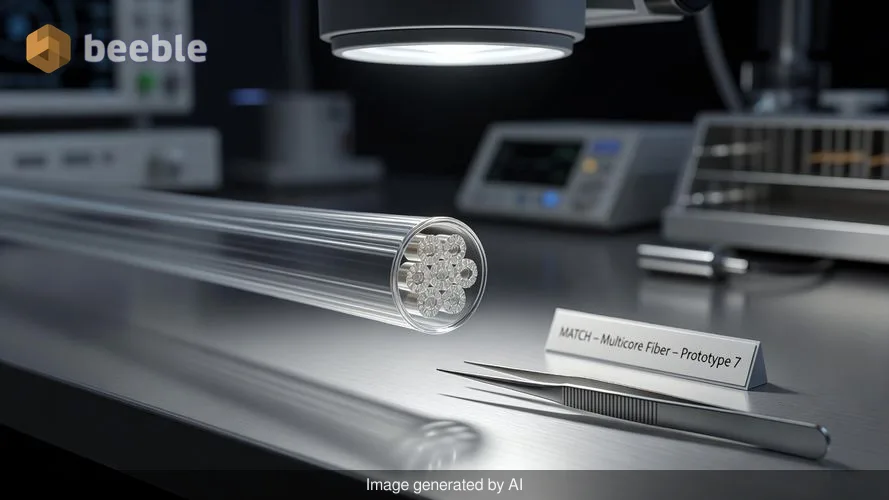
To solve this, a European consortium called MATCH is redesigning the internal architecture of the fiber itself. Instead of one highway lane for light, they are cramming multiple lanes into the same thin strand. This shift from single-mode fiber to multicore fiber (MCF) is a fundamental change in how we build the internet. It is the difference between trying to drive a faster car on a narrow road and building a multi-level expressway.
The physics of the digital squeeze
Standard optical fiber has a single central core where light travels. To increase capacity, companies used to just lay more cables. But burying thousands of miles of new glass under oceans and city streets is expensive and slow. Space-division multiplexing (SDM) is the technical answer to this logistics nightmare. Multicore fiber allows several independent streams of light to travel in parallel within the same glass cladding.
Behind the jargon, this is a materials science challenge. If the cores are too close together, the light leaks from one to the other, a problem called crosstalk. If they are too far apart, the fiber becomes too thick and brittle to manufacture or install. The MATCH project, a doctoral training network funded by the European Commission, brings together 14 partners to solve these manufacturing and engineering puzzles. They are working on fibers that have four, seven, or even nineteen cores, all while keeping the cable thin enough to fit into existing conduits.
Why the MATCH project matters for the supply chain
Innovation in hardware rarely happens in a vacuum. It requires a steady supply of specialized engineers and a synchronized manufacturing chain. The MATCH network, coordinated by Professor Adolfo Cartaxo at Iscte in Portugal, links academic powerhouses like the Université de Limoges and the University of Stuttgart with industrial giants like Nokia and Prysmian. This connection ensures that a breakthrough in a lab in France can actually be manufactured at scale in a factory in Germany.
For the average user, this collaboration is the reason why your internet bill might stay flat even as your data usage climbs. By increasing the capacity of a single cable by ten times or more, operators reduce the cost per bit. They also save energy. Running one multicore cable requires less power and fewer cooling resources than running ten separate single-core cables. In an era where data centers consume a growing share of global electricity, these efficiency gains are a practical necessity.
Comparing the old and new guard of connectivity
The transition to multicore technology represents a shift in how we view digital infrastructure. The following table shows how these technologies differ in practical terms.
| Feature | Conventional Single-Mode Fiber | Multicore Fiber (MCF) |
|---|---|---|
| Data Channels | 1 core per strand | 4 to 19+ cores per strand |
| Capacity | Reaching physical limits | 10x to 20x higher potential |
| Energy Efficiency | High per-bit consumption | Lower per-bit consumption |
| Physical Size | Standard 125-micron diameter | Mostly standard 125 to 250-micron |
| Main Use Case | General telecommunications | AI clusters, subsea cables, sensing |
More than just faster Netflix
While speed is the headline, multicore fiber offers a second, more surprising benefit: it can feel the world. This is known as distributed sensing. Because these fibers have multiple cores, one core can carry data while another acts as a high-precision sensor.
Practically speaking, this means the same cable providing internet to a coastal town can also detect the early vibrations of an earthquake or a shift in the seabed. In cities, these fibers can monitor the structural health of bridges or detect the heat signature of a fire in a tunnel before a smoke detector even triggers. The MATCH project is specifically exploring how to integrate these sensing functions into the next generation of networks. Instead of just being a pipe for data, the fiber becomes a digital nervous system for the planet.
The market side of the glass revolution
On the market side, the move to MCF is a response to the massive capital expenditures of tech giants. Companies like Google, Meta, and Microsoft are currently the largest buyers of undersea cables and high-end networking gear. Their need to link massive AI data centers across continents is driving the demand for multicore technology.
Historically, new fiber tech took decades to move from the lab to the home. However, the pressure from AI development is accelerating this timeline. The MATCH project is training 13 doctoral researchers who will likely end up at the companies building this infrastructure. These researchers are working on everything from machine learning algorithms that manage network traffic to the physical machines that draw the glass strands. The goal is a streamlined transition that doesn't require replacing every existing piece of equipment in a telecom office.
What this means for your digital life
From a consumer standpoint, you won't need to buy a new "multicore router" anytime soon. The impact happens at the macro level. When the backbone of the internet is more efficient, the services built on top of it become more stable. Looking at the big picture, this technology prevents the "data traffic jam" that many analysts predicted would happen by the end of this decade.
Essentially, multicore fiber is a foundational upgrade. It ensures that when you use a VR headset or an autonomous vehicle, the network behind the scenes has the headroom to handle the load. It also means that environmental monitoring will become cheaper and more widespread, as we won't need to install separate sensors for every bridge or pipeline.
Ultimately, the work being done by the MATCH consortium is about future-proofing. As we move more of our lives into the cloud, the physical glass threads connecting those clouds must evolve. The transition to multicore fiber is a silent, invisible revolution that will define the next twenty years of global communication. Rather than worrying about the limits of the current internet, we should observe how these invisible industrial mechanics are quietly expanding to meet our growing appetite for data.
Sources: MATCH Project Consortium, European Commission Horizon Europe Research Portal, Iscte – Instituto Universitário de Lisboa Official Announcements, Nokia Infinera Technical Briefs, Prysmian Group Industrial Reports.



See you on the other side.
Our end-to-end encrypted email and cloud storage solution provides the most powerful means of secure data exchange, ensuring the safety and privacy of your data.
/ Create a free account
