


The Invisible Human Cost of Your Next AI Upgrade

When you interact with a generative AI tool or unbox a flagship smartphone, you are holding the end result of a global industrial pipeline that starts deep within cleanroom laboratories in South Korea. These devices rely on silicon chips that serve as the digital crude oil of the twenty-first century—a foundational resource that powers everything from data centers to the sensor in your microwave. But right now, the machinery that produces this resource is humming with a different kind of energy: the sound of thousands of workers demanding a fair share of the wealth they create.
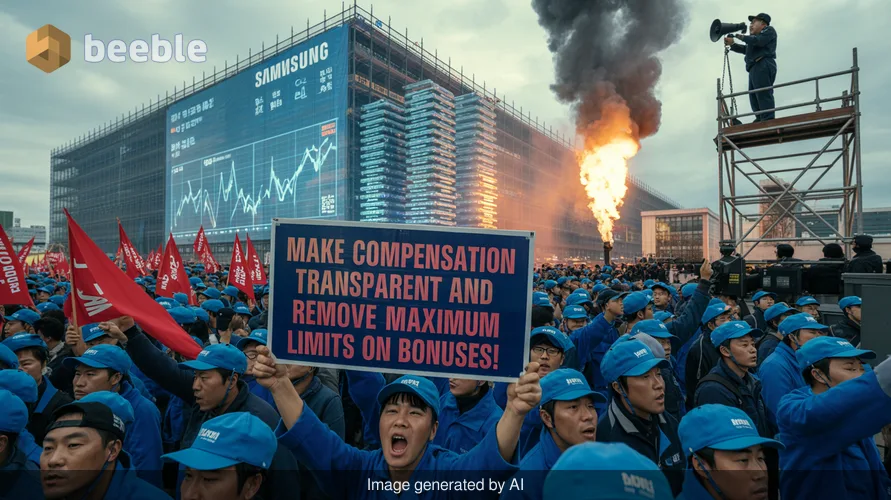
Looking at the big picture, the massive surge in artificial intelligence adoption has created a financial windfall for semiconductor giants. Samsung Electronics, the world’s largest producer of memory chips, recently projected a staggering first-quarter operating profit of 57.2 trillion won (roughly €33 billion). However, behind these astronomical figures lies a growing systemic rift between the corporate suite and the factory floor. On April 23, 2026, the quiet efficiency of Samsung’s Pyeongtaek chip complex was replaced by the chants of roughly 40,000 unionized workers protesting what they describe as an opaque and unfair bonus system.
The Anatomy of a High-Stakes Bonus Dispute
To understand why these workers are threatening an 18-day strike starting in May, we have to look under the hood of how Samsung compensates its staff. Historically, Samsung has utilized a complex profit-sharing model. In good years, bonuses can make up a significant portion of an employee's annual take-home pay. But as the AI boom sends profits into the stratosphere, workers argue that the current system is designed to benefit the company more than the people keeping the production lines running.
In simple terms, the union is calling for two primary changes: transparency in how compensation is calculated and the removal of the maximum limit on bonuses. Currently, even if Samsung has a record-shattering year, employee bonuses are capped. The workers’ argument is straightforward: if the company is seeing unprecedented growth due to their labor during an AI-driven demand spike, that success should be reflected proportionally in their paychecks.
Samsung management has attempted to douse the flames by offering bonuses in the form of restricted stock. From a corporate standpoint, this is a clever move to ensure long-term loyalty and keep cash on the balance sheet. However, for the average user or worker living through a period of volatile global inflation, restricted stock doesn't pay the monthly mortgage. The union has rejected this offer, standing firm on their demand for tangible cash compensation that reflects the company's robust performance.
Why the AI Boom is a Pressure Cooker
On the market side, Samsung is not operating in a vacuum. On the very day of the protests, its chief rival, SK Hynix, reported its own best-ever quarterly results. SK Hynix has been more agile in capturing the High Bandwidth Memory (HBM) market—a specialized type of chip essential for the massive servers that run AI models. This competitive landscape puts Samsung in a difficult position. The company is trying to reclaim its dominance in HBM while simultaneously managing a restive workforce.
| Feature | Samsung Electronics (Projected) | SK Hynix (Actual Q1) |
|---|---|---|
| Operating Profit | ~57.2 Trillion Won | Record High (Propelled by AI) |
| Labor Status | Threatened 18-day strike | Stable (Relative to Samsung) |
| Primary Driver | AI Infrastructure/Memory | HBM Dominance/Data Centers |
| Union Demands | Bonus transparency/No caps | Routine negotiations |
For the average consumer, this might feel like a distant corporate drama. But in everyday life, this conflict has a direct line to your wallet. Samsung and SK Hynix together produce about two-thirds of the world's memory chips. If Samsung’s union follows through with an 18-day strike, the disruption would be systemic. Experts estimate it could cost the company over 1 trillion won per day in lost productivity. When the supply of "digital crude oil" slows down, the price of every refined product—from laptops and gaming consoles to the servers that host your cloud photos—starts to climb.
Chokepoints and Global Vulnerabilities
Zooming out, the timing of this labor unrest is particularly precarious. While the internal conflict at Samsung is intense, external factors are adding layers of complexity to the semiconductor industry. Shifting geopolitical tensions in the Middle East have disrupted the supply of noble gases like helium and neon, which are critical for the lithography processes used to etch patterns onto silicon.
Curiously, while SK Hynix management claims these conflicts won’t have a meaningful impact on production, the combination of supply chain fragility and labor strikes creates a volatile cocktail. To put it another way, if a factory is already struggling to get the raw materials it needs, the last thing it can afford is for the workers to walk out the door. The interconnected nature of modern manufacturing means that a picket line in Pyeongtaek can lead to a delayed product launch in San Francisco or London.
Behind the Jargon: What This Means for You
Ultimately, the Samsung strike represents a pivotal moment in the AI era. It is a debate over who gets to keep the value generated by automation and advanced computing. As a result of this friction, we are likely to see several tangible effects on the consumer market over the next 12 to 18 months:
- Price Elasticity of Gadgets: If production halts for nearly three weeks, expect "temporary" price hikes on SSDs (solid-state drives) and RAM modules. Historically, the memory market is highly cyclical, and supply shocks lead to rapid retail price increases.
- Product Delays: We are entering the window where manufacturers finalize their fall product lineups. A significant strike could push back the release dates of the next generation of smartphones or tablets that rely on Samsung’s cutting-edge memory.
- The Transparency Trend: If the Samsung union succeeds in winning compensation transparency, it could set a precedent for other tech giants. We might see a decentralized movement where workers across the tech sector demand a more streamlined and visible link between company profits and personal pay.
The Bottom Line
From a journalist’s perspective, it is easy to get lost in the spreadsheets of multi-billion won profits. But practically speaking, this story is about the friction between the digital future we are being sold and the physical reality of the people who build it. The AI revolution is often described as a frictionless ascent into a more efficient world, yet it remains anchored to the industrial mechanics of high-pressure manufacturing plants and the human beings who staff them.
As you observe your own digital habits—perhaps noticing how much faster your new laptop handles AI tasks or how much more you’re paying for cloud storage—remember the workers in Pyeongtaek. Their struggle for transparency is a reminder that even the most streamlined technology has a foundational human element. Shift your perspective from the screen to the supply chain; the next time you see a price jump in tech, it may not just be "inflation" or "market forces," but the result of a workforce demanding that the AI boom doesn't leave them behind.
Sources:
- Samsung Electronics First Quarter Earnings Guidance (April 2026)
- SK Hynix Quarterly Investor Relations Report
- National Samsung Electronics Union (NSEU) Press Briefing
- Ministry of Trade, Industry and Energy (South Korea) Semiconductor Export Data



See you on the other side.
Our end-to-end encrypted email and cloud storage solution provides the most powerful means of secure data exchange, ensuring the safety and privacy of your data.
/ Create a free account
